


Efficacy of the HPV-16/18 vaccine: final according to protocol results from the blinded phase of the randomized Costa Rica HPV-16/18 vaccine trial
- PMID: 25018097
- PMCID: PMC4166498
- DOI: 10.1016/j.vaccine.2014.06.038
Efficacy of the HPV-16/18 vaccine: final according to protocol results from the blinded phase of the randomized Costa Rica HPV-16/18 vaccine trial
Abstract
Background: A community-based randomized trial was conducted in Costa Rica to evaluate the HPV-16/18 AS04-adjuvanted vaccine (NCT00128661). The primary objective was to evaluate efficacy of the vaccine to prevent cervical intraepithelial neoplasia 2 or more severe disease (CIN2+) associated with incident HPV-16/18 cervical infections. Secondary objectives were to evaluate efficacy against CIN2+ associated with incident cervical infection by any oncogenic HPVs and to evaluate duration of protection against incident cervical infection with HPV-16/18. Vaccine safety and immunogenicity over the 4-year follow-up were also evaluated.
Methods: We randomized (3727 HPV arm; 3739 control arm), vaccinated (HPV-16/18 or Hepatitis A) and followed (median 53.8 months) 7466 healthy women aged 18-25 years. 5312 women (2635 HPV arm; 2677 control arm) were included in the according to protocol analysis for efficacy. The full cohort was evaluated for safety. Immunogenicity was considered on a subset of 354 (HPV-16) and 379 (HPV-18) women. HPV type was assessed by PCR on cervical specimens. Immunogenicity was assessed using ELISA and inhibition enzyme immunoassays. Disease outcomes were histologically confirmed. Vaccine efficacy and 95% confidence intervals (95%CI) were computed.
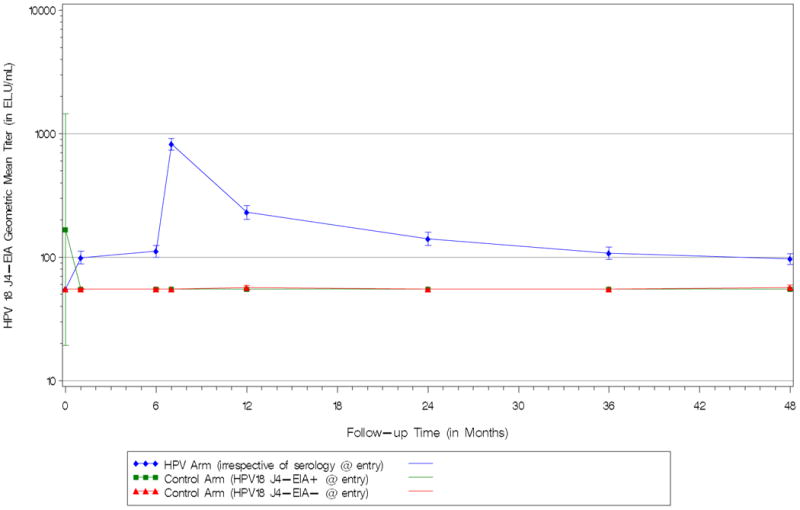
Results: Vaccine efficacy was 89.8% (95% CI: 39.5-99.5; N=11 events total) against HPV-16/18 associated CIN2+, 59.9% (95% CI: 20.7-80.8; N=39 events total) against CIN2+ associated with non-HPV-16/18 oncogenic HPVs and 61.4% (95% CI: 29.5-79.8; N=51 events total) against CIN2+ irrespective of HPV type. The vaccine had an acceptable safety profile and induced robust and long-lasting antibody responses.
Conclusions: Our findings confirm the high efficacy and immunogenicity of the HPV-16/18 vaccine against incident HPV infections and cervical disease associated with HPV-16/18 and other oncogenic HPV types. These results will serve as a benchmark to which we can compare future findings from the ongoing extended follow-up of participants in the Costa Rica trial.
Trial registration: Registered with clinicaltrials.gov: NCT00128661.
Keywords: Cervical neoplasia; Clinical trial; Human papillomaviruses; Prevention; Vaccination.
Published by Elsevier Ltd.
Conflict of interest statement
Figures


References
-
- Koutsky LA, Ault KA, Wheeler CM, Brown DR, Barr E, Alvarez FB, et al. A controlled trial of a human papillomavirus type 16 vaccine. New Eng J Med. 2002;347:1645–51. - PubMed
-
- Harper DM, Franco EL, Wheeler C, Ferris DG, Jenkins D, Schuind A, et al. Efficacy of a bivalent L1 virus-like particle vaccine in prevention of infection with human papillomavirus types 16 and 18 in young women: a randomised controlled trial. Lancet. 2004;364:1757–65. - PubMed
-
- Harro CD, Pang YY, Roden RB, Hildesheim A, Wang Z, Reynolds MJ, et al. Safety and immunogenicity trial in adult volunteers of a human papillomavirus 16 L1 viruslike particle vaccine. J Natl Cancer Inst. 2001;93:284–92. - PubMed
-
- Paavonen J, Jenkins D, Bosch FX, Naud P, Salmeron J, Wheeler CM, et al. Efficacy of a prophylactic adjuvanted bivalent L1 virus-like-particle vaccine against infection with human papillomavirus types 16 and 18 in young women: an interim analysis of a phase III double-blind, randomised controlled trial. Lancet. 2007;369:2161–70. - PubMed
-
- Paavonen J, Naud P, Salmeron J, Wheeler CM, Chow SN, Apter D, et al. Efficacy of human papillomavirus (HPV)-16/18 AS04-adjuvanted vaccine against cervical infection and precancer caused by oncogenic HPV types (PATRICIA): final analysis of a double-blind, randomised study in young women. Lancet. 2009;374:301–14. - PubMed
Publication types
MeSH terms
Substances
Associated data
Grants and funding
LinkOut - more resources
Full Text Sources
Other Literature Sources
Medical
