


Islet cell transplantation for the treatment of type 1 diabetes: recent advances and future challenges
- PMID: 25018643
- PMCID: PMC4075233
- DOI: 10.2147/DMSO.S50789
Islet cell transplantation for the treatment of type 1 diabetes: recent advances and future challenges
Abstract
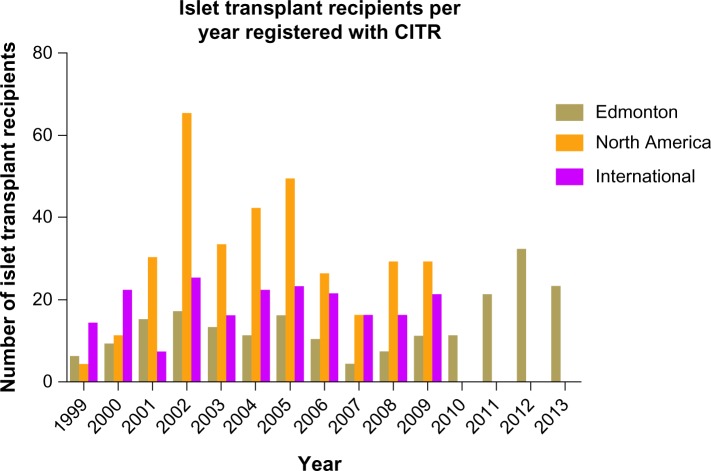
Islet transplantation is a well-established therapeutic treatment for a subset of patients with complicated type I diabetes mellitus. Prior to the Edmonton Protocol, only 9% of the 267 islet transplant recipients since 1999 were insulin independent for >1 year. In 2000, the Edmonton group reported the achievement of insulin independence in seven consecutive patients, which in a collaborative team effort propagated expansion of clinical islet transplantation centers worldwide in an effort to ameliorate the consequences of this disease. To date, clinical islet transplantation has established improved success with insulin independence rates up to 5 years post-transplant with minimal complications. In spite of marked clinical success, donor availability and selection, engraftment, and side effects of immunosuppression remain as existing obstacles to be addressed to further improve this therapy. Clinical trials to improve engraftment, the availability of insulin-producing cell sources, as well as alternative transplant sites are currently under investigation to expand treatment. With ongoing experimental and clinical studies, islet transplantation continues to be an exciting and attractive therapy to treat type I diabetes mellitus with the prospect of shifting from a treatment for some to a cure for all.
Keywords: Edmonton Protocol; engraftment; immunosuppression; islet transplantation; type I diabetes mellitus.
Figures
References
-
- Polonsky KS. The past 200 years in diabetes. New Engl J Med. 2012;367(14):1332–1340. - PubMed
-
- Lacy PE, Kostianovsky M. Method for the isolation of intact islets of Langerhans from the rat pancreas. Diabetes. 1967;16(1):35–39. - PubMed
-
- Reckard CR, Ziegler MM, Barker CF. Physiological and immunological consequences of transplanting isolated pancreatic islets. Surgery. 1973;74(1):91–99. - PubMed
Publication types
LinkOut - more resources
Full Text Sources
Other Literature Sources
