


Burden of chronic kidney disease: North Africa
- PMID: 25018981
- PMCID: PMC4089607
- DOI: 10.1038/kisup.2013.5
Burden of chronic kidney disease: North Africa
Abstract
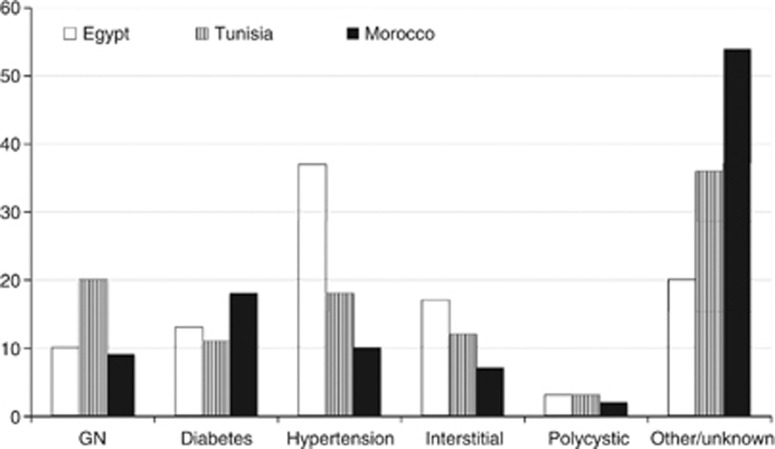
North Africa (NAF) is composed of six countries located in the African Sahara, namely the Western Sahara, Morocco, Algeria, Tunisia, Libya, and Egypt. Common features between these countries include similar climate, ecology, population genetics, and the socioeconomic environment. This commonality reflects on the chronic kidney disease (CKD) profile in these countries. While there are some estimates on the epidemiology of end-stage kidney disease, that of earlier stages is unknown. Several national screening programs are currently addressing this issue, such as the EGIPT-CKD project in Egypt and the MAREMAR study in Morocco. Preliminary results from the former suggest a prevalence of proteinuria in 10.6% of the relatives of patients on regular dialysis treatment. Despite the lack of reliable registries, it was possible to gather information on the etiology of CKD by direct contact with leading nephrologists in those countries. It turns out that glomerulonephritis (GN) accounts for 9-20%, diabetes 11-18%, hypertensive nephrosclerosis 10-35%, chronic interstitial nephritis 7-17%, and polycystic disease 2-3%. Compared to two decades earlier, diabetes has become more common at the expense of GN, proliferative GN, and amyloidosis regressed in favor of IgA and membranous nephropathies in Tunisian adults. Conventional schistosomal nephropathies are regressing in favor of hepatitis C viral (HCV) nephropathy in Egyptians. Focal segmental glomerulosclerosis is increasing at the expense of proliferative GNs in the region at large. Access to regular dialysis has been optimized during the past decade, with favorable outcomes despite the high incidence of HCV infection, tuberculosis, and protein-calorie malnutrition. Kidney transplantation is available in all NAF countries except the Western Sahara. About 650 transplants are performed annually from live donors, the majority in Egypt, where data from the largest center in Mansoura display a 10-year graft survival of 62%. Many transplants are performed from living unrelated donors, particularly in Egypt, which creates an ethical debate. Legislation for deceased-donor transplantation has been passed successively over the past two decades in Tunisia, Morocco, Algeria, and Egypt, which is expected to reflect quantitatively and qualitatively on the transplantation activity in the near future.
Keywords: CKC burden; CKD screening; developing world; glomerulonephritis; tropical nephrology.
Figures
References
-
- Barsoum RS. Glomerulonephritis in disadvantaged populations. Clin Nephrol. 2010;74 (Suppl 1:S44–S50. - PubMed
-
- Barsoum R.History of dialysis in AfricaIn: Ing T, Rahman MA, Kjellstrand C (eds).Dialysis: History, Development and PromiseVol. 7B.Imperial College Press: London; 2012,599–610.
-
- Gouda Z, Mashaal G, Bello AK, et al. Egypt information, prevention, and treatment of chronic kidney disease (EGIPT-CKD) programme: prevalence and risk factors for microalbuminuria among the relatives of patients with CKD in Egypt. Saudi J Kidney Dis Transplant. 2011;22:1055–1063. - PubMed
-
- Persy VP, Remuzzi G, Perico N, et al. Prevention and transplantation in chronic kidney disease: what is achievable in emerging countries. Nephron Clin Pract. 2010;115:c122–c132. - PubMed
-
- Barsoum RS. End-stage renal disease in the developing world. Artif Organs. 2002;26:735–736. - PubMed
Grants and funding
LinkOut - more resources
Full Text Sources
Other Literature Sources
Miscellaneous
