


End-stage kidney disease among indigenous peoples of Australia and New Zealand
- PMID: 25018983
- PMCID: PMC4089695
- DOI: 10.1038/kisup.2013.7
End-stage kidney disease among indigenous peoples of Australia and New Zealand
Abstract
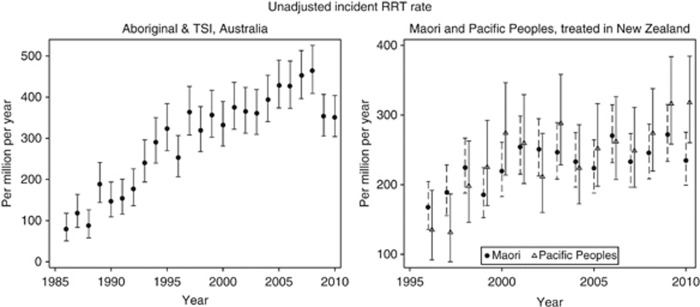
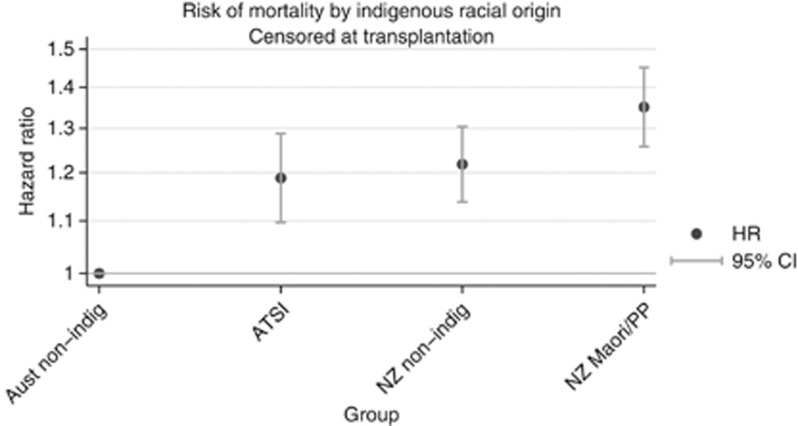
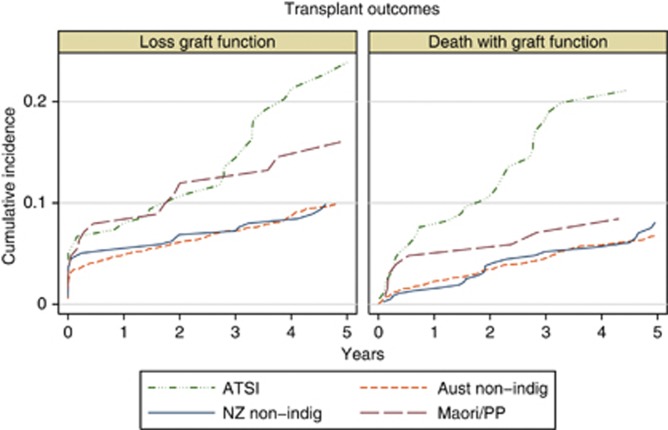
Although possessing different anthropological origins, there are similarities in the epidemiology of end-stage kidney disease (ESKD) among the indigenous peoples of Australia (the Australian Aborigines and Torres Strait Islanders) and New Zealand (Maori and Pacific Peoples). In both countries there is a substantially increased rate of ESKD among these groups. This is more marked in Australia than in New Zealand, but in both countries the relative rate (in comparison to non-indigenous rates) as well as absolute rate have nearly stabilized in recent years. The excess risk affects females particularly-in contrast to the non-indigenous picture. Among Aboriginal and Torres Strait Islander people in Australia, there is a strong age interaction, with the most marked risk being among those aged 25 to 45 years. Indigenous peoples are less likely to be treated with home dialysis, and much less likely to receive a kidney transplant. In particular, rates of living donation are very low among indigenous groups in both countries. Outcomes during dialysis treatment and during transplantation are inferior to those of nonindigenous ones, even after adjustment for the higher prevalence of comorbidities. The underlying causes for these differences are complex, but the slowing and possible stabilization of incident rate changes is heartening.
Keywords: Aboriginal dialysis transplant outcomes; Australia; Maori; New Zealand.
Figures
References
-
- Statistics New Zealand Quickstats about New Zealand's population and dwellings18 May 2007. Available from: http://www.stats.govt.nz/~/media/Statistics/Census/2006-reports/quicksta... (cited 31 March 2012).
-
- ANZDATA Registry In: McDonald SP, Hurst K (eds).Thirty-fourth Report: Methods and Definitions ANZDATA Registry: Adelaide; 2011, p vii.
-
- McDonald SP, Russ GR. The burden of end stage renal disease (ESRD) among indigenous peoples in Australia & New Zealand. Kidney Int. 2003;63 (Suppl s83:s123–s127. - PubMed
-
- Australian Institute of Health and Welfare End-Stage Kidney Disease in Australia: Total Incidence, 2003–2007Cat. no. PHE 143. AIHW: Canberra, 2011.
-
- Cass A, Cunningham J, Wang Z, et al. Regional variation in the incidence of end-stage renal disease in indigenous Australians. Med J Aust. 2001;175:24–27. - PubMed
LinkOut - more resources
Full Text Sources
Other Literature Sources
