


Chondrogenic differentiation of human adipose-derived stem cells: a new path in articular cartilage defect management?
- PMID: 25019085
- PMCID: PMC4075010
- DOI: 10.1155/2014/740926
Chondrogenic differentiation of human adipose-derived stem cells: a new path in articular cartilage defect management?
Abstract
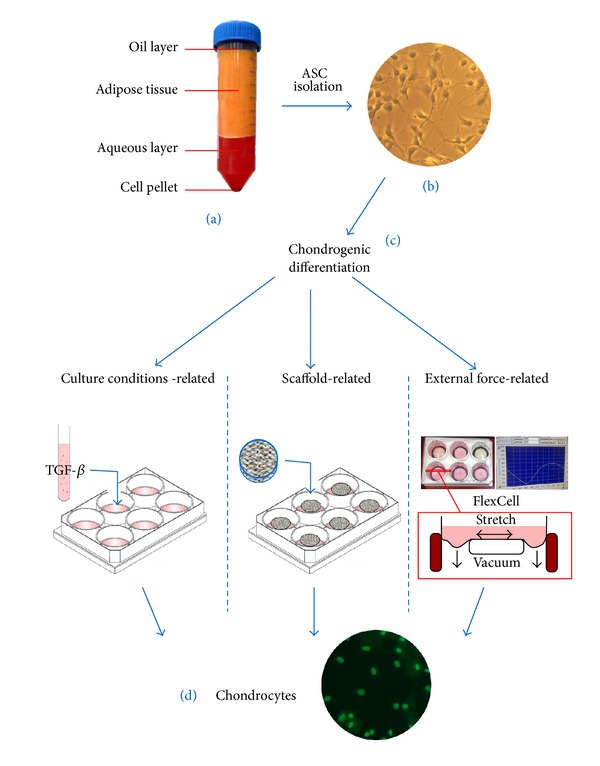
According to data published by the Centers for Disease Control and Prevention, over 6 million people undergo a variety of medical procedures for the repair of articular cartilage defects in the U.S. each year. Trauma, tumor, and age-related degeneration can cause major defects in articular cartilage, which has a poor intrinsic capacity for healing. Therefore, there is substantial interest in the development of novel cartilage tissue engineering strategies to restore articular cartilage defects to a normal or prediseased state. Special attention has been paid to the expansion of chondrocytes, which produce and maintain the cartilaginous matrix in healthy cartilage. This review summarizes the current efforts to generate chondrocytes from adipose-derived stem cells (ASCs) and provides an outlook on promising future strategies.
Figures
References
-
- Brittberg M, Lindahl A, Nilsson A, Ohlsson C, Isaksson O, Peterson L. Treatment of deep cartilage defects in the knee with autologous chondrocyte transplantation. The New England Journal of Medicine. 1994;331(14):889–895. - PubMed
-
- Micheli LJ, Browne JE, Erggelet C, et al. Autologous chondrocyte implantation of the knee: multicenter experience and minimum 3-year follow-up. Clinical Journal of Sport Medicine. 2001;11(4):223–228. - PubMed
-
- Steinwachs M. New technique for cell-seeded collagen-matrix-supported autologous chondrocyte transplantation. Arthroscopy. 2009;25(2):208–211. - PubMed
-
- Tohyama H, Yasuda K, Minami A, et al. Atelocollagen-associated autologous chondrocyte implantation for the repair of chondral defects of the knee: a prospective multicenter clinical trial in Japan. Journal of Orthopaedic Science. 2009;14(5):579–588. - PubMed
-
- Gille J, Ehlers E-M, Okroi M, Russlies M, Behrens P. Apoptotic chondrocyte death in cell-matrix biocomposites used in autologous chondrocyte transplantation. Annals of Anatomy. 2002;184(4):325–332. - PubMed
Publication types
MeSH terms
LinkOut - more resources
Full Text Sources
Other Literature Sources
Medical
