. 2014 Oct;13(10):2646-60.
doi: 10.1074/mcp.M113.036632. Epub 2014 Jul 14.

Predicting antidisease immunity using proteome arrays and sera from children naturally exposed to malaria

Affiliations

Predicting antidisease immunity using proteome arrays and sera from children naturally exposed to malaria

Olivia C Finney et al. Mol Cell Proteomics. 2014 Oct.

Abstract

Malaria remains one of the most prevalent and lethal human infectious diseases worldwide. A comprehensive characterization of antibody responses to blood stage malaria is essential to support the development of future vaccines, sero-diagnostic tests, and sero-surveillance methods. We constructed a proteome array containing 4441 recombinant proteins expressed by the blood stages of the two most common human malaria parasites, P. falciparum (Pf) and P. vivax (Pv), and used this array to screen sera of Papua New Guinea children infected with Pf, Pv, or both (Pf/Pv) that were either symptomatic (febrile), or asymptomatic but had parasitemia detectable via microscopy or PCR. We hypothesized that asymptomatic children would develop antigen-specific antibody profiles associated with antidisease immunity, as compared with symptomatic children. The sera from these children recognized hundreds of the arrayed recombinant Pf and Pv proteins. In general, responses in asymptomatic children were highest in those with high parasitemia, suggesting that antibody levels are associated with parasite burden. In contrast, symptomatic children carried fewer antibodies than asymptomatic children with infections detectable by microscopy, particularly in Pv and Pf/Pv groups, suggesting that antibody production may be impaired during symptomatic infections. We used machine-learning algorithms to investigate the relationship between antibody responses and symptoms, and we identified antibody responses to sets of Plasmodium proteins that could predict clinical status of the donors. Several of these antibody responses were identified by multiple comparisons, including those against members of the serine enriched repeat antigen family and merozoite protein 4. Interestingly, both P. falciparum serine enriched repeat antigen-5 and merozoite protein 4 have been previously investigated for use in vaccines. This machine learning approach, never previously applied to proteome arrays, can be used to generate a list of potential seroprotective and/or diagnostic antigens candidates that can be further evaluated in longitudinal studies.


Conflict of interest statement

Conflict of interest: The authors have declared that no conflict of interest exists.

Figures
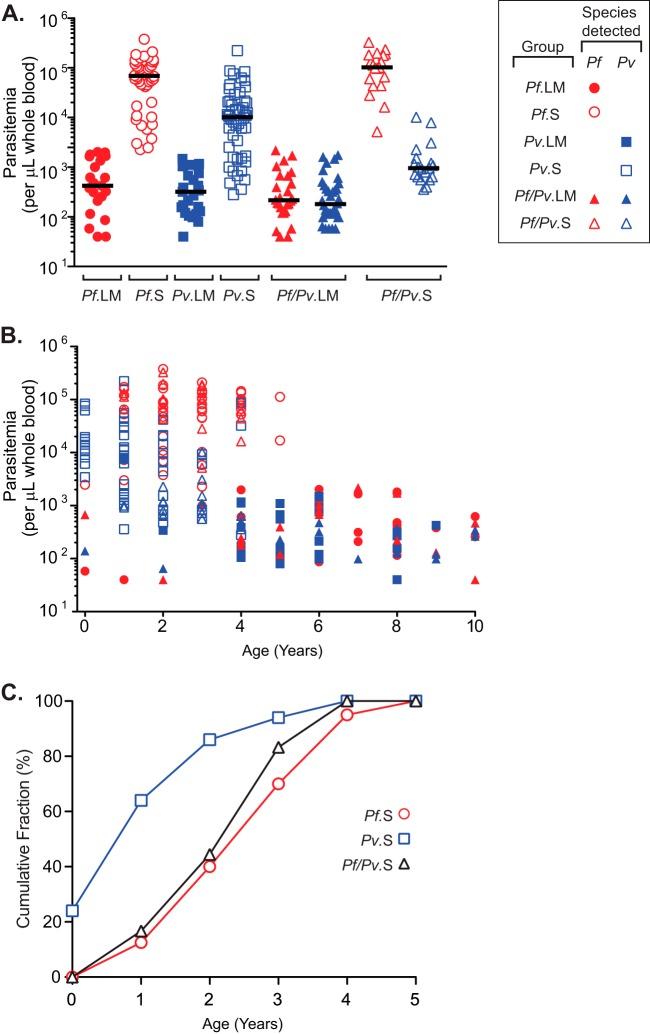
Fig. 1.
Fig. 1.
Mean parasitemia, age distribution, and cumulative incidence of symptoms in smear positive children infected with Pf, Pv or both. A, Parasitemia (number of parasites detected by light microscopy per μl of whole blood) is shown for the six clinical groups with parasites detectable by smear: Pf. LM (asymptomatic children positive only for P. falciparum; filled red circles); Pf.S (symptomatic children positive only for P. falciparum; open red circles); Pv.LM (asymptomatic children positive only for P. vivax; filled blue squares); Pv.S (symptomatic children positive only for P. vivax; open blue squares); Pf/Pv.LM (asymptomatic children positive for P. falciparum and P. vivax; red and blue filled triangles, respectively); and Pf/Pv.S (symptomatic children positive for P. falciparum and P. vivax; red and blue open triangles, respectively). Solid black bars show the median for each group. B, Relationship between parasitemia and age (in years) for all six clinical groups included in part A. Symbols are as in part A. For mixed Pf/Pv infections, each child is represented by two values (one for Pf and one for Pv parasitemia). C, Cumulative incidence of symptomatic malaria cases. Shown are the cumulative fractions of symptomatic children that are positive for Pf (open red circles), Pv (open blue squares), or Pf and Pv (open black triangles), as a function of age (in years).
Fig. 2.
Fig. 2.
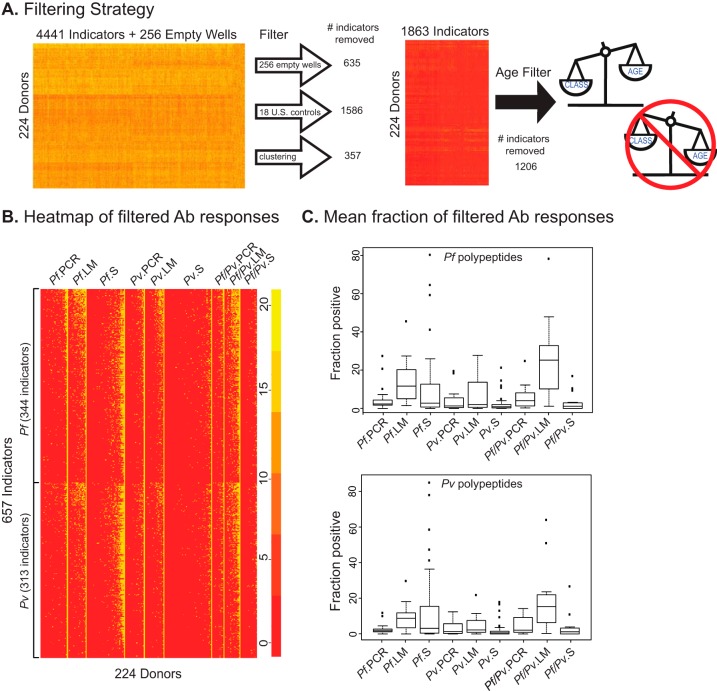
Data filtering strategy and global view of antibody responses against arrayed proteins. A, Depiction of the filtering strategy used to eliminate uninformative responses. Shown are the number of responses removed by the “Empty Well” and “US Control” filters, the clustering algorithm and the “Age” filter for the complete dataset of antibody responses from 224 donors to 4441 arrayed proteins. B, Heatmap showing the antibody responses of all donors against arrayed proteins after applying the dataset filtering pipeline described in part A. Responses were sorted by clinical groups (in columns) and by the Plasmodium species of the arrayed protein (in rows). The scale shows the relative reactivity of each spot, with red and yellow corresponding to the lowest and highest reactivity, respectively. C, Box plots showing the fraction of arrayed Pf (top) and Pv (bottom) proteins recognized by serum of children in each of the nine clinical groups.
Fig. 3.
Fig. 3.
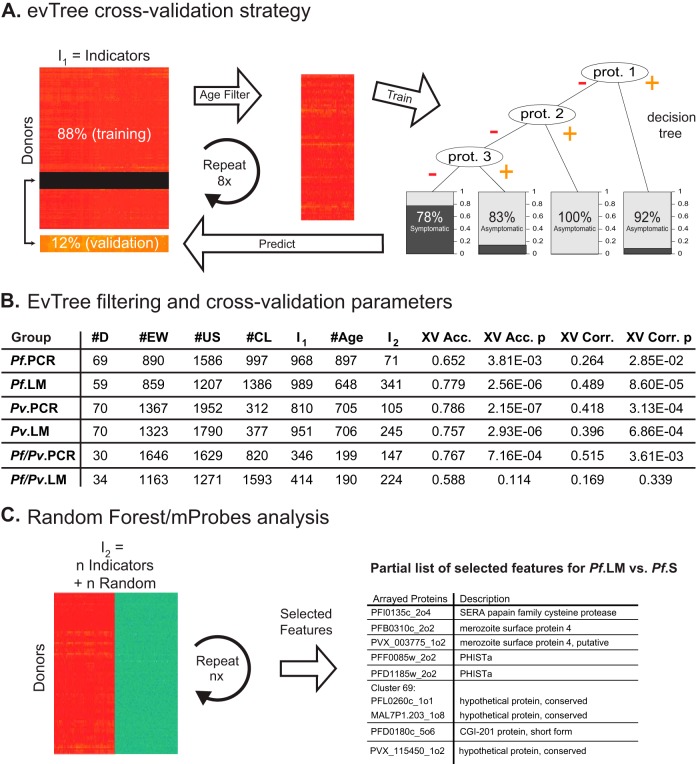
Machine-learning approach for biomarker selection. A, evTree cross-validation strategy used to compare antibody responses in each of the six asymptomatic groups to those in the corresponding symptomatic groups. After dividing each dataset into an 88% training set and a 12% validation set and applying the age filter, the evTree algorithm was trained with 8-fold cross-validation to generate decision trees that predicted whether donors were symptomatic or asymptomatic based on their antibody responses to subsets of arrayed proteins. B, Results of filtering and evTree cross-validation parameters for each of the six pairwise comparisons. The table shows the number of donors in each comparison (#D); the number of responses removed by the empty well (#EW), U.S. naïve donor (#US), and clustering (#CL) filters; the number of responses that remained after these filters were applied (I1); the number of responses removed by the age filter (#Age) and the number of responses that remained after it was applied (I2); the cross-validated accuracy (XV Acc.) and p value (XV Acc. p) of the resulting classifier; as well as the corresponding Matthew's correlation coefficient (XV Corr.) and p value (XV Corr. p) for the classifier. C, Overview of mProbes with Random Forest feature selection strategy used to identify antibody responses that discriminate between symptomatic and asymptomatic donors. After adding noise by randomizing labels for indicators that remain rafter the Age filter was applied (I2), the algorithm identifies features that distinguish between symptomatic and asymptomatic donors. Shown is a representative subset of features selected from the Pf. LM versus Pf.S pairwise comparison.

References

    1. Murray C. J., Rosenfeld L. C., Lim S. S., Andrews K. G., Foreman K. J., Haring D., Fullman N., Naghavi M., Lozano R., Lopez A. D. (2012) Global malaria mortality between 1980 and 2010: A systematic analysis. Lancet 379, 413–431 - PubMed
    1. WHO (2011) World Malaria Report 2011. World Health Organization, Geneva
    1. Price R. N., Douglas N. M., Anstey N. M. (2009) New developments in Plasmodium vivax malaria: severe disease and the rise of chloroquine resistance. Curr. Opin. Inf. Dis. 22, 430–435 - PubMed
    1. Baird J. K. (2013) Evidence and implications of mortality associated with acute Plasmodium vivax malaria. Clin. Microbiol. Rev. 26, 36–57 - PMC - PubMed
    1. Snounou G., Viriyakosol S., Jarra W., Thaithong S., Brown K. N. (1993) Identification of the four human malaria parasite species in field samples by the polymerase chain reaction and detection of a high prevalence of mixed infections. Mol. Biochem. Parasitol. 58, 283–292 - PubMed

MeSH terms

Substances