Diminished brain resilience syndrome: A modern day neurological pathology of increased susceptibility to mild brain trauma, concussion, and downstream neurodegeneration
- PMID: 25024897
- PMCID: PMC4093745
- DOI: 10.4103/2152-7806.134731
Diminished brain resilience syndrome: A modern day neurological pathology of increased susceptibility to mild brain trauma, concussion, and downstream neurodegeneration
Abstract
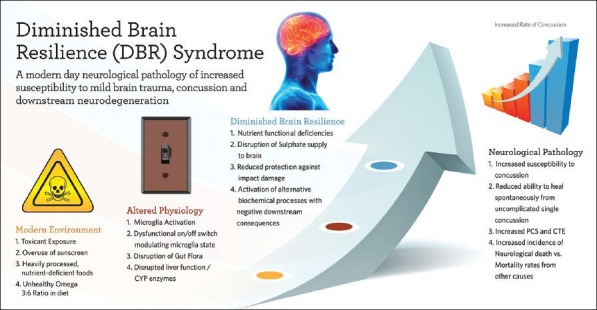
The number of sports-related concussions has been steadily rising in recent years. Diminished brain resilience syndrome is a term coined by the lead author to describe a particular physiological state of nutrient functional deficiency and disrupted homeostatic mechanisms leading to increased susceptibility to previously considered innocuous concussion. We discuss how modern day environmental toxicant exposure, along with major changes in our food supply and lifestyle practices, profoundly reduce the bioavailability of neuro-critical nutrients such that the normal processes of homeostatic balance and resilience are no longer functional. Their diminished capacity triggers physiological and biochemical 'work around' processes that result in undesirable downstream consequences. Exposure to certain environmental chemicals, particularly glyphosate, the active ingredient in the herbicide, Roundup(®), may disrupt the body's innate switching mechanism, which normally turns off the immune response to brain injury once danger has been removed. Deficiencies in serotonin, due to disruption of the shikimate pathway, may lead to impaired melatonin supply, which reduces the resiliency of the brain through reduced antioxidant capacity and alterations in the cerebrospinal fluid, reducing critical protective buffering mechanisms in impact trauma. Depletion of certain rare minerals, overuse of sunscreen and/or overprotection from sun exposure, as well as overindulgence in heavily processed, nutrient deficient foods, further compromise the brain's resilience. Modifications to lifestyle practices, if widely implemented, could significantly reduce this trend of neurological damage.
Keywords: Chronic traumatic encephalopathy; glyphosate; neurotoxins; postconcussion syndrome; sports-related concussion.
Figures
Similar articles
-
Environmental Subconcussive Injury, Axonal Injury, and Chronic Traumatic Encephalopathy.Front Neurol. 2018 Mar 27;9:166. doi: 10.3389/fneur.2018.00166. eCollection 2018. Front Neurol. 2018. PMID: 29636723 Free PMC article. Review.
-
[Mild traumatic brain injury and postconcussive syndrome: a re-emergent questioning].Encephale. 2012 Sep;38(4):329-35. doi: 10.1016/j.encep.2011.07.003. Epub 2011 Aug 31. Encephale. 2012. PMID: 22980474 Review. French.
-
Neurological consequences of traumatic brain injuries in sports.Mol Cell Neurosci. 2015 May;66(Pt B):114-22. doi: 10.1016/j.mcn.2015.03.012. Epub 2015 Mar 12. Mol Cell Neurosci. 2015. PMID: 25770439 Review.
-
Sports-related concussions: diagnosis, complications, and current management strategies.Neurosurg Focus. 2016 Apr;40(4):E5. doi: 10.3171/2016.1.FOCUS15617. Neurosurg Focus. 2016. PMID: 27032922
-
Traumatic brain injury (TBI) in collision sports: Possible mechanisms of transformation into chronic traumatic encephalopathy (CTE).Metabolism. 2019 Nov;100S:153943. doi: 10.1016/j.metabol.2019.07.007. Metabolism. 2019. PMID: 31610856 Review.
Cited by
-
Is GERD a Factor in Osteonecrosis of the Jaw? Evidence of Pathology Linked to G6PD Deficiency and Sulfomucins.Dis Markers. 2016;2016:8376979. doi: 10.1155/2016/8376979. Epub 2016 Sep 28. Dis Markers. 2016. PMID: 27773962 Free PMC article.
-
Preoperative Status of Gut Microbiota Predicts Postoperative Delirium in Patients With Gastric Cancer.Front Psychiatry. 2022 Mar 3;13:852269. doi: 10.3389/fpsyt.2022.852269. eCollection 2022. Front Psychiatry. 2022. PMID: 35308872 Free PMC article.
-
Examining the Correlation between Acute Behavioral Manifestations of Concussion and the Underlying Pathophysiology of Chronic Traumatic Encephalopathy: A Pilot Study.J Neurol Psychol. 2018 May;6(1):10.13188/2332-3469.1000037. doi: 10.13188/2332-3469.1000037. Epub 2018 May 11. J Neurol Psychol. 2018. PMID: 30079371 Free PMC article.
-
Environmental Subconcussive Injury, Axonal Injury, and Chronic Traumatic Encephalopathy.Front Neurol. 2018 Mar 27;9:166. doi: 10.3389/fneur.2018.00166. eCollection 2018. Front Neurol. 2018. PMID: 29636723 Free PMC article. Review.
-
Neuroimaging assessment of early and late neurobiological sequelae of traumatic brain injury: implications for CTE.Front Neurosci. 2015 Sep 24;9:334. doi: 10.3389/fnins.2015.00334. eCollection 2015. Front Neurosci. 2015. PMID: 26441507 Free PMC article. Review.
References
-
- Aoyama K, Watabe M, Nakaki T. Regulation of neuronal glutathione synthesis. J Pharmacol Sci. 2008;108:227–38. - PubMed
-
- Aoyama K, Suh SW, Hamby AM, Liu J, Chan WY, Chen Y, et al. Neuronal glutathione deficiency and age-dependent neurodegeneration in the EAAC1 deficient mouse. Nat Neurosci. 2006;9:119–26. - PubMed
-
- Arand M, Melzner H, Kinzl L, Bruckner UB, Gebhard F. Early inflammatory mediator response following isolated traumatic brain injury and other major trauma in humans. Langenbecks Arch Surg. 2001;386:241–8. - PubMed
Publication types
LinkOut - more resources
Full Text Sources
Other Literature Sources