


Effect of miscarriage history on maternal-infant bonding during the first year postpartum in the first baby study: a longitudinal cohort study
- PMID: 25028056
- PMCID: PMC4107477
- DOI: 10.1186/1472-6874-14-83
Effect of miscarriage history on maternal-infant bonding during the first year postpartum in the first baby study: a longitudinal cohort study
Abstract
Background: Miscarriage, the unexpected loss of pregnancy before 20 weeks gestation, may have a negative effect on a mother's perception of herself as a capable woman and on her emotional health when she is pregnant again subsequent to the miscarriage. As such, a mother with a history of miscarriage may be at greater risk for difficulties navigating the process of becoming a mother and achieving positive maternal-infant bonding with an infant born subsequent to the loss. The aim of this study was to examine the effect of miscarriage history on maternal-infant bonding after the birth of a healthy infant to test the hypothesis that women with a history of miscarriage have decreased maternal-infant bonding compared to women without a history of miscarriage.
Methods: We completed secondary analysis of the First Baby Study, a longitudinal cohort study, to examine the effect of a history of miscarriage on maternal-infant bonding at 1 month, 6 months, and 12 months after women experienced the birth of their first live-born baby. In a sample of 2798 women living in Pennsylvania, USA, we tested our hypothesis using linear regression analysis of Shortened Postpartum Bonding Questionnaire (S-PBQ) scores, followed by longitudinal analysis using a generalized estimating equations model with repeated measures.
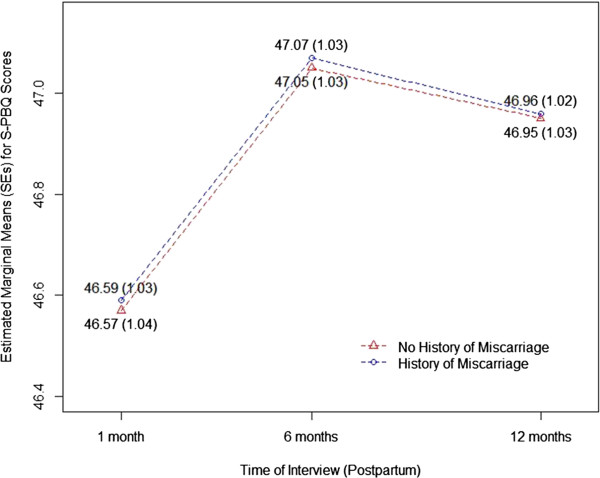
Results: We found that women with a history of miscarriage had similar S-PBQ scores as women without a history of miscarriage at each of the three postpartum time points. Likewise, longitudinal analysis revealed no difference in the pattern of maternal-infant bonding scores between women with and without a history of miscarriage.
Conclusions: Women in the First Baby Study with a history of miscarriage did not differ from women without a history of miscarriage in their reported level of bonding with their subsequently born infants. It is important for clinicians to recognize that even though some women may experience impaired bonding related to a history of miscarriage, the majority of women form a healthy bond with their infant despite this history.
Figures
References
-
- Brockington IF. Motherhood and Mental Health. New York: Oxford University Press; 1996.
-
- Madrid A, Skolek S, Shapiro F. Repairing Failures in Bonding Through EMDR. Clin Case Stud. 2006;5(4):271–286.
-
- Sharan H, Yahav J, Peleg D, Ben-Rafael Z, Merlob P. Hospitalization for early bonding of the genetic mother after a surrogate pregnancy: Report of two cases. Birth. 2001;28(4):270–273. - PubMed
Publication types
MeSH terms
Grants and funding
LinkOut - more resources
Full Text Sources
Other Literature Sources
Medical
Research Materials
