Review
. 2014 Apr-Jun;26(2):89-121.
doi: 10.5935/0103-507x.20140017.

Brazilian recommendations of mechanical ventilation 2013. Part I

[Article in English, Portuguese]
Carmen Sílvia Valente BarbasAlexandre Marini IsolaAugusto Manoel de Carvalho FariasAlexandre Biasi CavalcantiAna Maria Casati GamaAntonio Carlos Magalhães DuarteArthur ViannaAry Serpa NetoBruno de Arruda BravimBruno do Valle PinheiroBruno Franco MazzaCarlos Roberto Ribeiro de CarvalhoCarlos Toufen JúniorCid Marcos Nascimento DavidCorine TaniguchiDébora Dutra da Silveira MazzaDesanka DragosavacDiogo Oliveira ToledoEduardo Leite CostaEliana Bernardete CaserEliezer SilvaFabio Ferreira AmorimFelipe SaddyFilomena Regina Barbosa Gomes GalasGisele Sampaio SilvaGustavo Faissol Janot de MatosJoão Claudio EmmerichJorge Luis Dos Santos ValiattiJosé Mario Meira TelesJosué Almeida VictorinoJuliana Carvalho FerreiraLuciana Passuello do Vale ProdomoLudhmila Abrahão HajjarLuiz Cláudio MartinsLuiz Marcelo Sá MalbouissonMara Ambrosina de Oliveira VargasMarco Antonio Soares ReisMarcelo Brito Passos AmatoMarcelo Alcântara HolandaMarcelo ParkMarcia JacomelliMarcos TavaresMarta Cristina Paulette DamascenoMurillo Santucci César AssunçãoMoyzes Pinto Coelho Duarte DamascenoNazah Cherif Mohamad YoussefPaulo José Zimmermann TeixeiraPedro CarusoPéricles Almeida Delfino DuarteOctavio MessederRaquel Caserta EidRicardo Goulart RodriguesRodrigo Francisco de JesusRonaldo Adib KairallaSandra JustinoSérgio Nogueira NemerSimone Barbosa RomeroVerônica Moreira Amado
Review

Brazilian recommendations of mechanical ventilation 2013. Part I

[Article in English, Portuguese]
Carmen Sílvia Valente Barbas et al. Rev Bras Ter Intensiva. 2014 Apr-Jun.

Abstract

Perspectives on invasive and noninvasive ventilatory support for critically ill patients are evolving, as much evidence indicates that ventilation may have positive effects on patient survival and the quality of the care provided in intensive care units in Brazil. For those reasons, the Brazilian Association of Intensive Care Medicine (Associação de Medicina Intensiva Brasileira - AMIB) and the Brazilian Thoracic Society (Sociedade Brasileira de Pneumonia e Tisiologia - SBPT), represented by the Mechanical Ventilation Committee and the Commission of Intensive Therapy, respectively, decided to review the literature and draft recommendations for mechanical ventilation with the goal of creating a document for bedside guidance as to the best practices on mechanical ventilation available to their members. The document was based on the available evidence regarding 29 subtopics selected as the most relevant for the subject of interest. The project was developed in several stages, during which the selected topics were distributed among experts recommended by both societies with recent publications on the subject of interest and/or significant teaching and research activity in the field of mechanical ventilation in Brazil. The experts were divided into pairs that were charged with performing a thorough review of the international literature on each topic. All the experts met at the Forum on Mechanical Ventilation, which was held at the headquarters of AMIB in São Paulo on August 3 and 4, 2013, to collaboratively draft the final text corresponding to each sub-topic, which was presented to, appraised, discussed and approved in a plenary session that included all 58 participants and aimed to create the final document.


Conflict of interest statement

Conflicts of interest: With the help of the Brazilian Thoracic Society, the AMIB Division of Scientific Issues procured financial support from industrial companies and laboratories, distributed as sponsorship quotas, to cover part of the event costs (participants' air tickets, food and lodging). None of those companies participated in the drafting of the present document, nor had access to its content until it was disclosed (after its final format was approved) as brochures distributed at the Brazilian Congress of Intensive Care Medicine in Rio de Janeiro in 2013. The companies that collaborated with the present project are: Air Liquide, Covidien, GE, Intermed, Magnamed, Mindray and Philips.

Individual conflicts of interest:

Carmen Silvia Valente Barbas - received honorary for lectures from Covidien and Mindray. Alexandre Marini Ísola - received honorary for lectures from Covidien and Mindray. Augusto Manoel de Carvalho Farias - received funds for CAPTIVATE study from Novartis and support to attend the AMIB congress from Sanofi-Aventis and Expressa. Ana Maria Casati Gama - received grant support from Boehringer company for lectures and for attending ATS congress in 2014. Arthur Oswaldo de Abreu Vianna - received funding support to attend critical care congress from E. Tamussino. Carlos Roberto Ribeiro Carvalho - is a stake holder of TIMPEL. Corine Taniguchi - received honoraria for a lecture on ventilator-associated pneumonia from Covidien and for two classes on automatic weaning from mechanical ventilation from Draeger. Diogo Oliveira Toledo - received honoraria from Danone and Nestlé for lecutres. Gustavo Faissol Janot de Matos - received financial support from Edwards Lifescience for training lecture given to company employees. Jorge Luis Valiatti - received honoraria from Intermed Brazil for consulting and training during the years 2005-2012. José Mario Meira Teles - received honoraria for lectures from Hospira. Juliana Carvalho Ferreira - received grants to her Institution. Marcelo Brito Passos Amato - declares that his laboratory (LIM-09 USP) has received funding for research in the last 5 years from the following companies: a) Covidien 2012-2014 (for experimental studies and simulations on patient-ventilator synchrony), b) Dixtal Biomedical/Philips 2009-2013 (for experimental studies on Electrical Impedance Tomography), c) the SA Timpel 2013-2014 (for experimental studies on Electrical Impedance Tomography). Marcelo Alcântara Holanda - declares he is the founder and owner of the platform and the virtual simulator for teaching XLung Mechanical Ventilation. Marcelo Park - receivedfunding for lectures on ECMO from Maquet and Nipro. Murillo Santucci César Assunção - received honoraria for lectures from the following industries: Edwards Lifescience, Eli Lilly, Pfizer, Astrazeneca, Roche, Thermo-Fisher, Astellas, Novartis, and Baxter and research grants and monitors from Edwards Lifescience, Dixtal-Philips, Masimo and Eli Lilly. Alexandre Biasi Cavalcanti, Antonio Duarte, Ary Serpa Neto, Bruno Bravin, Bruno do Vale Pinheiro, Bruno Franco Mazza, Carlos Toufen, Cid Marcos David, Débora Dutra da Silveira Mazza, Desanka Dragosavac, Eduardo Leite, Eliana Caser, Eliezer Silva, Fabio Amorim, Felipe Saddy, Filomena Galas, Gisele Sampaio, João Claudio Emmerich, Josué Victorino, Luciana Prodomo, Ludhmila Abrahão Hajjar, Luis Claudio Martins, Luis Marcelo Malbouisson, Mara Ambrosina Vargas, Marco Antonio Soares Reis, Marcia Jacomelli, Marcos Soares Tavares, Marta Cristina Paulette Damasceno, Moyzes Pinto Coelho Duarte Damasceno, Nazah Youssef, Paulo José Zimmermann, Pedro Caruso, Péricles Almeida Delfino Duarte, Octavio Messeder, Raquel Caserta Eid, Ricardo Goulart Rodrigues, Rodrigo Francisco de Jesus, Ronaldo Adib Kairalla, Sandra Justino, Sergio Nemer, Simone Barbosa Romero and Verônica Amado - have no conflict of interest.

Figures
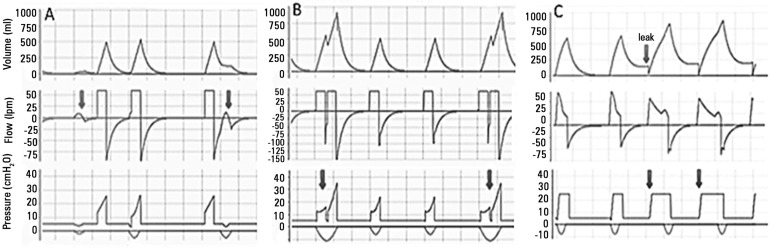
Figure 1
Figure 1
Trigger asynchronies identified in volume-, flow- and pressure-time curves, indicated by arrows. Negative deflections in the pressure-time curves represent the patient’s inspiratory effort (muscle pressure), which are only visible when the esophageal pressure is monitored. Panel A) Lost efforts. The first arrow indicates a weak stimulus, which is unable to trigger the ventilator, thus resulting in a small positive flow wave and minimal tidal volume. The second arrow points to effort during expiration, which failed to trigger the ventilator and merely sufficed for the flow to return to baseline and become slightly positive. Panel B) Double-triggering. Example in volume-controlled ventilation. The patient’s inspiratory efforts persist at the time of cycling-off, thus triggering another cycle. The corresponding volumes are added together (stacking), and the airway pressure increases, causing the high-pressure alarm to go off. Panel C) Auto-triggering. In the support pressure mode, some cycles are triggered without a patient inspiratory effort, which can be facilitated by leaks; this is observed in the volume-time curve, which does not return to baseline (the inspired volume is greater than the expired volume). Figures obtained at Xlung.net, a virtual mechanical ventilation simulator. Available at: http//:www.xlung.net.
Figure 2
Figure 2
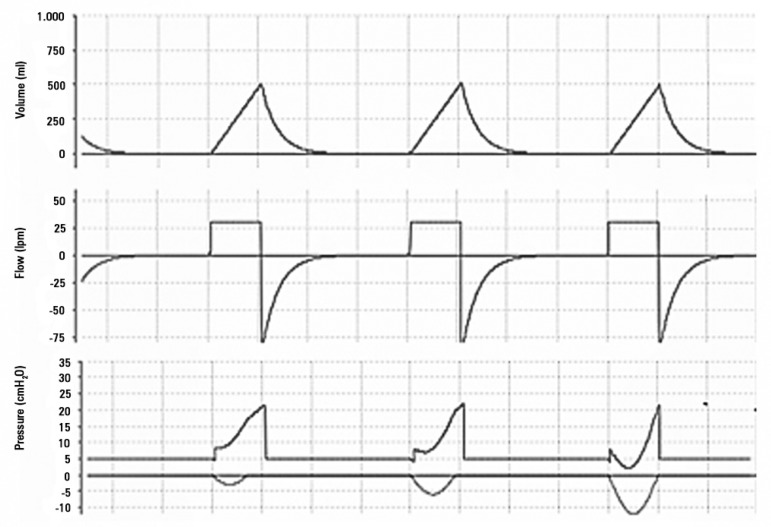
Flow asynchrony. In volume-controlled mode, the flow rate was adjusted below the patient’s demand; the patient thus maintained muscle effort throughout inspiration, and the curve consequently became concave and upward. The asynchrony exhibits increasing intensity from the first to the third cycle, as represented in the figure. The negative deflections in the pressure-time curve represent the patient’s inspiratory effort (muscle pressure) and are only visible when esophageal pressure is monitored. Figures obtained at Xlung.net, a virtual mechanical ventilation simulator. Available at: http//:www.xlung.net.
Figure 3
Figure 3
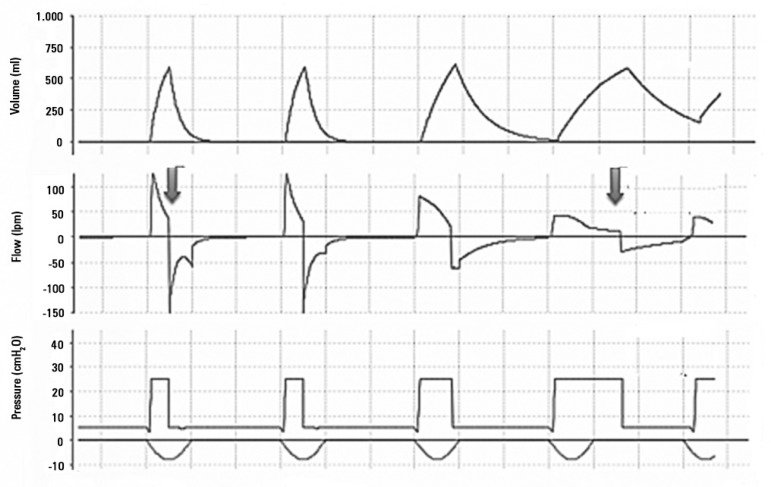
Cycling asynchronies during pressure support ventilation. In the first cycle, the cutoff point of 25% of the peak inspiratory flow (percentage of the cycling criterion) was reached rapidly; the ventilator’s inspiratory time was therefore shorter than the time desired by the patient. This is shown in the expiratory segment of the flow curve, which tends to return to the baseline as a result of the patient’s inspiratory effort, which is still present. The last cycle represents the opposite situation, i.e., delayed cycling. The flow reduction occurs very slowly, which is typical of airway obstruction; the cycling threshold is therefore reached with some delay. Sometimes, the cycle is interrupted by a contraction of the respiratory muscles, which causes an increase above the support pressure adjusted at the end of inspiration (not shown in this figure). Figures obtained at Xlung.net, a virtual mechanical ventilation simulator. Available at: http//:www.xlung.net
Figure 4
Figure 4
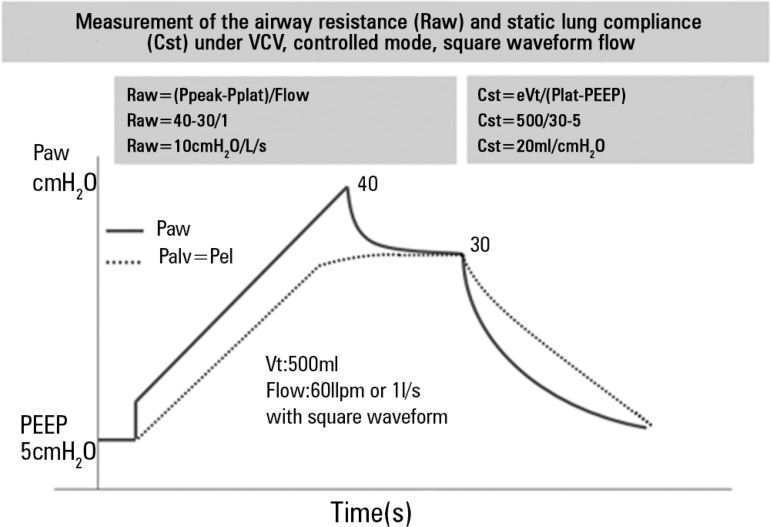
Inspiratory pause maneuver and estimation of the airway resistance and pause (or plateau) pressure. VCV - volume-controlled ventilation. Paw - airway pressure; PEEP - positive end-expiratory pressure; Vt - tidal volume; Pel - elastic pressure; Palv - alveolar pressure.

References

    1. Guyatt GH, Oxman AD, Vist GE, Kunz R, Falck-Ytter Y, Alonso-Coello P, Schünemann HJ, GRADE Working Group GRADE: an emerging consensus on rating quality of evidence and strength of recommendations. BMJ. 2008;336(7650):924–926. - PMC - PubMed
    1. Guyatt GH, Oxman AD, Kunz R, Vist GE, Falck-Ytter Y, Schünemann HJ, GRADE Working Group What is "quality of evidence" and why is it important to clinicians? BMJ. 2008;336(7651):995–998. - PMC - PubMed
    1. Guyatt GH, Oxman AD, Kunz R, Falck-Ytter Y, Vist GE, Liberati A, Schünemann HJ, GRADE Working Group Going from evidence to recommendations. BMJ. 2008;336(7652):1049–1051. Erratum in BMJ. 2008;336(7658):doi:10.1136/bmj.a402. - PMC - PubMed
    1. Brozek J, Oxman AD, Schünemann HJ. GRADEpro (Computer Program) Version 3.2 for Windows. 2012. Available at http://www.cc-ims.net/revman/gradepro.
    1. Hess DR. Noninvasive ventilation for acute respiratory failure. Respir Care. 2013;58(6):950–972. Review. - PubMed