High-volume hemofiltration and prone ventilation in subarachnoid hemorrhage complicated by severe acute respiratory distress syndrome and refractory septic shock
- PMID: 25028955
- PMCID: PMC4103947
- DOI: 10.5935/0103-507x.20140028
High-volume hemofiltration and prone ventilation in subarachnoid hemorrhage complicated by severe acute respiratory distress syndrome and refractory septic shock
Abstract
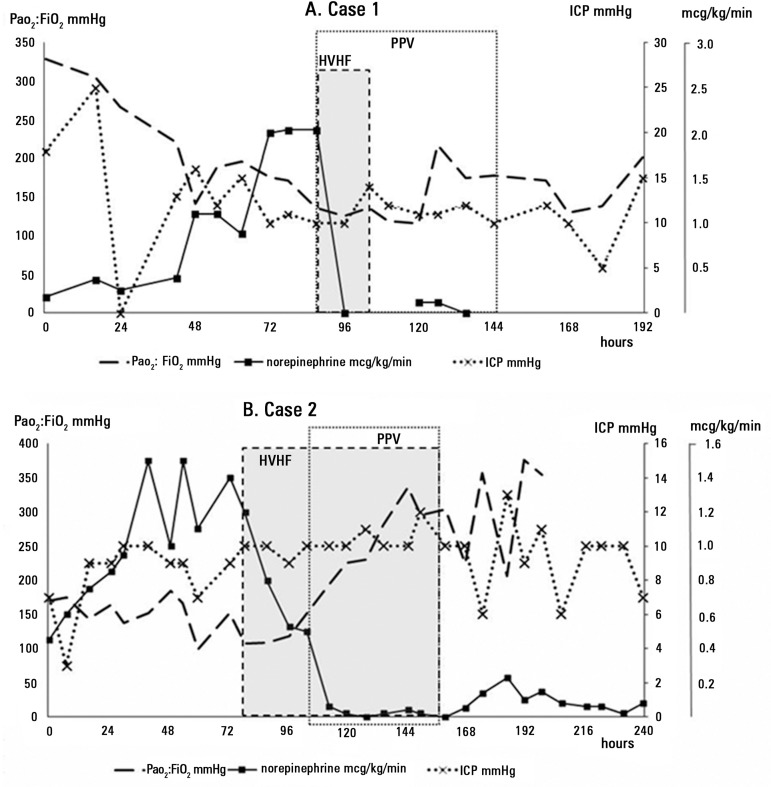
We report the successful treatment of two patients with aneurismal subarachnoid hemorrhage complicated by severe respiratory failure and refractory septic shock using simultaneous prone position ventilation and high-volume hemofiltration. These rescue therapies allowed the patients to overcome the critical situation without associated complications and with no detrimental effects on the intracranial and cerebral perfusion pressures. Prone position ventilation is now an accepted therapy for severe acute respiratory distress syndrome, and high-volume hemofiltration is a non-conventional hemodynamic support that has several potential mechanisms for improving septic shock. In this manuscript, we briefly review these therapies and the related evidence. When other conventional treatments are insufficient for providing safe limits of oxygenation and perfusion as part of basic neuroprotective care in subarachnoid hemorrhage patients, these rescue therapies should be considered on a case-by-case basis by an experienced critical care team.
Relatamos o tratamento bem-sucedido de dois pacientes com hemorragia subaracnóidea complicada com grave falência respiratória e choque séptico refratário, utilizando, simultaneamente, ventilação em posição prona e hemofiltração de alto volume. Esses tratamentos de resgate permitiram que os pacientes superassem a grave situação sem complicações associadas ou efeitos deletérios na pressão intracraniana e de perfusão cerebral. A ventilação em posição prona é, hoje, um tratamento aceito para síndrome de desconforto respiratório agudo grave, e a hemofiltração de alto volume é um suporte hemodinâmico não convencional, que tem diversos mecanismos potenciais para melhorar o choque séptico. Neste artigo revisamos brevemente esses tratamentos e as evidências relacionadas. Quando outras terapias convencionais são insuficientes para proporcionar oxigenação e perfusão como parte do cuidado neuroprotetor básico dentro de limites seguros em pacientes com hemorragia subaracnóidea, esses tratamentos de resgate podem ser considerados caso a caso por uma equipe com experiência em cuidados críticos.
Conflict of interest statement
Figures
Comment in
-
To: High-volume hemofiltration and prone ventilation in subarachnoid hemorrhage complicated by severe acute respiratory distress syndrome and refractory septic shock.Rev Bras Ter Intensiva. 2014 Oct-Dec;26(4):435-6. doi: 10.5935/0103-507X.20140067. Rev Bras Ter Intensiva. 2014. PMID: 25607276 Free PMC article. No abstract available.
-
Authors' response.Rev Bras Ter Intensiva. 2014 Oct-Dec;26(4):436-7. Rev Bras Ter Intensiva. 2014. PMID: 25764572 No abstract available.
References
-
- Wartenberg KE, Schmidt JM, Claassen J, Temes RE, Frontera JA, Ostapkovich N, et al. Impact of medical complications on outcome after subarachnoid hemorrhage. Crit Care Med. 2006;34(3):617–623. quiz 624. - PubMed
-
- Wheeler AP, Bernard GR. Acute lung injury and the acute respiratory distress syndrome: a clinical review. Lancet. 2007;369(9572):1553–1564. - PubMed
-
- Thelandersson A, Cider A, Nellgård B. Prone position in mechanically ventilated patients with reduced intracranial compliance. Acta Anaesthesiol Scand. 2006;50(8):937–941. - PubMed
-
- Reinprecht A, Greher M, Wolfsberger S, Dietrich W, Illievich UM, Gruber A. Prone position in subarachnoid hemorrhage patients with acute respiratory distress syndrome: effects on cerebral tissue oxygenation and intracranial pressure. Crit Care Med. 2003;31(6):1831–1838. - PubMed
-
- Gruber A, Reinprecht A, Illievich UM, Fitzgerald R, Dietrich W, Czech T, et al. Extracerebral organ dysfunction and neurologic outcome after aneurysmal subarachnoid hemorrhage. Crit Care Med. 1999;27(3):505–514. - PubMed
Publication types
MeSH terms
LinkOut - more resources
Full Text Sources