


Evolutionary divergence in the catalytic activity of the CAM-1, ROR1 and ROR2 kinase domains
- PMID: 25029443
- PMCID: PMC4100928
- DOI: 10.1371/journal.pone.0102695
Evolutionary divergence in the catalytic activity of the CAM-1, ROR1 and ROR2 kinase domains
Abstract
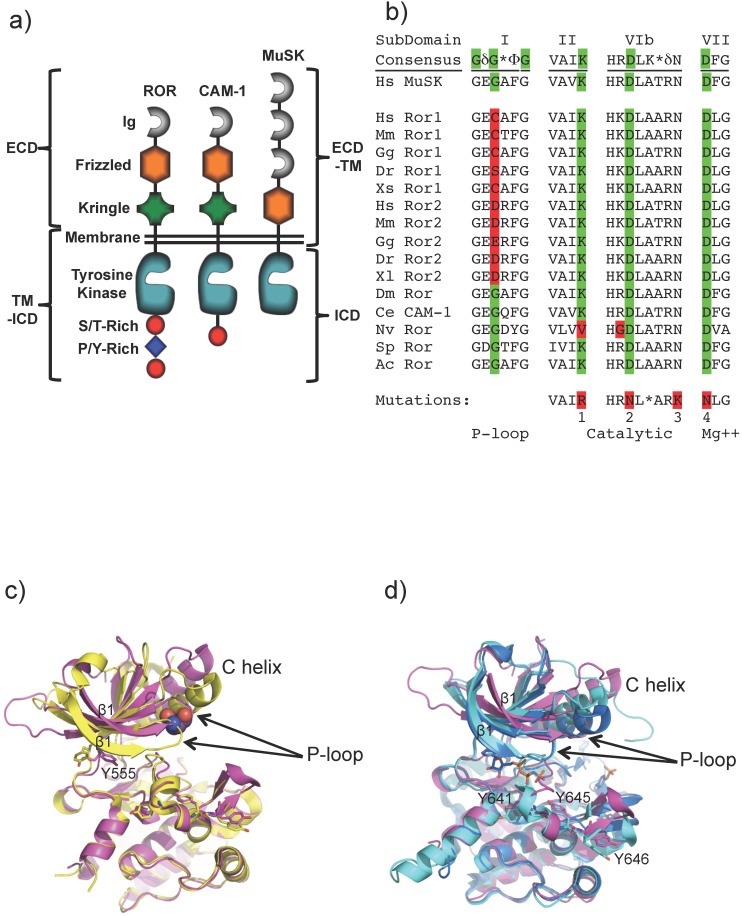
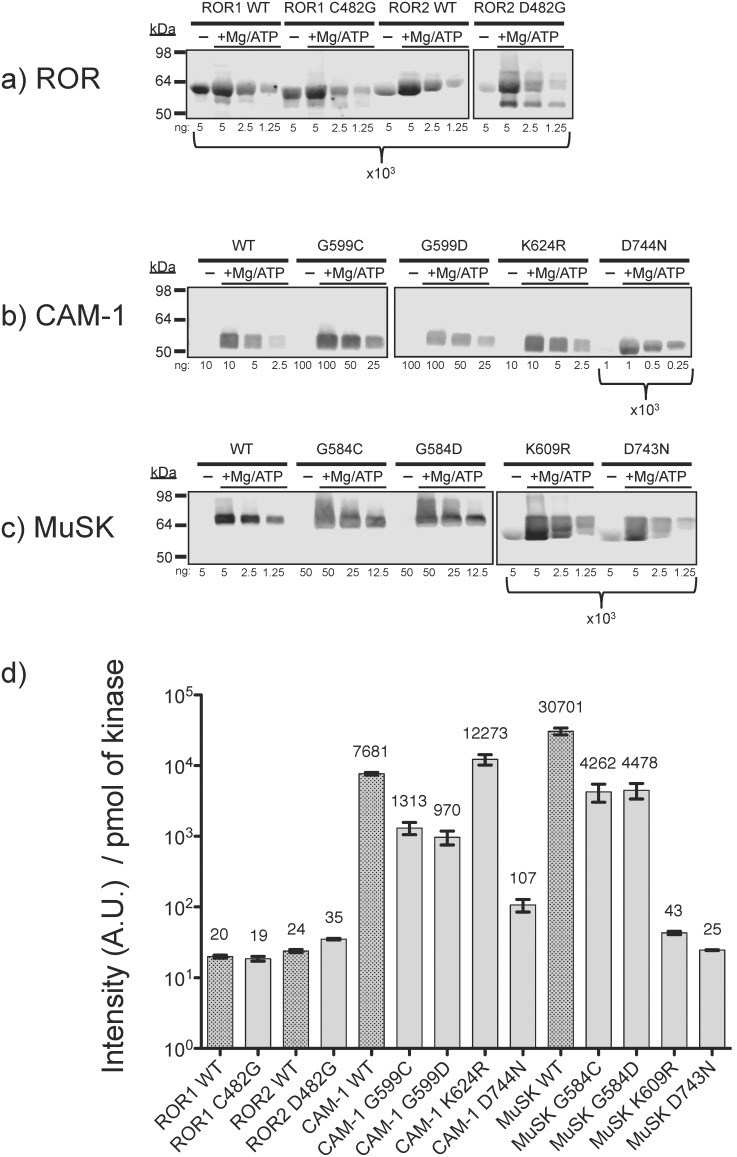
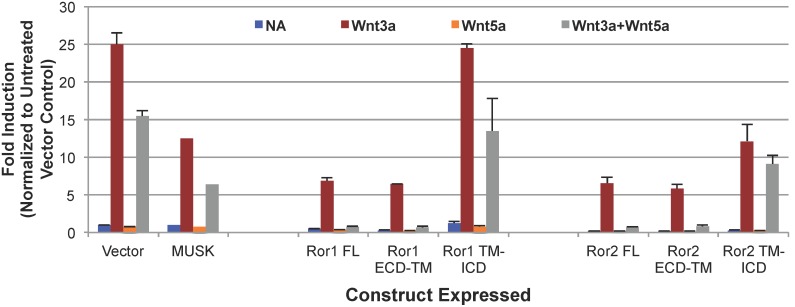
Receptor tyrosine kinase-like orphan receptors (ROR) 1 and 2 are atypical members of the receptor tyrosine kinase (RTK) family and have been associated with several human diseases. The vertebrate RORs contain an ATP binding domain that deviates from the consensus amino acid sequence, although the impact of this deviation on catalytic activity is not known and the kinase function of these receptors remains controversial. Recently, ROR2 was shown to signal through a Wnt responsive, β-catenin independent pathway and suppress a canonical Wnt/β-catenin signal. In this work we demonstrate that both ROR1 and ROR2 kinase domains are catalytically deficient while CAM-1, the C. elegans homolog of ROR, has an active tyrosine kinase domain, suggesting a divergence in the signaling processes of the ROR family during evolution. In addition, we show that substitution of the non-consensus residues from ROR1 or ROR2 into CAM-1 and MuSK markedly reduce kinase activity, while restoration of the consensus residues in ROR does not restore robust kinase function. We further demonstrate that the membrane-bound extracellular domain alone of either ROR1 or ROR2 is sufficient for suppression of canonical Wnt3a signaling, and that this domain can also enhance Wnt5a suppression of Wnt3a signaling. Based on these data, we conclude that human ROR1 and ROR2 are RTK-like pseudokinases.
Conflict of interest statement
Figures
References
-
- Masiakowski P, Carroll RD (1992) A novel family of cell surface receptors with tyrosine kinase-like domain. J Biol Chem 267: 26181–26190. - PubMed
-
- Afzal AR, Rajab A, Fenske CD, Oldridge M, Elanko N, et al. (2000) Recessive Robinow syndrome, allelic to dominant brachydactyly type B, is caused by mutation of ROR2. Nat Genet 25: 419–422. - PubMed
-
- Enomoto M, Hayakawa S, Itsukushima S, Ren DY, Matsuo M, et al. (2009) Autonomous regulation of osteosarcoma cell invasiveness by Wnt5a/Ror2 signaling. Oncogene 28: 3197–3208. - PubMed
-
- Daneshmanesh AH, Mikaelsson E, Jeddi-Tehrani M, Bayat AA, Ghods R, et al. (2008) Ror1, a cell surface receptor tyrosine kinase is expressed in chronic lymphocytic leukemia and may serve as a putative target for therapy. Int J Cancer 123: 1190–1195. - PubMed
MeSH terms
Substances
LinkOut - more resources
Full Text Sources
Other Literature Sources
Molecular Biology Databases
Miscellaneous
