


Mating system shifts and transposable element evolution in the plant genus Capsella
- PMID: 25030755
- PMCID: PMC4112209
- DOI: 10.1186/1471-2164-15-602
Mating system shifts and transposable element evolution in the plant genus Capsella
Abstract
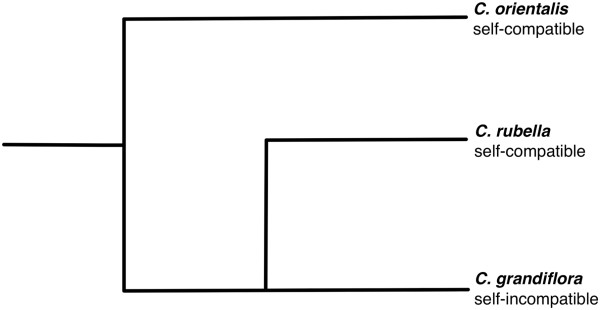
Background: Despite having predominately deleterious fitness effects, transposable elements (TEs) are major constituents of eukaryote genomes in general and of plant genomes in particular. Although the proportion of the genome made up of TEs varies at least four-fold across plants, the relative importance of the evolutionary forces shaping variation in TE abundance and distributions across taxa remains unclear. Under several theoretical models, mating system plays an important role in governing the evolutionary dynamics of TEs. Here, we use the recently sequenced Capsella rubella reference genome and short-read whole genome sequencing of multiple individuals to quantify abundance, genome distributions, and population frequencies of TEs in three recently diverged species of differing mating system, two self-compatible species (C. rubella and C. orientalis) and their self-incompatible outcrossing relative, C. grandiflora.
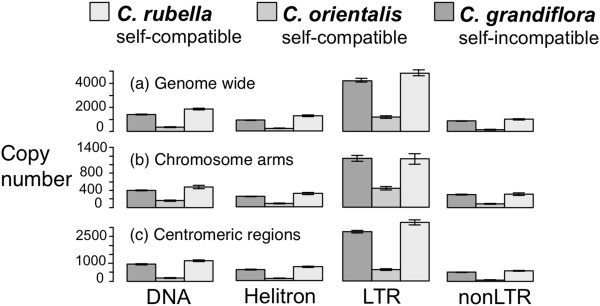
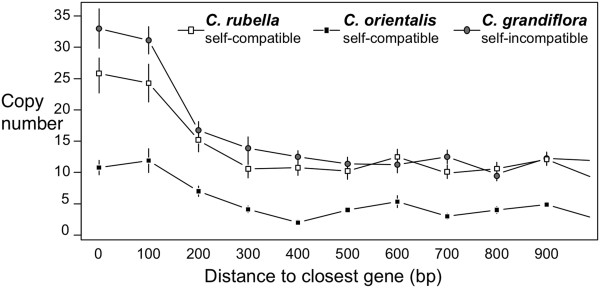
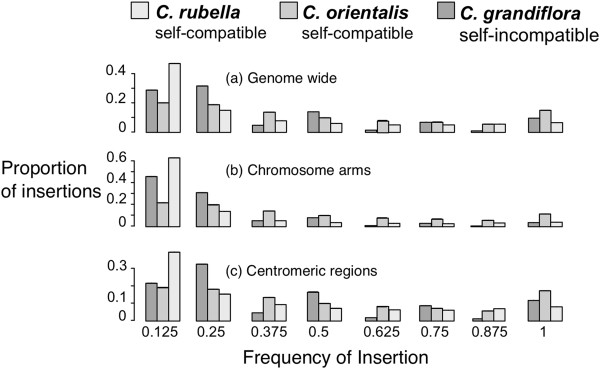
Results: We detect different dynamics of TE evolution in our two self-compatible species; C. rubella shows a small increase in transposon copy number, while C. orientalis shows a substantial decrease relative to C. grandiflora. The direction of this change in copy number is genome wide and consistent across transposon classes. For insertions near genes, however, we detect the highest abundances in C. grandiflora. Finally, we also find differences in the population frequency distributions across the three species.
Conclusion: Overall, our results suggest that the evolution of selfing may have different effects on TE evolution on a short and on a long timescale. Moreover, cross-species comparisons of transposon abundance are sensitive to reference genome bias, and efforts to control for this bias are key when making comparisons across species.
Figures

References
-
- Schnable PS, Ware D, Fulton RS, Stein JC, Wei F, Pasternak S, Liang C, Zhang J, Fulton L, Graves TA, Minx P, Reily AD, Courtney L, Kruchowski SS, Tomlinson C, Strong C, Delehaunty K, Fronick C, Courtney B, Rock SM, Belter E, Du F, Kim K, Abbott RM, Cotton M, Levy A, Marchetto P, Ochoa K, Jackson SM, Gillam B, et al. The B73 maize genome: complexity, diversity, and dynamics. Science. 2009;326:1112–1115. doi: 10.1126/science.1178534. - DOI - PubMed
-
- Chia JM, Song C, Bradbury PJ, Costich D, de Leon N, Doebley J, Elshire RJ, Gaut B, Geller L, Glaubitz JC, Gore M, Guill KE, Holland J, Hufford MB, Lai J, Li M, Liu X, Lu Y, McCombie R, Nelson R, Poland J, Prasanna BM, Pyhäjärvi T, Rong T, Sekhon RS, Sun Q, Tenaillon MI, Tian F, Wang J, Xu X, et al. Maize HapMap2 identifies extant variation from a genome in flux. Nat Genet. 2012;44:803–807. doi: 10.1038/ng.2313. - DOI - PubMed
Publication types
MeSH terms
Substances
Associated data
LinkOut - more resources
Full Text Sources
Other Literature Sources
