


Probing the smoking-suicide association: do smoking policy interventions affect suicide risk?
- PMID: 25031313
- PMCID: PMC4271090
- DOI: 10.1093/ntr/ntu106
Probing the smoking-suicide association: do smoking policy interventions affect suicide risk?
Abstract
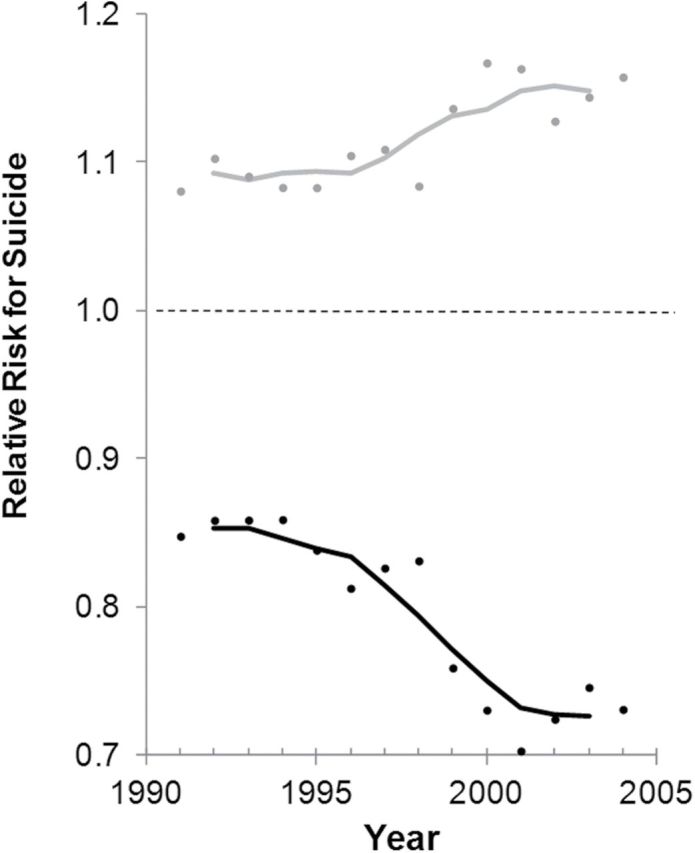
Introduction: Smokers exhibit elevated risk for suicide, but it is unknown whether smoking interventions reduce suicide risk. We examined whether state-level policy interventions-increases in cigarette excise taxes and strengthening of smoke-free air laws-corresponded to a reduction in suicide risk during the 1990s and the early 2000s. We also examined whether the magnitude of such reductions correlated with individuals' predicted probability of smoking, which would be expected if the associations stemmed from changes in smoking behavior.
Methods: We paired individual-level data on suicide deaths from the U.S. Multiple Cause of Death files, years 1990-2004, with living population data from the same period. These were linked with state data on cigarette excise taxes and smoke-free air policies. Utilizing a quasiexperimental analytical approach, we estimated the association between changes in policy and suicide risk. To examine whether associations correlated with individuals' probability of smoking, we used external survey data to derive a predicted probability of smoking function from demographic variables, which was then used to stratify the population by predicted smoking prevalence.
Results: Cigarette excise taxes, smoke-free air policies, and an index combining the two policies all exhibited protective associations with suicide. The associations were strongest in segments of the population where predicted smoking prevalence was the highest and weaker in segments of the population where predicted smoking prevalence was the lowest, suggesting that the protective associations were related to changes in smoking behavior.
Conclusion: These results provide support for the proposition that population interventions for smoking could reduce risk for suicide.
© The Author 2014. Published by Oxford University Press on behalf of the Society for Research on Nicotine and Tobacco. All rights reserved. For permissions, please e-mail: journals.permissions@oup.com.
Figures
References
-
- Angrist J. D., Pischke J.-S. (2008). Mostly harmless econometrics: An empiricist’s companion. Princeton, NL: Princeton University Press.
-
- Angst J., Clayton P. (1986). Premorbid personality of depressive, bipolar, and schizophrenic patients with special reference to suicidal issues. Comprehensive Psychiatry, 27, 511–532. 10.1016/0010-440X(86)90055-6 - PubMed
-
- Angst J., Clayton P. J. (1998). Personality, smoking and suicide: A prospective study. Journal of Affective Disorders, 51, 55–62. 10.1016/S0165-0327(98)00156-6 - PubMed
-
- Berry W. D., Ringquist E. J., Fording R. C., Hanson R. L. (1998). Measuring citizen and government ideology in the American states, 1960–93. American Journal of Political Science, 42, 327–348. 10.2307/2991759
-
- Bertrand M., Duflo E., Mullainathan S. (2004). How much should we trust differences-in-differences estimates? Quarterly Journal of Economics, 119, 249–275. 10.1162/003355304772839588
Publication types
MeSH terms
Grants and funding
LinkOut - more resources
Full Text Sources
Other Literature Sources
Medical
Molecular Biology Databases
