


Tree-based model for thyroid cancer prognostication
- PMID: 25033070
- PMCID: PMC4184064
- DOI: 10.1210/jc.2014-2197
Tree-based model for thyroid cancer prognostication
Abstract
Background: Death is uncommon in thyroid cancer patients, and the factors important in predicting survival remain inadequately studied. The objective of this study was to assess prognostic effects of patient, tumor, and treatment factors and to determine prognostic groups for thyroid cancer survival.
Methods: Using data from the Surveillance, Epidemiology, and End Results Program (SEER), we evaluated overall and disease-specific survival (DSS) in 43 392 well-differentiated thyroid cancer patients diagnosed from 1998 through 2005. Multivariable analyses were performed using Cox proportional hazards regression, survival trees, and random survival forest. Similar analyses were performed using National Cancer Data Base data, with overall survival (OS) evaluated in 131 484 thyroid cancer patients diagnosed from 1998 through 2005. Relative importance of factors important to survival was assessed based on the random survival forest analyses.
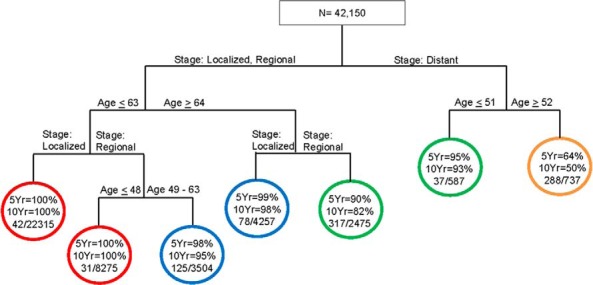
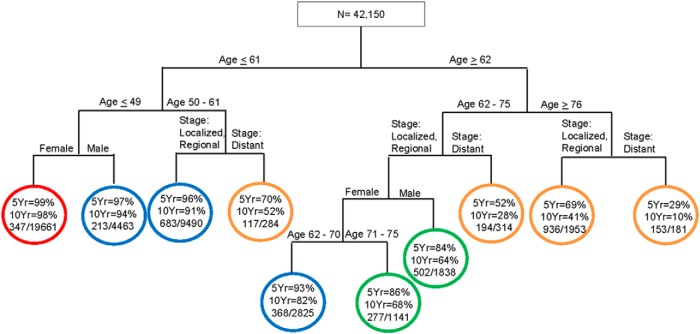
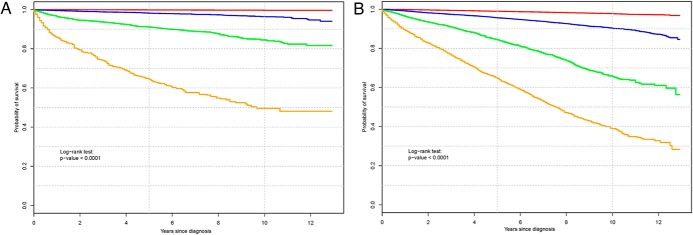
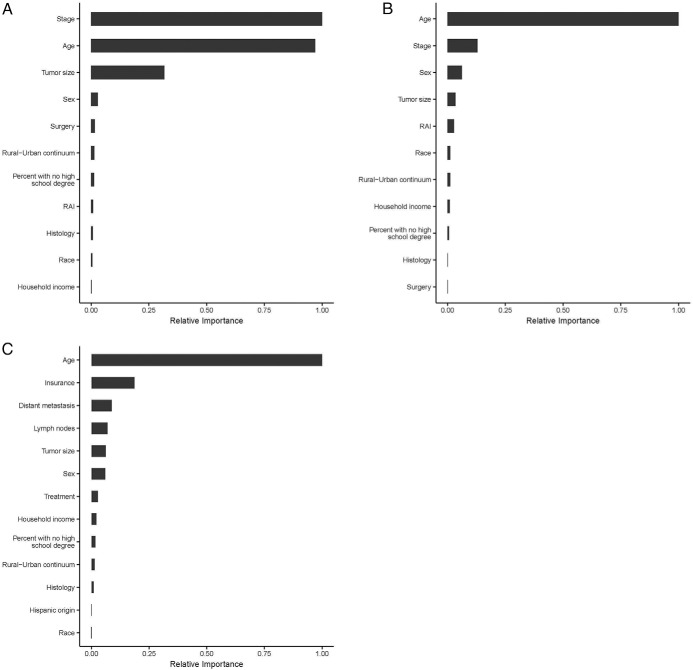
Results: Using survival tree analyses, we identified 4 distinct prognostic groups based on DSS (P < .0001). The 5-year DSS of these prognostic groups was 100%, 98%, 91%, 64%, whereas the 10-year survival was 100%, 96%, 85%, and 50%. Based on random survival forest analyses, the most important factors for DSS were SEER stage and age at diagnosis. For OS, important prognostic factors were similar, except age at diagnosis demonstrated marked importance relative to SEER stage. Similar results for OS were found using National Cancer Data Base data.
Conclusion: This study identifies distinct prognostic groups for thyroid cancer and illustrates the importance of patient age to both disease-specific and OS. These findings have implications for patient education and thyroid cancer treatment.
Figures
References
-
- Common cancer types. National Cancer Institute at the National Institutes of Health website. http://www.cancer.gov/cancertopics/types/commoncancers Accessed July 6, 2014
-
- The American Cancer Society. Available at: www.cancer.org Accessed July 2, 2014
-
- Hundahl SA, Fleming ID, Fremgen AM, Menck HR. A National Cancer Data Base report on 53,856 cases of thyroid carcinoma treated in the U.S., 1985–1995 [see comments]. Cancer. 1998;83(12):2638–2648 - PubMed
-
- Jung TS, Kim TY, Kim KW, et al. Clinical features and prognostic factors for survival in patients with poorly differentiated thyroid carcinoma and comparison to the patients with the aggressive variants of papillary thyroid carcinoma. Endocr J. 2007;54(2):265–274 - PubMed
-
- Jonklaas J, Sarlis NJ, Litofsky D, et al. Outcomes of patients with differentiated thyroid carcinoma following initial therapy. Thyroid. 2006;16(12):1229–1242 - PubMed
Publication types
MeSH terms
Supplementary concepts
Grants and funding
LinkOut - more resources
Full Text Sources
Other Literature Sources
Medical
