. 2014 Dec;8(8):1626-39.
doi: 10.1016/j.molonc.2014.06.013. Epub 2014 Jul 3.

The tumor promoting activity of the EP4 receptor for prostaglandin E2 in murine skin

Affiliations

The tumor promoting activity of the EP4 receptor for prostaglandin E2 in murine skin

Melissa S Simper et al. Mol Oncol. 2014 Dec.

Abstract

To determine whether the EP4 receptor for prostaglandin E2 (PGE2) contributes to the tumor promoting activity of PGs in murine skin, EP4 over-expressing mice (BK5.EP4) were generated and subjected carcinogenesis protocols. An initiation/promotion protocol resulted in 25-fold more squamous cell carcinomas (SCCs) in the BK5.EP4 mice than wild type (WT) mice. An increase in SCCs also occurred following treatment with initiator alone or UV irradiation. The initiator dimethylbenz[a]anthracene caused cytotoxicity in BK5.EP4, but not WT mice, characterized by sloughing of the interfollicular epidermis, regeneration and subsequent SCC development. A comparison of transcriptomes between BK5.EP4 and WT mice treated with PGE2 showed a significant upregulation of a number of genes known to be associated with tumor development, supporting a pro-tumorigenic role for the EP4 receptor.

Keywords: EP4 receptor; Murine skin; Prostaglandin E(2); Skin tumors; Tumor promotion.


Figures

Figure 1
Figure 1
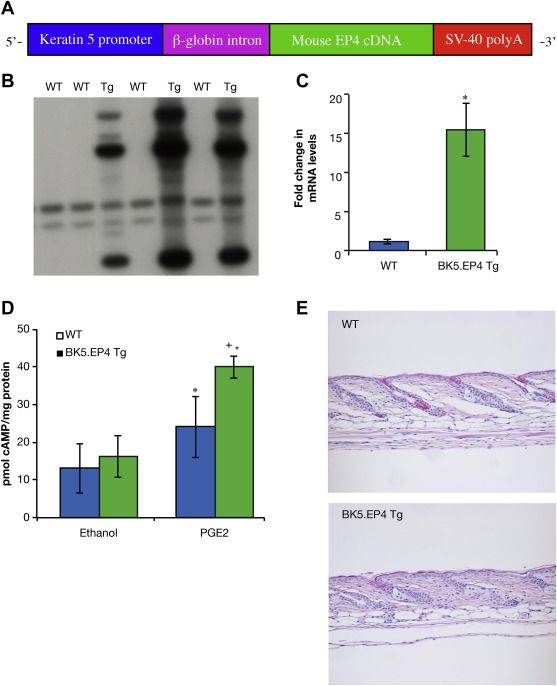
Expression of the EP4 transgene. A. Diagram of the bovine keratin 5 EP4 (BK5.EP4) construct. B. Southern blot showing integration of the BK5.EP4 construct. C. Increased EP4 mRNA levels in line 9 BK5.EP4 transgenic mice (n = 3; bars ± SD) (p < 0.01). D. Increased cAMP levels after vehicle or 30 μg PGE2 treatment (1 h) in vivo (n = 5 per group ± SD (WT PGE2 v. WT EtOH, p < 0.05; BK5.EP4 PGE2 v. WT PGE2, p < 0.005; BK5.EP4 PGE2 v. BK5.EP4 EtOH, p < 0.0001), assayed as described in Methods and Materials. E. Histology of representative H&E stained sections of skins from WT (top) and line 9 BK5.EP4 mice (bottom).
Figure 2
Figure 2
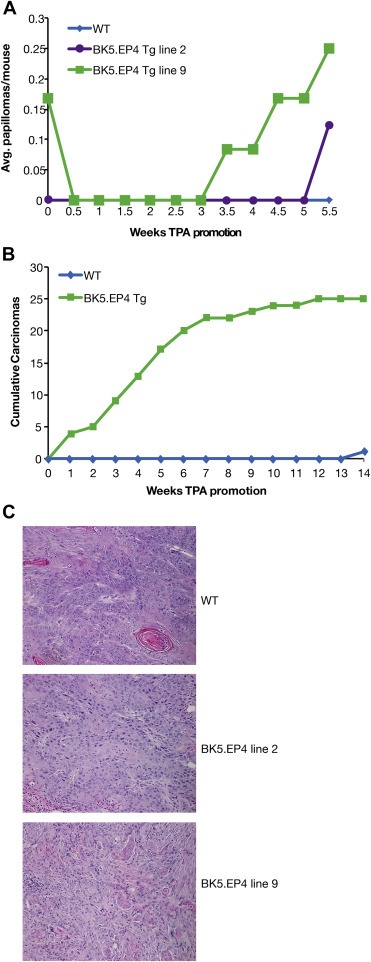
Enhanced tumor response in BK5.EP4 mice. A two‐stage DMBA/TPA protocol was carried out with WT and lines 2 and 9 of the BK5.EP4 mice. A. Papilloma multiplicity (average number of tumors per mouse; n = 13 WT, n = 8 line 2, n = 12 line 9 BK5.EP4 mice). B. Cumulative squamous cell carcinomas (SCCs) in line 9 BK5.EP4 (n = 28) and WT (n = 30) mice. C. Histology of H&E stained sections from SCCs from WT, line 2 and line 9 BK5.EP4 mice.
Figure 3
Figure 3
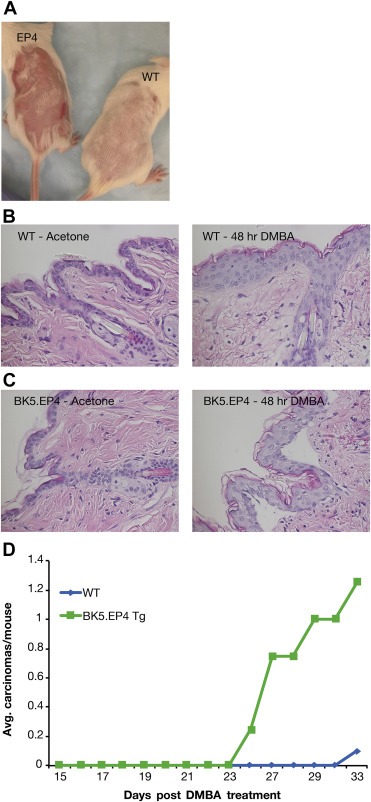
Response of WT and BK5.EP4 mice to a single treatment with 400 μg DMBA. A. Macroscopic appearance of dorsal area of treated WT and BK5.EP4 mice. B. Representative histology of H&E stained skin sections of WT (n = 3) mice 48 h after treatment with acetone or DMBA. C. Representative histology of H&E stained skin sections of BK5.EP4 (n = 3) mice 48 h after treatment with acetone or DMBA. D. Carcinoma multiplicity of WT (n = 11) and BK5.EP4 (n = 13) mice after a single treatment with DMBA.
Figure 4
Figure 4
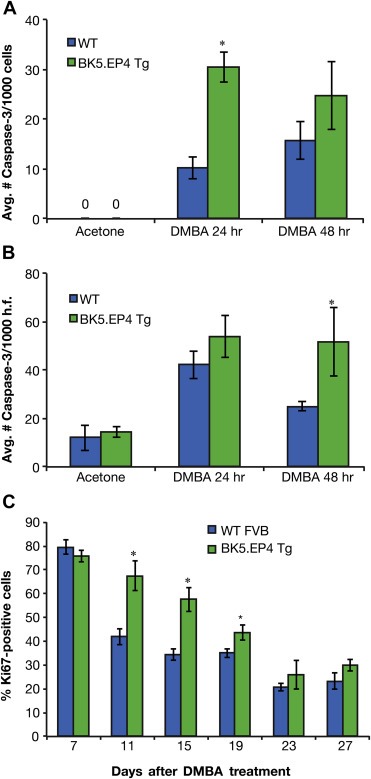
Proliferative, apoptotic and angiogenic response to DMBA treatment. A. Average number of caspase 3 positive cells/1000 cells in the interfollicular epidermis of WT and BK5.EP4 mice following acetone or DMBA (400 μg) treatment (n = 3 ± SD; DMBA 24 h BK5.EP4 v. WT, p < 0.01). B. Average number of caspase 3 positive cells/100 cells in hair follicles of acetone or DMBA treated WT and BK5.EP4 mice (n = 3 ± SD; DMBA 48 h BK5.EP4 v. WT, p < 0.02). C. Percentage of basal keratinocytes staining positive for Ki67, a marker of proliferation, in WT and BK5.EP4 mice following DMBA treatment (n = 3 ± SD; BK5.EP4 v. WT day 11, p < 0.005; BK5.EP4 v. WT day 15, p < 0.005; BK5.EP4 v. WT day 19, p < 0.02).
Figure 5
Figure 5
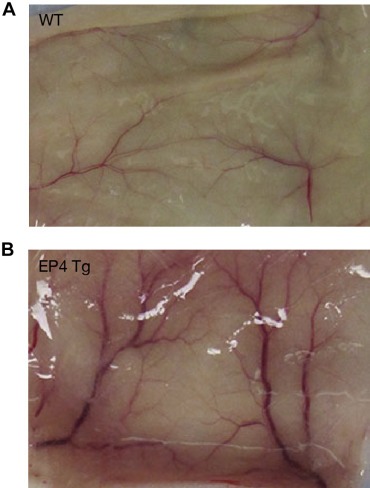
DMBA‐induced angiogenesis in BK5.EP4 mice. Macroscopic appearance of the backside of the skin of WT and BK5.EP4 mice 10 days after topical treatment with 400 μg DMBA. Photograph is representative of groups of 3 mice/genotype.
Figure 6
Figure 6
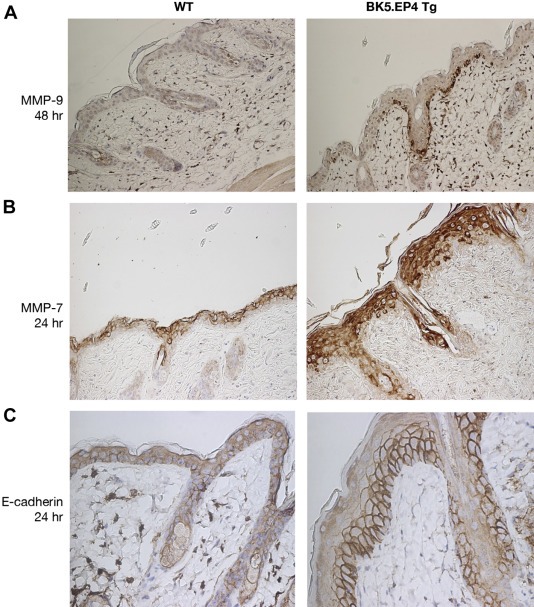
DMBA‐induced alterations in MMP‐9, MMP‐7 and E‐cadherin. WT and BK5.EP4 transgenic mice (n = 3 each) were treated with 400 μg DMBA, sacrificed after 24 and 48 h and after 5 days and processed for IHC (200× magnification). A. Representative skin sections stained with an antibody against MMP‐9 48 h after treatment. B. Representative skin sections stained with an antibody against MMP‐7 24 h after treatment. C. Representative skin section stained with an antibody against E‐cadherin 24 h after treatment.

References

    1. Abrahao, A.C. , Castilho, R.M. , Squarize, C.H. , Molinolo, A.A. , dos Santos-Pinto, D. , Gutkind, J.S. , 2010. A role for COX2-derived PGE2 and PGE2-receptor subtypes in head and neck squamous carcinoma cell proliferation. Oral Oncol. 46, 880–887. - PMC - PubMed
    1. Anders, S. , Huber, W. , 2010. Differential expression analysis for sequence count data. Genome Biol. 11, R106 - PMC - PubMed
    1. Aziz, M.H. , Wheeler, D.L. , Bhamb, B. , Verma, A.K. , 2006. Protein kinase C delta overexpressing transgenic mice are resistant to chemically but not to UV radiation-induced development of squamous cell carcinomas: a possible link to specific cytokines and cyclooxygenase-2. Cancer Res. 66, 713–722. - PubMed
    1. Baba, Y. , Nosho, K. , Shima, K. , Goessling, W. , Chan, A.T. , Ng, K. , Chan, J.A. , Giovannucci, E.L. , Fuchs, C.S. , Ogino, S. , 2010. PTGER2 overexpression in colorectal cancer is associated with microsatellite instability, independent of CpG island methylator phenotype. Cancer Epidemiol. Biomarkers Prev. 19, 822–831. - PMC - PubMed
    1. Brouxhon, S. , Konger, R.L. , VanBuskirk, J. , Sheu, T.J. , Ryan, J. , Erdle, B. , Almudevar, A. , Breyer, R.M. , Scott, G. , Pentland, A.P. , 2007. Deletion of prostaglandin E2 EP2 receptor protects against ultraviolet-induced carcinogenesis, but increases tumor aggressiveness. J. Invest. Dermatol. 127, 439–446. - PubMed

Publication types

MeSH terms