


Second primary lung cancers: smokers versus nonsmokers after resection of stage I lung adenocarcinoma
- PMID: 25038021
- PMCID: PMC4410355
- DOI: 10.1016/j.athoracsur.2014.04.098
Second primary lung cancers: smokers versus nonsmokers after resection of stage I lung adenocarcinoma
Abstract
Background: Smokers have a higher risk of developing non-small cell lung cancer (NSCLC) than never-smokers, but the relative risk of developing second primary lung cancer (SPLC) is unclear. Determining the risk of SPLC in smokers versus never-smokers after treatment of an initial cancer may help guide recommendations for long-term surveillance.
Methods: Patients who underwent resection for stage I adenocarcinoma were identified from a prospectively maintained institutional database. Patients with other histologies, synchronous lesions, or who received neoadjuvant or adjuvant therapy were excluded. The SPLCs were identified based on Martini criteria.
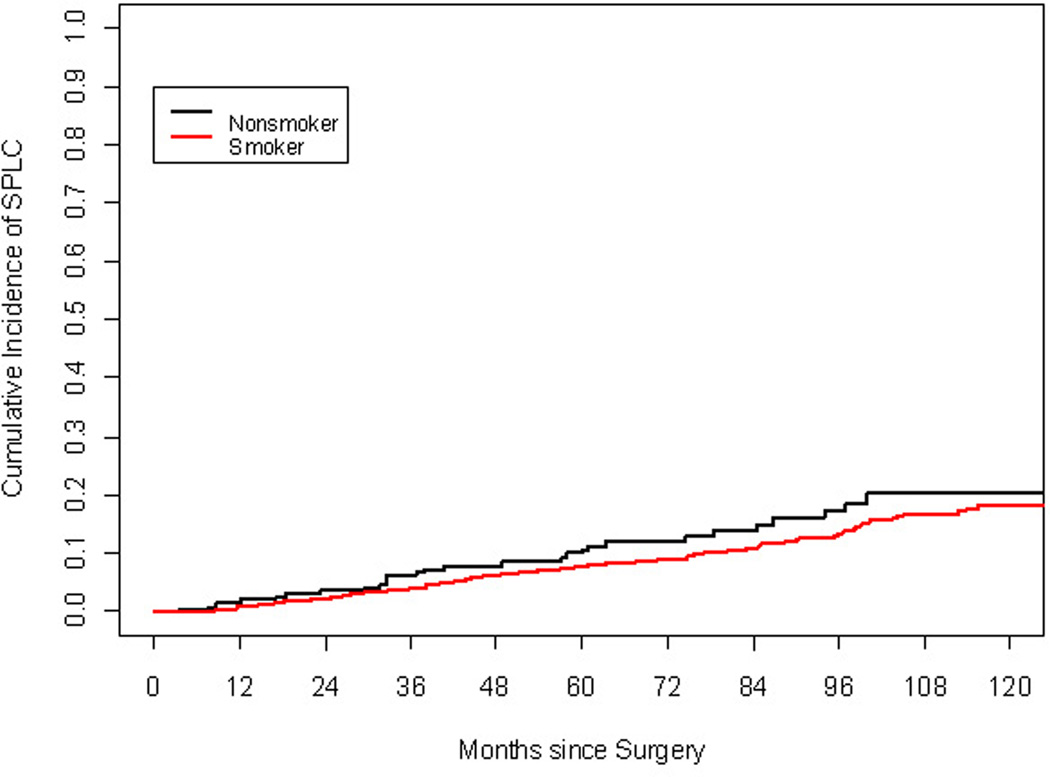
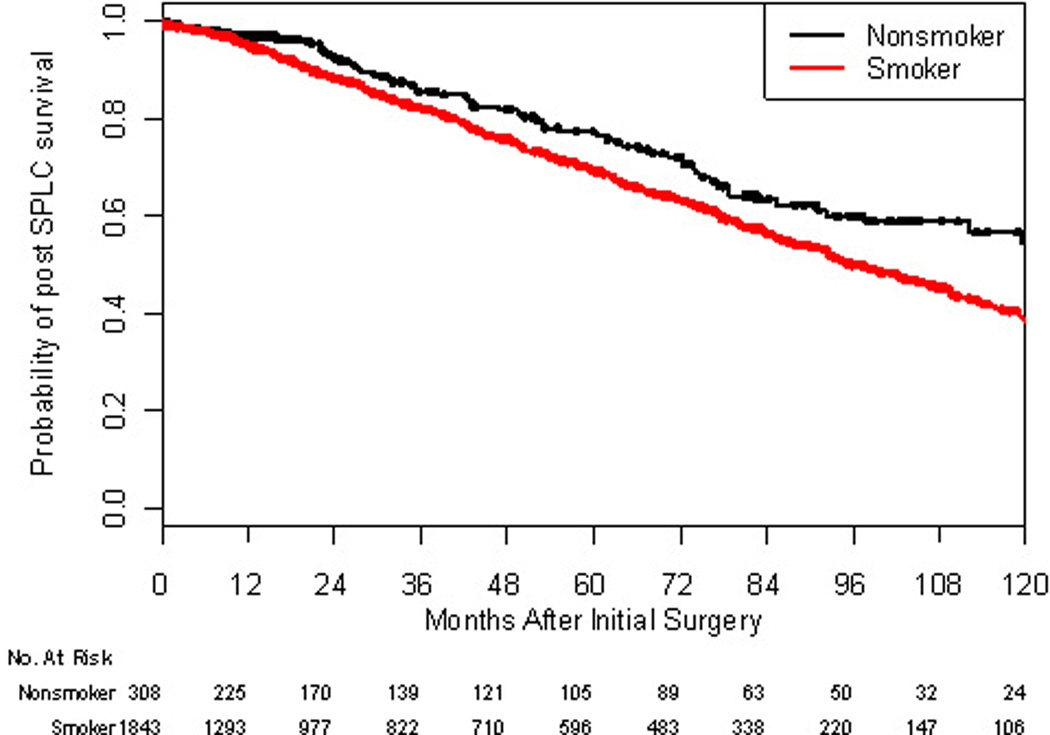
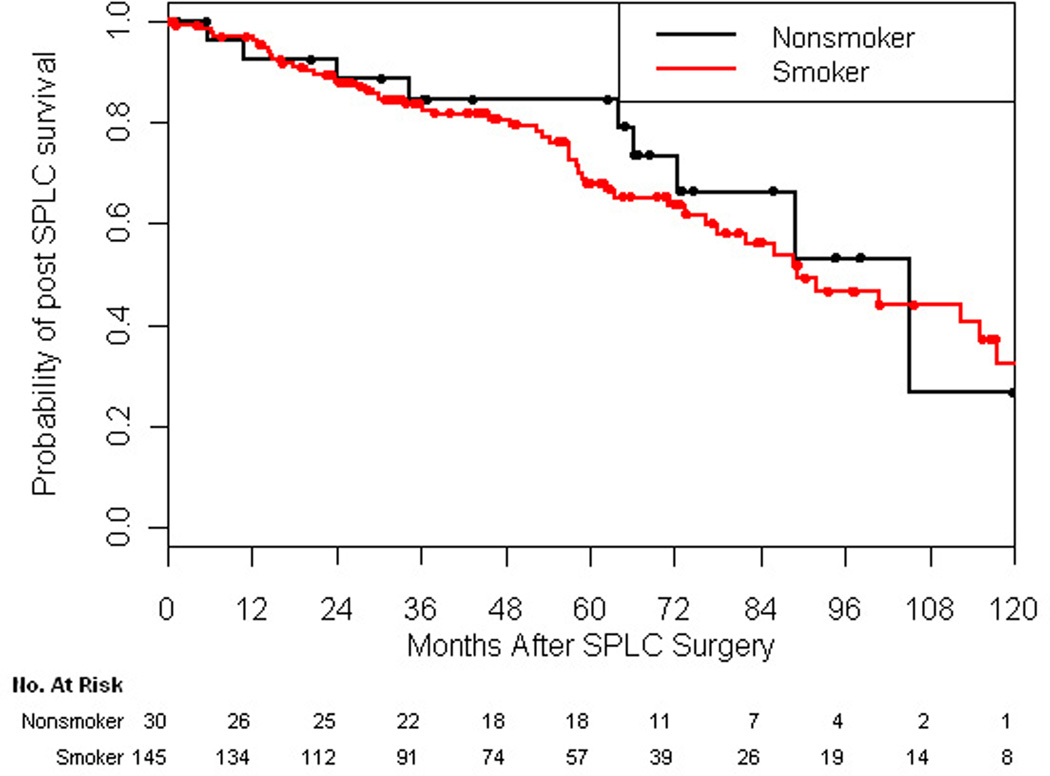
Results: From 1995 to 2012, a total of 2,151 patients underwent resection for stage I adenocarcinoma (308 never-smokers [14%] and 1,843 ever-smokers [86%]). SPLC developed in 30 never-smokers (9.9%) and 145 ever-smokers (7.8%). The SPLC was detected by surveillance computed tomography scan in the majority of patients (161; 92%). In total, 87% of never-smokers and 83% of ever-smokers had stage I SPLC. There was no significant difference in the cumulative incidence of SPLC between never-smokers and ever-smokers (p = 0.18) in a competing-risks analysis. The cumulative incidence at 10 years was 20.3% for never-smokers and 18.2% for ever-smokers.
Conclusions: Although smokers have a greater risk of NSCLC, the risk of a second primary cancer developing after resection of stage I lung cancer is comparable between smokers and never-smokers. The majority of these second primary cancers are detectable at a curable stage. Ongoing postoperative surveillance should be recommended for all patients regardless of smoking status.
Copyright © 2014 The Society of Thoracic Surgeons. Published by Elsevier Inc. All rights reserved.
Figures
References
-
- Siegel R, DeSantis C, Virgo K, et al. Cancer treatment and survivorship statistics, 2012. CA Cancer J Clin. 2012;62:220–241. - PubMed
-
- Mountzios G, Fouret P, Soria JC. Mechanisms of disease: signal transduction in lung carcinogenesis―a comparison of smokers and never-smokers. Nat Clin Pract Oncol. 2008;5:610–618. - PubMed
Publication types
MeSH terms
Grants and funding
LinkOut - more resources
Full Text Sources
Other Literature Sources
Medical
