A glimpse of matrix metalloproteinases in diabetic nephropathy
- PMID: 25039784
- PMCID: PMC4281028
- DOI: 10.2174/0929867321666140716092052
A glimpse of matrix metalloproteinases in diabetic nephropathy
Abstract
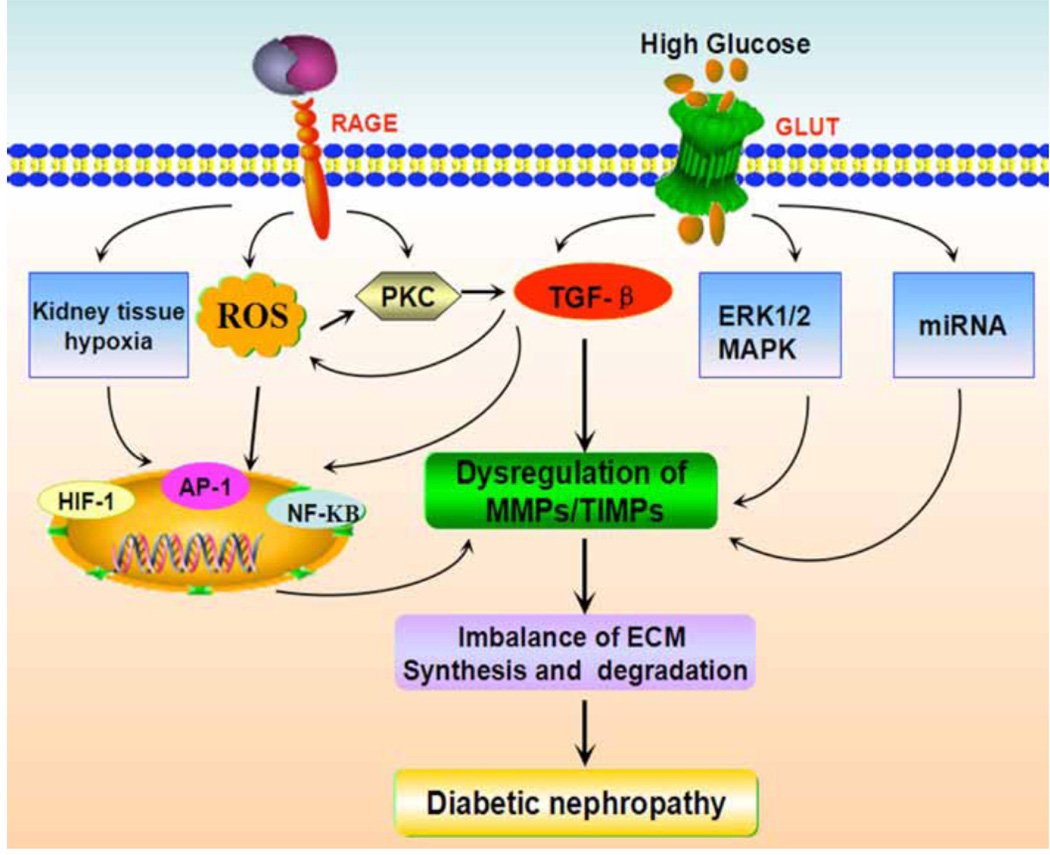
Matrix metalloproteinases (MMPs) are proteolytic enzymes belonging to the family of zinc-dependent endopeptidases that are capable of degrading almost all the proteinaceous components of the extracellular matrix (ECM). It is known that MMPs play a role in a number of renal diseases, such as, various forms of glomerulonephritis and tubular diseases, including some of the inherited kidney diseases. In this regard, ECM accumulation is considered to be a hallmark morphologic finding of diabetic nephropathy, which not only is related to the excessive synthesis of matrix proteins, but also to their decreased degradation by the MMPs. In recent years, increasing evidence suggest that there is a good correlation between the activity or expression of MMPs and progression of renal disease in patients with diabetic nephropathy and in various experimental animal models. In such a diabetic milieu, the expression of MMPs is modulated by high glucose, advanced glycation end products (AGEs), TGF-β, reactive oxygen species (ROS), transcription factors and some of the microRNAs. In this review, we focused on the structure and functions of MMPs, and their role in the pathogenesis of diabetic nephropathy.
Conflict of interest statement
The author(s) confirm that this article content has no conflicts of interest.
Figures
References
-
- Rychlik I, Miltenberger-Miltenyi G, Ritz E. The drama of the continuous increase in end-stage renal failure in patients with type II diabetes mellitus. Nephrol. Dial. Transplant. 1998;13(Suppl 8):6–10. - PubMed
-
- Marcelli D, Spotti D, Conte F, Limido A, Lonati F, Malberti F, Locatelli F. Prognosis of diabetic patients on dialysis: analysis of Lombardy Registry data. Nephrol. Dial. Transplant. 1995;10(10):1895–1900. - PubMed
-
- Bruno G, Merletti F, Biggeri A, Bargero G, Ferrero S, Pagano G, Cavallo Perin P, Casale Monferrato S. Progression to overt nephropathy in type 2 diabetes: the Casale Monferrato Study. Diabetes Care. 2003;26(7):2150–2155. - PubMed
-
- Fagot-Campagna A, Nelson RG, Knowler WC, Pettitt DJ, Robbins DC, Go O, Welty TK, Lee ET, Howard BV. Plasma lipoproteins and the incidence of abnormal excretion of albumin in diabetic American Indians: the Strong Heart Study. Diabetologia. 1998;41(9):1002–1009. - PubMed
Publication types
MeSH terms
Substances
Grants and funding
LinkOut - more resources
Full Text Sources
Other Literature Sources
Medical