Observational Study
. 2014 Dec;15(12):2105-19.
doi: 10.1111/pme.12502. Epub 2014 Jul 8.

Burden of illness associated with peripheral and central neuropathic pain among adults seeking treatment in the United States: a patient-centered evaluation

Affiliations
Observational Study

Burden of illness associated with peripheral and central neuropathic pain among adults seeking treatment in the United States: a patient-centered evaluation

Caroline Schaefer et al. Pain Med. 2014 Dec.

Abstract

Objective: The aim of this study was to evaluate patient-reported burden associated with peripheral and central neuropathic pain (NeP) by pain severity and NeP condition.

Design: Six hundred twenty-four subjects with one of six NeP conditions were recruited during routine office visits. Subjects consented to retrospective chart review and completed a one-time questionnaire (including EuroQol-5 dimensions, 12-item Short-Form Health Survey, Brief Pain Inventory-Short Form, Medical Outcomes Study Sleep Scale, Hospital Anxiety and Depression Scale, and demographic and clinical characteristics). Pain severity scores were used to stratify subjects by mild, moderate, and severe pain. Summary statistics and frequency distributions were calculated. Differences by severity level were compared using Kruskal-Wallis (continuous variables) and chi-square or Fisher's exact test (categorical variables). Effect size was computed with Cohen's d (mild vs severe).

Results: Subjects' mean age was 55.5. The majority (80.8%) had moderate or severe pain. Patient-reported outcomes (health status, physical and mental health, pain interference with function, sleep, anxiety, and depression) were significantly worse among subjects with greater pain severity (all P < 0.0001). Severe pain subjects were negatively impacted by ≥30% in each outcome compared with mild pain subjects; standardized effect size was moderate for anxiety (0.59) and large (>0.95) for all others. The observed burden was most substantial among chronic low back pain-NeP, although the pattern of disease burden was similar across the six NeP conditions.

Conclusions: Subjects across NeP conditions exhibited high pain levels, which were significantly associated with poor function, compromised health status and sleep, and increased anxiety and depression. Results indicate substantial patient burden across broad NeP, particularly among subjects with severe pain.

Keywords: Burden of Illness; Health Status; Health-Related Quality of Life; Neuropathic Pain; Pain Assessment; Patient-Reported Outcomes.


Figures

Figure 1
Figure 1
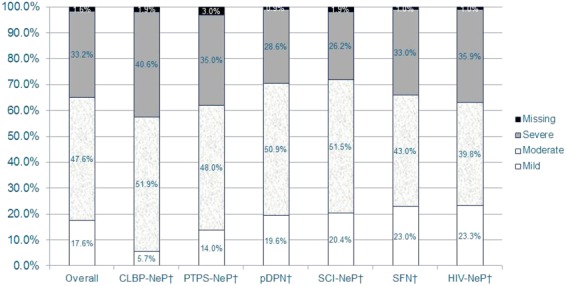
The majority of NeP subjects reported moderate or severe pain, regardless of NeP condition*.*Scores on the BPI-SF Pain Severity Index were used to classify average pain severity. Ten subjects did not respond to all required items needed to calculate a BPI-SF average pain severity score and thus were not included in any analysis by pain severity category (“missing”).Pain severity levels for the individual NeP conditions have been previously published [15,20,37,38] or are being submitted for publication.BPI-SF = Brief Pain Inventory-Short Form; CLBP-NeP = chronic low back pain with a neuropathic pain component; HIV-NeP = human immunodeficiency virus-related peripheral neuropathic pain; NeP = neuropathic pain; pDPN = painful diabetic peripheral neuropathy; PTPS-NeP = post-trauma/post-surgery neuropathic pain; SCI-NeP = spinal cord injury-related neuropathic pain; SFN = painful peripheral neuropathy with small fiber involvement. [Color figure can be viewed in the online issue, which is available at http://wileyonlinelibrary.com.]
Figure 2
Figure 2
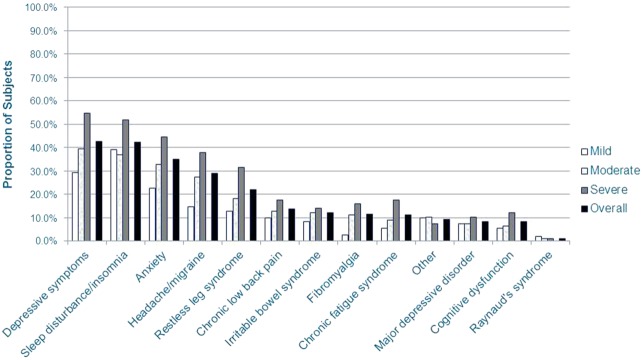
NeP subjects reported a variety of comorbid conditions*.*Scores on the BPI-SF Pain Severity Index were used to classify average pain severity. Ten subjects did not respond to all required items needed to calculate a BPI-SF average pain severity score and thus were not included in any analysis by pain severity category. A significant difference was observed across pain severity levels for depressive symptoms (P < 0.0001), sleep disturbance/insomnia (P = 0.0037), anxiety (P = 0.0003), headache/migraine (P < 0.0001), cognitive dysfunction (P = 0.0491), restless leg syndrome (P = 0.0001), chronic fatigue syndrome (P = 0.0019), and fibromyalgia (P = 0.0008).BPI-SF = Brief Pain Inventory-Short Form; NeP = neuropathic pain. [Color figure can be viewed in the online issue, which is available at http://wileyonlinelibrary.com.]
Figure 3
Figure 3
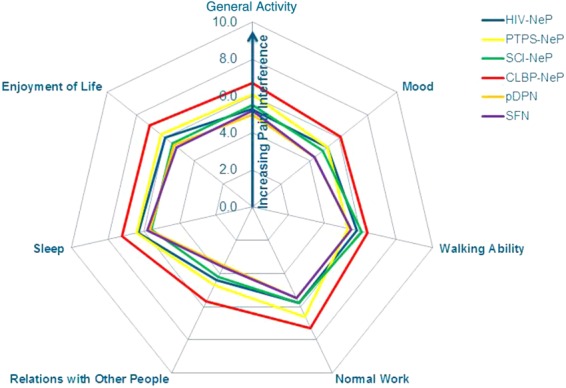
Pain interference with function trends is consistent across NeP conditions**Significant differences were observed across NeP conditions for all items (all P < 0.0010), except walking ability (P = 0.1612) and the Pain Interference Index (all P < 0.0010).CLBP-NeP = chronic low back pain with a neuropathic pain component; HIV-NeP = human immunodeficiency virus-related peripheral neuropathic pain; NeP = neuropathic pain; pDPN = painful diabetic peripheral neuropathy; PTPS-NeP = post-trauma/post-surgery neuropathic pain; SCI-NeP = spinal cord injury-related neuropathic pain; SFN = painful peripheral neuropathy with small fiber involvement. [Color figure can be viewed in the online issue, which is available at http://wileyonlinelibrary.com.]
Figure 4
Figure 4
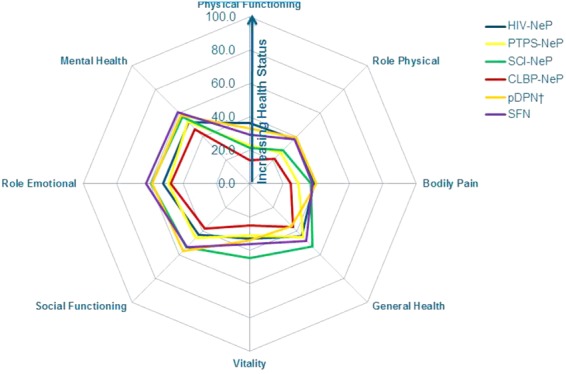
Trends across domains of physical and mental health are consistent across NeP conditions*.*Significant differences were observed across NeP conditions for all domains (all P < 0.003).Mean summary scores for pDPN have been previously published [15].CLBP-NeP = chronic low back pain with a neuropathic pain component; HIV-NeP = human immunodeficiency virus-related peripheral neuropathic pain; NeP = neuropathic pain; pDPN = painful diabetic peripheral neuropathy; PTPS-NeP = post-trauma/post-surgery neuropathic pain; SCI-NeP = spinal cord injury-related neuropathic pain; SFN = painful peripheral neuropathy with small fiber involvement. [Color figure can be viewed in the online issue, which is available at http://wileyonlinelibrary.com.]
Figure 5
Figure 5
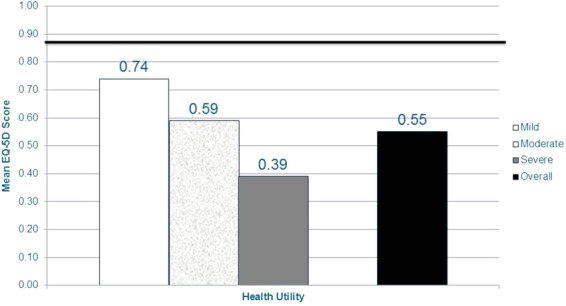
NeP subjects with more severe pain have worse general health status*.*Scores on the BPI-SF Pain Severity Index were used to classify average pain severity. Ten subjects did not respond to all required items needed to calculate a BPI-SF average pain severity score and thus were not included in any analysis by pain severity category. EQ-5D health state utility scored on a −0.11 to 1.00 scale; population norm (0.87 [39]) is indicated by the dark horizontal bar. A significant difference was observed across pain severity levels for EQ-5D health state utility (P < 0.0001). A large standardized effect size (Cohen's d) was observed for the EQ-5D health state utility when comparing mild and severe subjects: 2.03.BPI-SF = Brief Pain Inventory-Short Form; EQ-5D = EuroQol 5-dimensions; NeP = neuropathic pain. [Color figure can be viewed in the online issue, which is available at http://wileyonlinelibrary.com.]
Figure 6
Figure 6
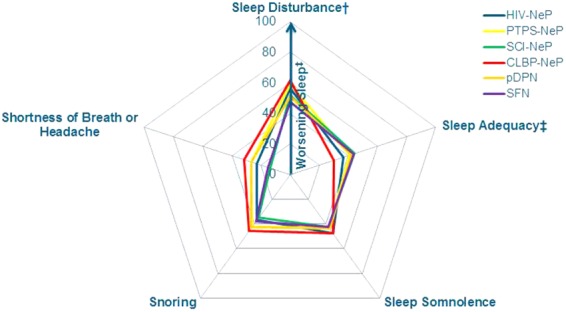
Trends across domains of sleep are consistent across NeP conditions*.*Significant differences were observed across NeP conditions for sleep disturbance, sleep adequacy, shortness of breath or headache domains (all P < 0.03).Mean sleep disturbance for PTPS-NeP has been previously published [20].The sleep adequacy item differs from all others in that higher scores indicate better outcomes on this item.CLBP-NeP = chronic low back pain with a neuropathic pain component; HIV-NeP = human immunodeficiency virus-related peripheral neuropathic pain; NeP = neuropathic pain; pDPN = painful diabetic peripheral neuropathy; PTPS-NeP = post-trauma/post-surgery neuropathic pain; SCI-NeP = spinal cord injury-related neuropathic pain; SFN = painful peripheral neuropathy with small fiber involvement. [Color figure can be viewed in the online issue, which is available at http://wileyonlinelibrary.com.]
Figure 7
Figure 7
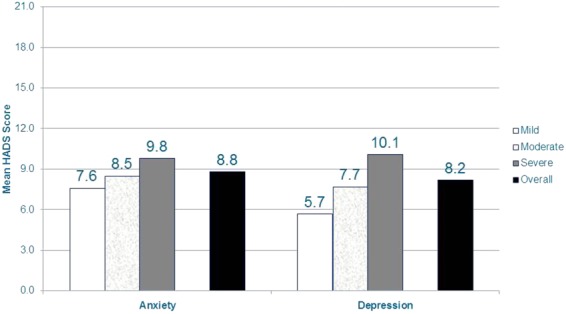
NeP subjects with more severe pain have more anxiety and depression*.*Scores on the BPI-SF Pain Severity were used to classify average pain severity. Ten subjects did not respond to all required items needed to calculate a BPI-SF average pain severity score and thus were not included in any analysis by pain severity category. HADS anxiety and depression scales scored on a 0–21 scale, where 0–7 is normal, 8–10 is mild, 11–14 is moderate, and 15–21 is severe. Significant differences were observed across pain severity levels for the anxiety and depression scales (both P < 0.0001). A medium standardized effect size (Cohen's d) was observed for the anxiety scale when comparing mild and severe subjects: 0.59. A large standardized effect size (Cohen's d) was observed for the depression scale when comparing mild and severe subjects: 1.02.BPI-SF = Brief Pain Inventory-Short Form; HADS = Hospital Anxiety and Depression Scale; NeP = neuropathic pain. [Color figure can be viewed in the online issue, which is available at http://wileyonlinelibrary.com.]

References

    1. Treede RD, Jensen TS, Campbell JN, et al. Neuropathic pain: Redefinition and a grading system for clinical and research purposes. Neurology. 2008;70(18):1630–1635. - PubMed
    1. IASP. Diagnosis and classification of neuropathic pain. Pain: Clinical Updates. 2010;18(7):1–6.
    1. NINDS. 2014. Peripheral Neuropathy Fact Sheet. Available at: http://www.ninds.nih.gov/disorders/peripheralneuropathy/detail_periphera... (accessed November 2012)
    1. Yawn BP, Wollan PC, Weingarten TN, et al. The prevalence of neuropathic pain: Clinical evaluation compared with screening tools in a community population. Pain Med. 2009;10(3):586–593. - PMC - PubMed
    1. Taylor RS. Epidemiology of refractory neuropathic pain. Pain Pract. 2006;6(1):22–26. - PubMed

Publication types