


The replicometer is broken: telomeres activate cellular senescence in response to genotoxic stresses
- PMID: 25040628
- PMCID: PMC4331758
- DOI: 10.1111/acel.12246
The replicometer is broken: telomeres activate cellular senescence in response to genotoxic stresses
Abstract
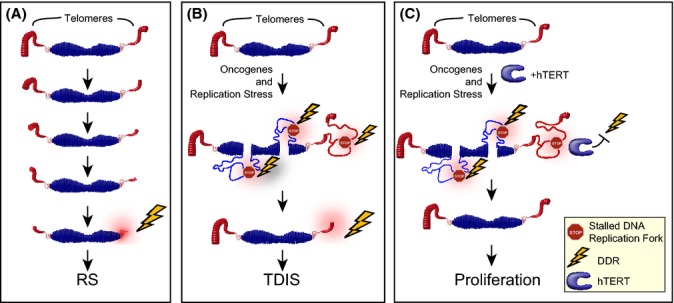
Telomeres, the ends of our linear chromosomes, can function as 'replicometers', capable of counting cell division cycles as they progressively erode with every round of DNA replication. Once they are critically short, telomeres become dysfunctional and consequently activate a proliferative arrest called replicative senescence. For many years, telomeres were thought to be autonomous structures, largely isolated from cell intrinsic and extrinsic signals, whose function is to prevent limitless cellular proliferation, a characteristic of most cancer cells. It is becoming increasingly evident, however, that telomeres not only count cell divisions, but also function as sensors of genotoxic stresses to stop cell cycle progression prematurely and long before cells would have entered replicative senescence. This stable growth arrest, triggered by dysfunctional telomeres that are not necessarily critically short, likely evolved as a tumor-suppressing mechanism as it prevents proliferation of cells that are at risk for acquiring potentially hazardous and transforming mutations both in vitro and in vivo. Here, we review studies supporting the concept that telomeres are important cellular structures whose function not only is to count cell divisions, but also to act as molecular switches that can rapidly stop cell cycle progression permanently in response to a variety of stresses, including oncogenic signals.
Keywords: DNA damage; aging; cellular senescence; hTERT; p53; telomerase; telomere; tumor suppression.
© 2014 The Authors. Aging Cell published by the Anatomical Society and John Wiley & Sons Ltd.
Figures
References
-
- Bartkova J, Rezaei N, Liontos M, Karakaidos P, Kletsas D, Issaeva N, Vassiliou LV, Kolettas E, Niforou K, Zoumpourlis VC, Takaoka M, Nakagawa H, Tort F, Fugger K, Johansson F, Sehested M, Andersen CL, Dyrskjot L, Orntoft T, Lukas J, Kittas C, Helleday T, Halazonetis TD, Bartek J, Gorgoulis VG. Oncogene-induced senescence is part of the tumorigenesis barrier imposed by DNA damage checkpoints. Nature. 2006;444:633–637. - PubMed
Publication types
MeSH terms
Substances
Grants and funding
LinkOut - more resources
Full Text Sources
Other Literature Sources
Research Materials
Miscellaneous
