


Mitotic Index is an Independent Predictor of Recurrence-Free Survival in Meningioma
- PMID: 25040885
- PMCID: PMC4297750
- DOI: 10.1111/bpa.12174
Mitotic Index is an Independent Predictor of Recurrence-Free Survival in Meningioma
Abstract
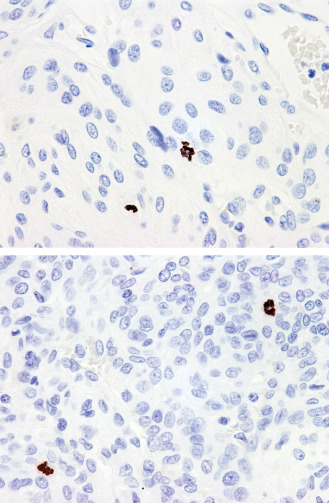
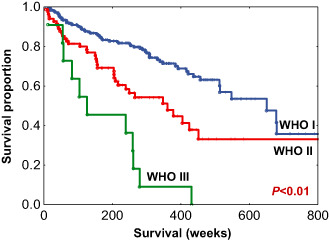
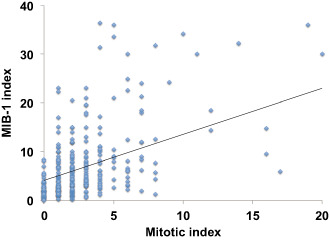
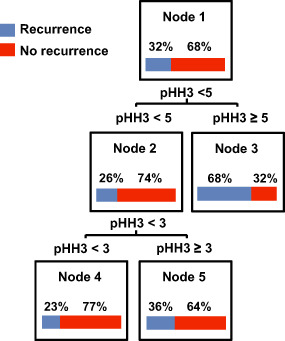
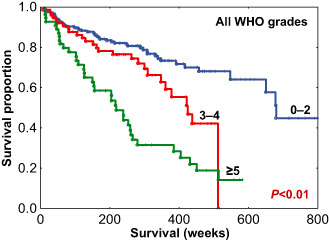
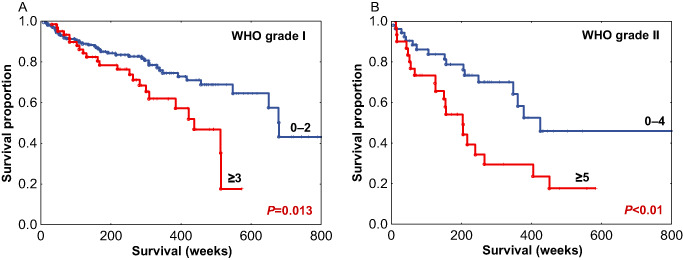
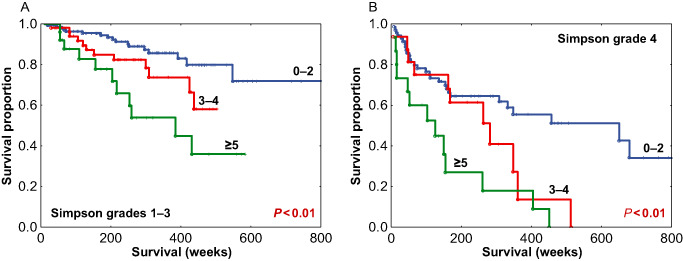
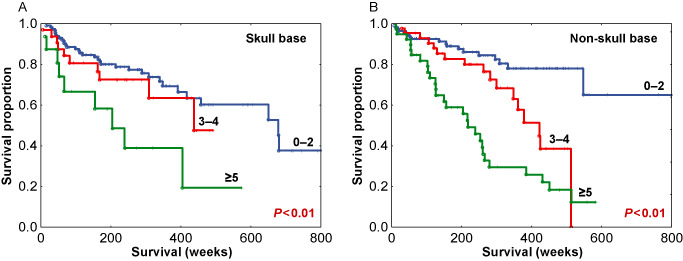
While World Health Organization (WHO) grading of meningioma stratifies patients according to recurrence risk overall, there is substantial within-grade heterogeneity with respect to recurrence-free survival (RFS). Most meningiomas are graded according to mitotic counts per unit area on hematoxylin and eosin sections, a method potentially confounded by tumor cellularity, as well as potential limitations of accurate mitotic figure detection on routine histology. To refine mitotic figure assessment, we evaluated 363 meningiomas with phospho-histone H3 (Ser10) and determined the mitotic index (number of mitoses per 1000 tumor cells). The median mitotic indices among WHO grade I (n = 268), grade II (n = 84) and grade III (n = 11) tumors were 1, 4 and 12. Classification and regression tree analysis to categorize cut-offs identified three subgroups defined by mitotic indices of 0-2, 3-4 and ≥5, which on univariate analysis were associated with RFS (P < 0.01). In multivariate analysis, mitotic index subgrouped in this manner was significantly associated with RFS (P < 0.01) after adjustment for Simpson grade, WHO grade and MIB-1 index. Mitotic index was then examined within individual WHO grade, showing that for grade I and grade II meningiomas, mitotic index can add additional information to RFS risk. The results suggest that the use of a robust mitotic marker in meningioma could refine risk stratification.
Keywords: meningioma; mitotic index; pHH3; recurrence-free survival.
© 2014 International Society of Neuropathology.
Figures
References
-
- Abry E, Thomassen IO, Salvesen OO, Torp SH (2010) The significance of Ki‐67/MIB‐1 labeling index in human meningiomas: a literature study. Pathol Res Pract 206:810–815. - PubMed
-
- Adlakha RC, Rao PN (1986) Molecular mechanisms of the chromosome condensation and decondensation cycle in mammalian cells. Bioessays 5:100–105. - PubMed
-
- Aghi MK, Carter BS, Cosgrove GR, Ojemann RG, Amin‐Hanjani S, Martuza RL et al (2009) Long‐term recurrence rates of atypical meningiomas after gross total resection with or without postoperative adjuvant radiation. Neurosurgery 64:56–60. - PubMed
-
- Amatya VJ, Takeshima Y, Sugiyama K, Kurisu K, Nishisaka T, Fukuhara T, Inai K (2001) Immunohistochemical study of Ki‐67 (MIB‐1), p53 protein, p21WAF1, and p27KIP1 expression in benign, atypical, and anaplastic meningiomas. Hum Pathol 32:970–975. - PubMed
Publication types
MeSH terms
Substances
Grants and funding
LinkOut - more resources
Full Text Sources
Other Literature Sources
