The burden of premature opioid-related mortality
- PMID: 25041316
- PMCID: PMC4171750
- DOI: 10.1111/add.12598
The burden of premature opioid-related mortality
Abstract
Background and aims: The burden of premature mortality due to opioid-related death has not been fully characterized. We calculated temporal trends in the proportion of deaths attributable to opioids and estimated years of potential life lost (YLL) due to opioid-related mortality in Ontario, Canada.
Design: Cross-sectional study.
Setting: Ontario, Canada.
Participants: Individuals who died of opioid-related causes between January 1991 and December 2010.
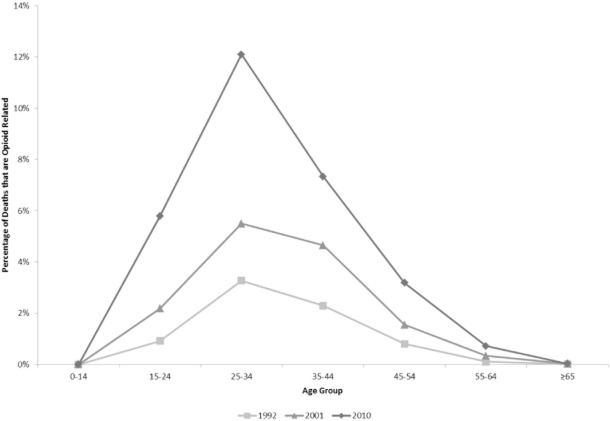
Measurements: We used the Registered Persons Database and data abstracted from the Office of the Chief Coroner to measure annual rates of opioid-related mortality. The proportion of all deaths related to opioids was determined by age group in each of 1992, 2001 and 2010. The YLL due to opioid-related mortality were estimated, applying the life expectancy estimates for the Ontario population.
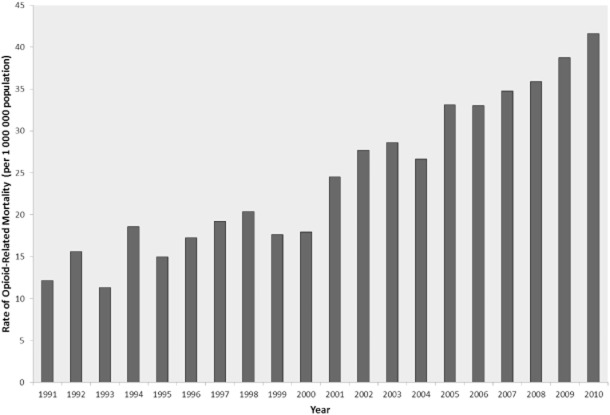
Findings: We reviewed 5935 opioid-related deaths in Ontario between 1991 and 2010. The overall rate of opioid-related mortality increased by 242% between 1991 (12.2 per 1 000 000 Ontarians) and 2010 (41.6 per 1 000 000 Ontarians; P < 0.0001). Similarly, the annual YLL due to premature opioid-related death increased threefold, from 7006 years (1.3 years per 1000 population) in 1992 to 21 927 years (3.3 years per 1000 population) in 2010. The proportion of deaths attributable to opioids increased significantly over time within each age group (P < 0.05). By 2010, nearly one of every eight deaths (12.1%) among individuals aged 25-34 years was opioid-related.
Conclusions: Rates of opioid-related deaths are increasing rapidly in Ontario, Canada, and are concentrated among the young, leading to a substantial burden of disease.
Keywords: Burden of disease; drug toxicity; mortality; observational epidemiology; opioid analgesics; pharmacoepidemiology.
© 2014 The Authors. Addiction published by John Wiley & Sons Ltd on behalf of Society for the Study of Addiction.
Figures
References
-
- Christo PJ, Grabow TS, Raja SN. Opioid effectiveness, addiction, and depression in chronic pain. Adv Psychosom Med. 2004;25:123–137. - PubMed
-
- Sehgal N, Colson J, Smith HS. Chronic pain treatment with opioid analgesics: benefits versus harms of long-term therapy. Expert Rev Neurother. 2013;13:1201–1220. - PubMed
-
- Gomes T, Mamdani MM, Dhalla IA, Paterson JM, Juurlink DN. Opioid dose and drug-related mortality in patients with nonmalignant pain. Arch Intern Med. 2011;171:686–691. - PubMed
MeSH terms
LinkOut - more resources
Full Text Sources
Other Literature Sources
Medical