. 2014 Nov;60(5):1708-16.
doi: 10.1002/hep.27313. Epub 2014 Sep 29.

Ongoing activation of autoantigen-specific B cells in primary biliary cirrhosis

Affiliations

Ongoing activation of autoantigen-specific B cells in primary biliary cirrhosis

Jun Zhang et al. Hepatology. 2014 Nov.

Abstract

The serologic hallmark of primary biliary cirrhosis (PBC), the antimitochondrial response to the E2 component of the pyruvate dehydrogenase complex (PDC-E2), has unique features, including continuous high titers of immunoglobulin M (IgM) and IgG reactivity throughout all stages of disease, capable not only of target enzyme inhibition, but also crossreactive with chemical xenobiotics that share molecular homology with the inner lipoyl domain of PDC-E2; such chemicals have been proposed as potential etiological agents. We used flow cytometry and enzyme-linked immunospot assay (ELISPOT) to examine B-cell subsets in 59 subjects, including 28 with PBC, 13 with primary sclerosing cholangitis (PSC), and 18 healthy controls. Strikingly, in PBC, although there were no significant differences in B-cell phenotype subpopulations, 10% of the total IgG and IgA plasmablast population and 23% of the IgM plasmablast population were uniquely reactive with PDC-E2, detected in the CXCR7+ CCR10low plasmablast population. In contrast, plasmablast reactivity to a control antigen, tetanus toxoid, was minimal and similar in all groups. Additionally, we isolated plasmablast-derived polyclonal antibodies and compared reactivity with plasma-derived antibodies and noted a distinct noncirculating tissue source of xenobiotic crossreacting antibodies. The high levels of autoantigen specific peripheral plasmablasts indicate recent activation of naive or memory B cells and a continuous and robust activation. The presence of CXCR7+ CCR10low PDC-E2-specific ASCs suggests a mechanistic basis for the migration of circulating antigen specific plasmablasts to the mucosal epithelial ligands CXCL12 and CCL28.

Conclusion: Our findings suggest a sustained rigorous B-cell response in PBC, likely activated and perpetuated by cognate autoantigen.


Figures

Figure 1
Figure 1
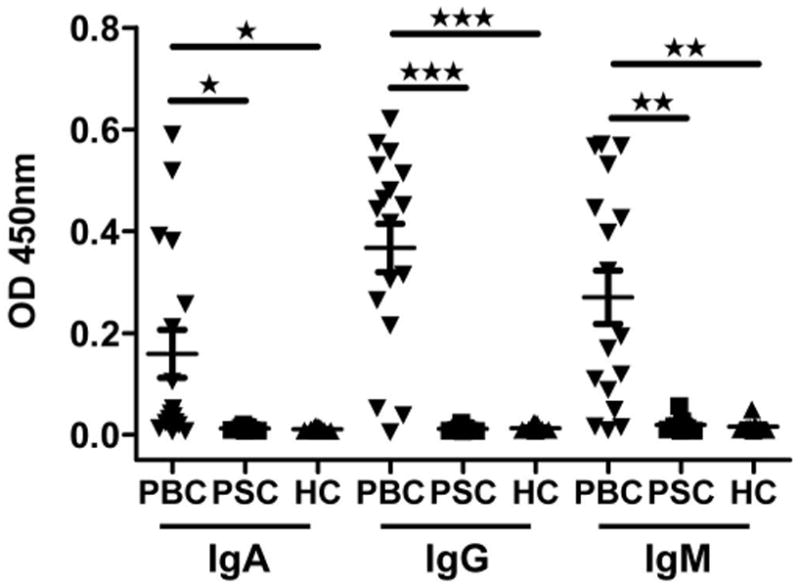
Plasma antibody reactivity to the autoantigen PDC-E2. Plasma samples from PBC patients (n=17), PSC patients (n=7) and healthy controls (n=8) were tested by ELISA for IgA, IgG and IgM isotype specific antibody activity against recombinant PDC-E2. *, p < 0.05; **, p < 0.01; ***, p < 0.001.
Figure 2
Figure 2
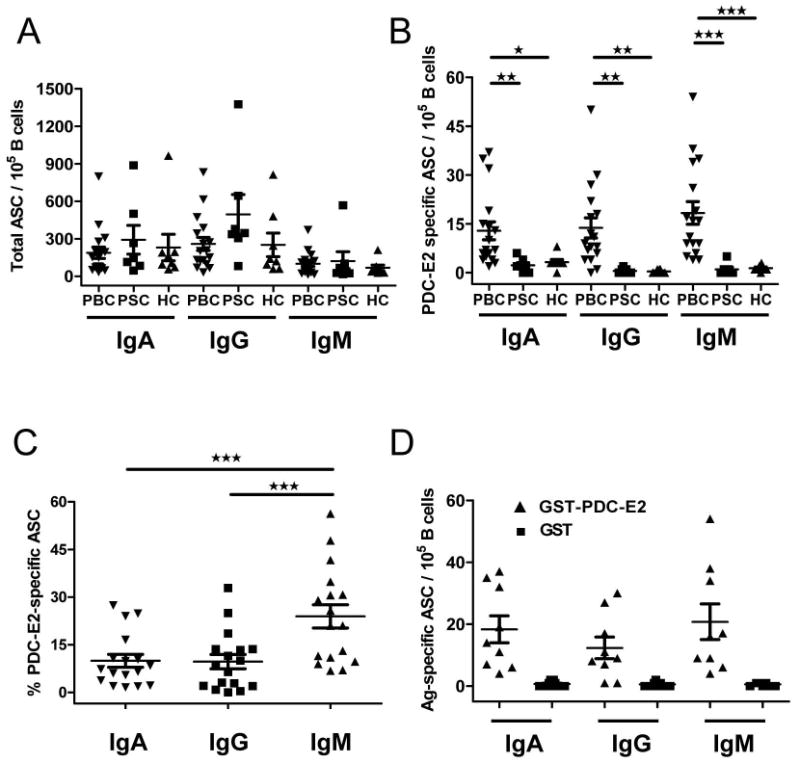
Frequencies of circulating total and PDC-E2-specific ASCs. Isolated B cells were assayed with ELISPOT to enumerate total and antigen-specific IgA, IgG and IgM ASCs. A. Frequency of total IgA, IgG and IgM ASCs in PBC patients (n=17), PSC patients (n=7) and healthy controls (n=8). B. Frequency of PDC-E2-specific IgA, IgG and IgM ASCs. C. Percentage of PDC-E2-specific ASCs in total ASCs of PBC patients. D. Frequency of ASCs from PBC patients (n=9) detected with ELISPOT plates coated with recombinant GST-PDC-E2 fusion protein or recombinant GST protein. *, p < 0.05; **, p < 0.01; ***, p < 0.001.
Figure 3
Figure 3
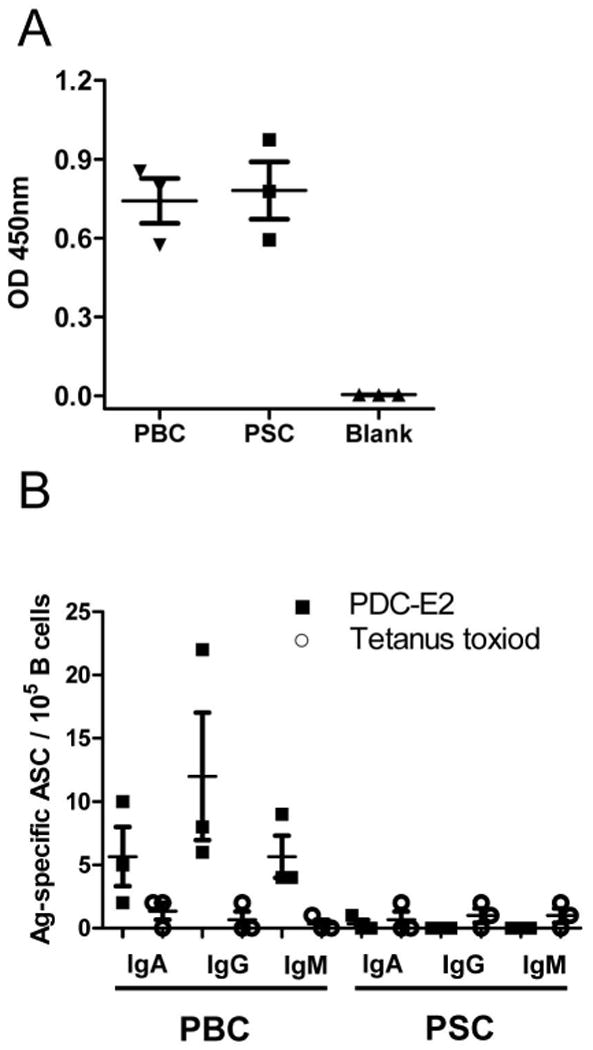
TT-specific plasma antibodies and circulating ASCs. Plasma and B cells from PBC patients (n=3) and PSC patients (n=3) were tested by ELISA or ELISPOT, respectively. A. TT-specific plasma antibodies. The background reading was obtained from blank wells without addition of plasma samples. B. Detection of TT-specific ASCs and PDC-E2-specific ASCs by ELISPOT.
Figure 4
Figure 4
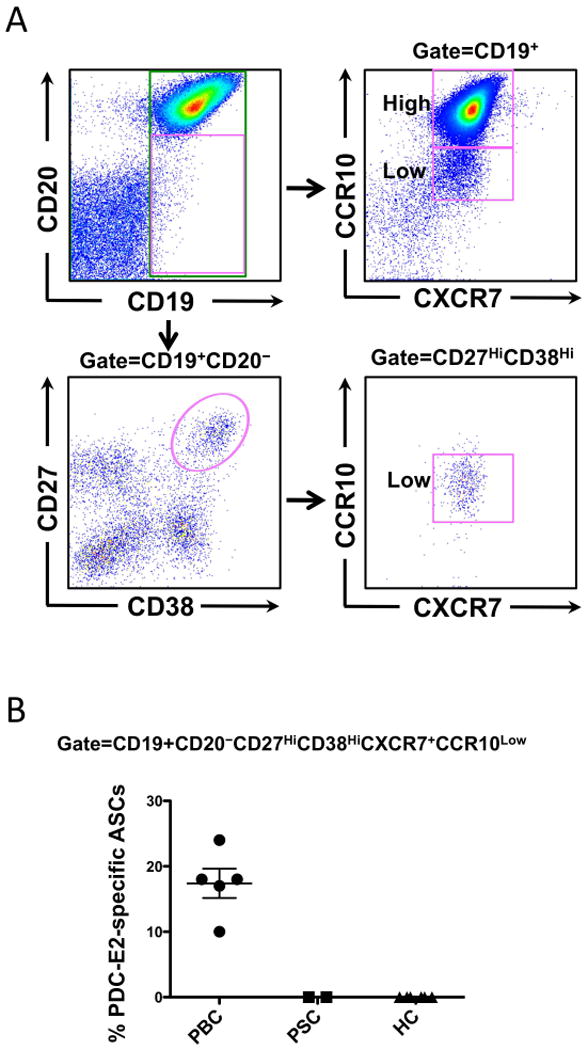
PDC-E2-specific ASCs express homing receptors CXCR7 and CCR10. Enriched B cells from PBC (n=5), and controls (n=8), including PSC (n=2) and healthy (n=6) were used to sort the CD3CD19+CD20CD27hiCD38hiCXCR7+CCR10low plasmablast population. A. Flow cytometric gating strategy analysis and sorting of plasmablasts. B. Total and PDC-E2-specific IgA/IgG/IgM ASCs in the sorted CXCR7+CCR10Low plasmablast population were enumerated by ELISPOT.
Figure 5
Figure 5
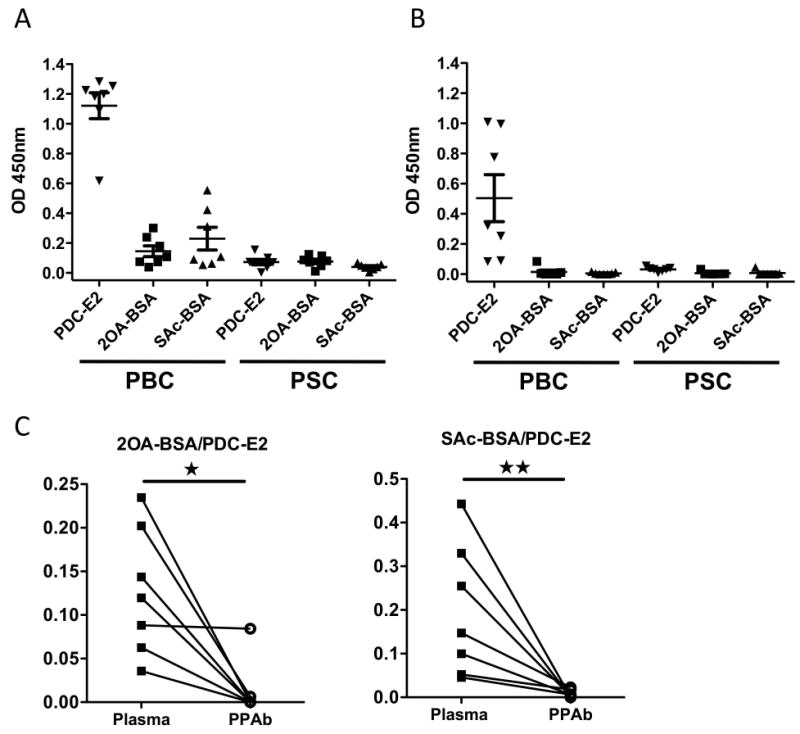
PDC-E2- and xenobiotic-specific antibody reactivity in plasma and PPAb. Plasma and PPAb samples from PBC (n=7) and PSC (n=7) patients were analyzed by ELISA for antibodies binding to recombinant PDC-E2 or the xenobiotics 2OA-BSA and SAc-BSA. All plasma samples were diluted 1:2000. All PPAb samples were diluted 1:10. Binding reactivity was detected with a mixture of conjugated anti-human IgA, IgG and IgM secondary antibodies. A. Plasma antibody binding to recombinant PDC-E2 and xenobiotics. B. PPAb binding to recombinant PDC-E2 and xenobiotics. C. Comparison of xenobiotic cross-reactivity, defined as the xenobiotic-specific binding (value of OD450nm) normalized to PDC-E2-specific binding of each sample, between plasma and PPAb of the PBC patients. *, p < 0.05; **, p < 0.01.

References

    1. Gardam S, Brink R. Non-Canonical NF-kappaB Signaling Initiated by BAFF Influences B Cell Biology at Multiple Junctures. Front Immunol. 2014;4:509. - PMC - PubMed
    1. Bergmann B, Grimsholm O, Thorarinsdottir K, Ren W, Jirholt P, Gjertsson I, Martensson IL. Memory B cells in mouse models. Scand J Immunol. 2013;78:149–156. - PubMed
    1. Wrammert J, Smith K, Miller J, Langley WA, Kokko K, Larsen C, Zheng NY, Mays I, Garman L, Helms C, et al. Rapid cloning of high-affinity human monoclonal antibodies against influenza virus. Nature. 2008;453:667–671. - PMC - PubMed
    1. Kunkel EJ, Butcher EC. Chemokines and the tissue-specific migration of lymphocytes. Immunity. 2002;16:1–4. - PubMed
    1. He XS, Sasaki S, Narvaez CF, Zhang C, Liu H, Woo JC, Kemble GW, Dekker CL, Davis MM, Greenberg HB. Plasmablast-derived polyclonal antibody response after influenza vaccination. J Immunol Methods. 2011;365:67–75. - PMC - PubMed

Publication types