Prevalence and trends of dementia in Korea: a systematic review and meta-analysis
- PMID: 25045221
- PMCID: PMC4101777
- DOI: 10.3346/jkms.2014.29.7.903
Prevalence and trends of dementia in Korea: a systematic review and meta-analysis
Abstract
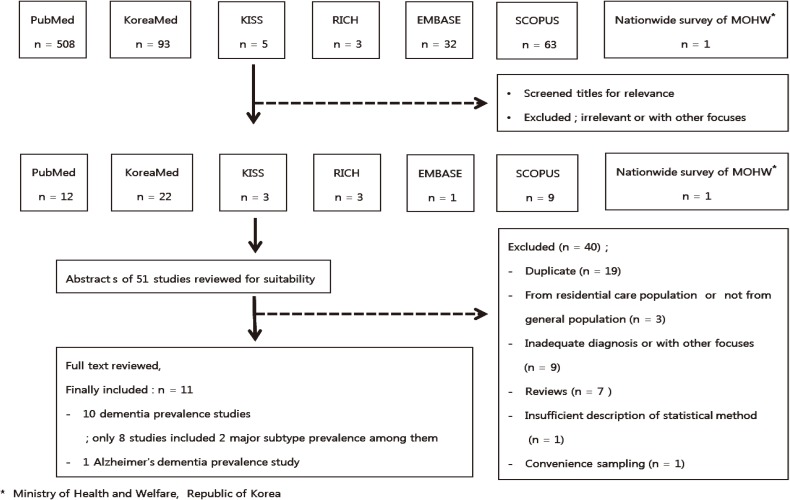
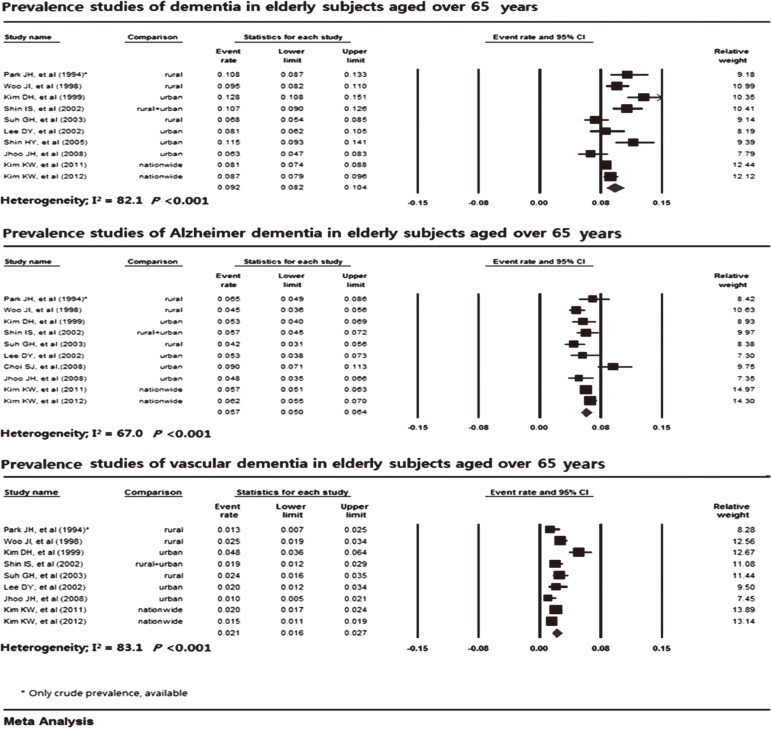
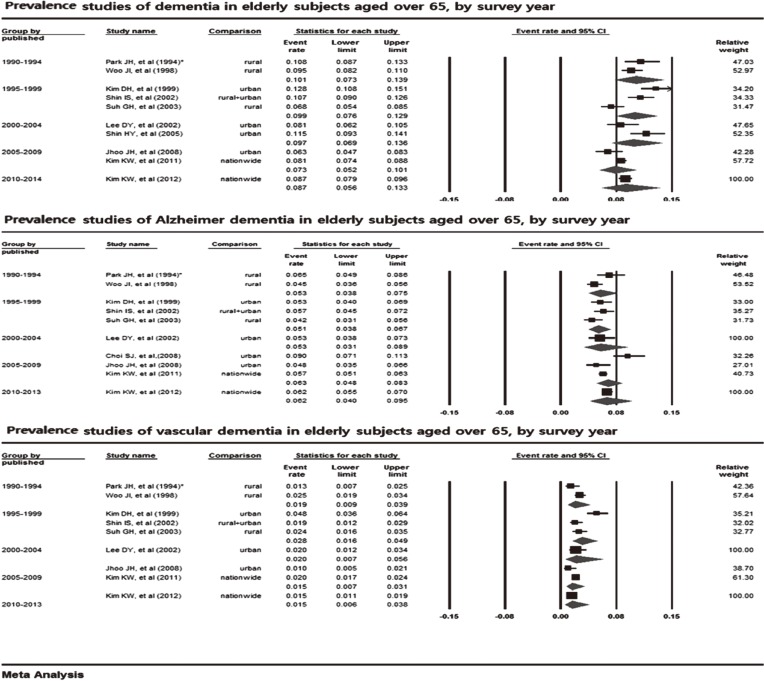
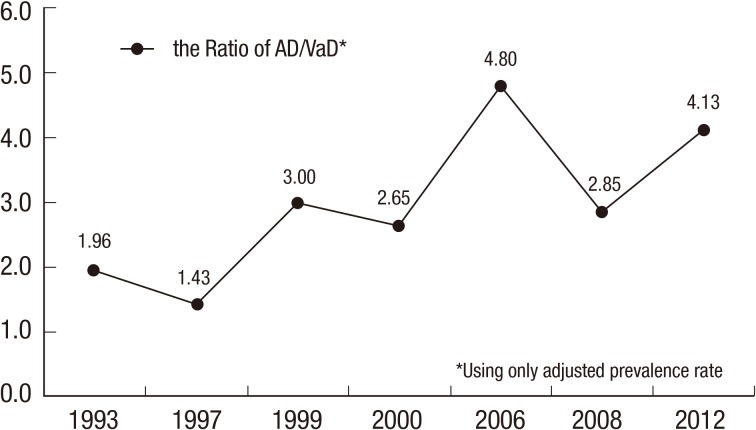
Through a systematic review and meta-analysis of epidemiological studies on dementia, we assessed the prevalence of dementia and its subtypes-Alzheimer' disease (AD) and vascular dementia (VaD)-in Korea. We searched for epidemiological studies on dementia published in 1990-2013 using PubMed, Scopus, EMBASE, KoreaMed, KISS, and RiCH. Dementia prevalence in elderly patients (aged≥65 yr) was 9.2% (95% confidence interval [CI], 8.2%-10.4%) from 11 studies, which was higher than those from Western and other Asian countries. AD was the most prevalent dementia type, with a prevalence of 5.7% (95% CI, 5.0%-6.4%) from 10 studies compared with 2.1% (95% CI, 1.6%-2.7%) for VaD from 9 studies. The age-specific prevalence of dementia approximately doubled with each 5.8-yr increase of age. Although a significant increasing trend of dementia prevalence was not observed, it increased slightly from 7.3% to 8.7% after 2005; AD prevalence increased after 1995 and VaD prevalence decreased after the early 2000s. The AD/VaD ratio increased from 1.96 in the early 1990s to 4.13 in the 2010s, similar to the worldwide ratio. Owing to this high prevalence in the aging population, dementia will impose significant economic burdens to Korean society.
Keywords: Dementia; Korea; Meta-Analysis; Prevalence; Trends.
Conflict of interest statement
The authors have no conflicts of interest to disclose.
Figures
References
-
- Population Projections: general and processed statistics, statistics on population. [accessed on 20 December 2013]. Available at http://www.kosis.kr.
-
- Korea National Statistical Office. Report on the population and housing census. Seoul: Korea National Statistical Office; 2005.
-
- World Population Prospects. The 2012 revision: population division, department of economic and social affairs. New York: United Nations; 2012. [accessed on 20 December 2013]. Available at http://esa.un.org/unpd/wpp.
-
- Kim KW, Park JH, Kim MH, Kim MD, Kim BJ, Kim SK, Kim JL, Moon SW, Bae JN, Woo JI, et al. A nationwide survey on the prevalence of dementia and mild cognitive impairment in South Korea. J Alzheimers Dis. 2011;23:281–291. - PubMed
Publication types
MeSH terms
LinkOut - more resources
Full Text Sources
Other Literature Sources
Medical