


The size of the primary tumor and age at initial diagnosis are independent predictors of the metastatic behavior and survival of patients with SDHB-related pheochromocytoma and paraganglioma: a retrospective cohort study
- PMID: 25048685
- PMCID: PMC4223758
- DOI: 10.1186/1471-2407-14-523
The size of the primary tumor and age at initial diagnosis are independent predictors of the metastatic behavior and survival of patients with SDHB-related pheochromocytoma and paraganglioma: a retrospective cohort study
Abstract
Background: Succinate dehydrogenase subunit B (SDHB) mutations are associated with aggressive pheochromocytoma (PHEO)/paraganglioma (PGL) behavior, often resulting in metastatic disease and fatal outcomes. These tumors are often larger, extra-adrenal, and contain lower catecholamine concentrations than other hereditary PHEOs/PGLs. This study evaluated the size and age at diagnosis of primary SDHB-related PHEOs/PGLs as independent predictors of their metastatic behavior and outcome (survival).
Methods: One hundred six patients with SDHB mutation-related PHEO/PGL were included in this retrospective study. The recorded largest diameters, locations, and patient ages at initial diagnosis of SDHB-related primary tumors were analyzed in the context of time to metastasis and patient survival.
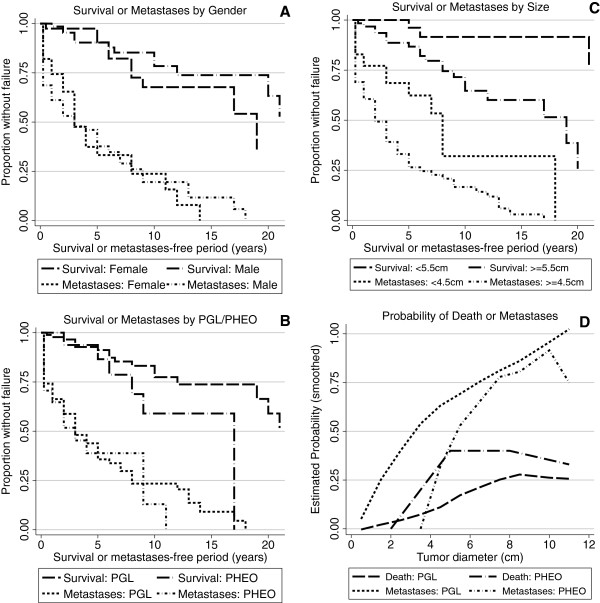
Results: First, the development of metastatic disease in patients with primary tumors ≥4.5 cm was significantly earlier than in patients with smaller tumors (P = 0.003). Second, patients with primary tumors larger than 5.5 cm also had worse overall survival than patients with smaller tumors (P = 0.008). Third, age at initial diagnosis was found to be an independent predictor of patient survival (PHEOs: P = 0.041; PGLs: P < 0.001). Fourth, we did not observe a significant difference in survival based on the specific SDHB mutations or patient sex.
Conclusion: Receiver operating characteristic curves established 4.5 cm as the best value to dichotomize the primary SDHB-related PHEO/PGL in order to evaluate the development of metastatic disease and 5.5 cm as the best value for survival prediction. Subsequently, the size of the primary tumor was found as an age-independent predictor of patient survival and metastases development in PGL. In both PHEO and PGL, age at diagnosis was found to be a size-independent predictor of patient survival. No significant difference was found in metastases development or patient survival between males and females or among specific SDHB mutations. This data further extends and supports previous recommendations that carriers with SDHB mutations must undergo early and regular evaluations to detect PHEO/PGL in order to achieve the best clinical outcome.
Figures
References
-
- DeLellis RA. Pathology and genetics of tumours of endocrine organs. Lyon: IARC Press; 2004.
-
- Lenders JW, Pacak K, Walther MM, Linehan WM, Mannelli M, Friberg P, Keiser HR, Goldstein DS, Eisenhofer G. Biochemical diagnosis of pheochromocytoma: which test is best? JAMA. 2002;287(11):1427–1434. - PubMed
-
- Brouwers FM, Eisenhofer G, Tao JJ, Kant JA, Adams KT, Linehan WM, Pacak K. High frequency of SDHB germline mutations in patients with malignant catecholamine-producing paragangliomas: implications for genetic testing. J Clin Endocrinol Metab. 2006;91(11):4505–4509. - PubMed
-
- Amar L, Baudin E, Burnichon N, Peyrard S, Silvera S, Bertherat J, Bertagna X, Schlumberger M, Jeunemaitre X, Gimenez-Roqueplo AP, Plouin PF. Succinate dehydrogenase B gene mutations predict survival in patients with malignant pheochromocytomas or paragangliomas. J Clin Endocrinol Metab. 2007;92(10):3822–3828. - PubMed
Publication types
MeSH terms
Substances
Grants and funding
LinkOut - more resources
Full Text Sources
Other Literature Sources
Medical
Miscellaneous
