


doi: 10.4161/onci.28327.
eCollection 2014.
Engineered chimeric antigen receptor-expressing T cells for the treatment of pancreatic ductal adenocarcinoma
Affiliations
- PMID: 25050204
- PMCID: PMC4063135
- DOI: 10.4161/onci.28327
Item in Clipboard
Engineered chimeric antigen receptor-expressing T cells for the treatment of pancreatic ductal adenocarcinoma
Oncoimmunology.
.
Abstract
Adoptive cell therapy with chimeric antigen receptor (CAR)-engineered T cells is under investigation as an approach to restore productive T cell immunosurveillance in patients with pancreatic ductal adenocarcinoma. Early findings demonstrate safety of this cell-based therapy and the capacity of CAR-expressing T cells to mediate anti-tumor activity as well as induce endogeneous antitumoral immune responses.
Keywords: T cell; adoptive cell therapy; cancer; chimeric antigen receptor; epitope spreading; immunosurveillance; pancreas.
Figures
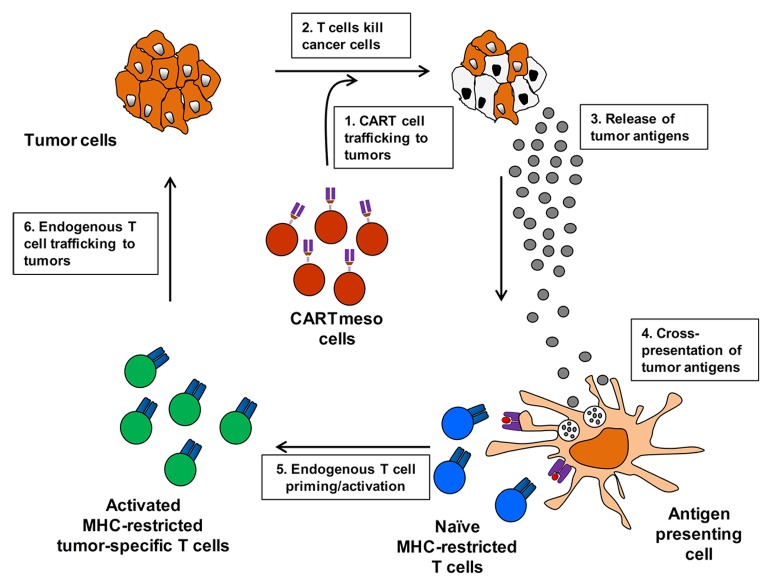
Figure 1. Chimeric antigen receptor modified T cell adoptive therapy induces an endogenous antitumor immune response through epitope spreading. Autologous chimeric antigen receptor (CAR)-engineered T cells induce the development of an endogenous antitumor immune response through a multi-step cyclical process as follows: 1) CAR-modified T (CART) cells infiltrate tumor lesions. 2) CART cells recognize tumor antigen expressed on the surface of cancer cells leading to tumor cell lysis. 3) Dying cancer cells release tumor antigens. 4) Tumor-associated proteins are engulfed by antigen presenting cells which process and present tumor-associated peptides in the context of major histocompatibility molecules (MHC) to endogenous T cells. 5) Tumor-specific T cells recognizing peptide/MHC complexes are primed and become activated. 6) Nascent, activated tumor-specific T cells infiltrate tumor lesions. Infiltrating tumor-specific T cells recognize tumor cells via T cell receptor engagement of peptide/MHC complexes present on tumor cells amplifying the initial antitumor T-cell response.
References
-
- Royal RE, Levy C, Turner K, Mathur A, Hughes M, Kammula US, Sherry RM, Topalian SL, Yang JC, Lowy I, et al. Phase 2 trial of single agent Ipilimumab (anti-CTLA-4) for locally advanced or metastatic pancreatic adenocarcinoma. J Immunother. 2010;33:828–33. doi: 10.1097/CJI.0b013e3181eec14c. - DOI - PMC - PubMed
-
- Le DT, Lutz E, Uram JN, Sugar EA, Onners B, Solt S, Zheng L, Diaz LA, Jr., Donehower RC, Jaffee EM, et al. Evaluation of ipilimumab in combination with allogeneic pancreatic tumor cells transfected with a GM-CSF gene in previously treated pancreatic cancer. J Immunother. 2013;36:382–9. doi: 10.1097/CJI.0b013e31829fb7a2. - DOI - PMC - PubMed
Publication types
Grants and funding
LinkOut - more resources
Full Text Sources
Other Literature Sources
