. 2014 Aug 5;111(31):11257-62.
doi: 10.1073/pnas.1401316111. Epub 2014 Jul 22.

Intravital imaging of cardiac function at the single-cell level

Affiliations

Intravital imaging of cardiac function at the single-cell level

Aaron D Aguirre et al. Proc Natl Acad Sci U S A. .

Abstract

Knowledge of cardiomyocyte biology is limited by the lack of methods to interrogate single-cell physiology in vivo. Here we show that contracting myocytes can indeed be imaged with optical microscopy at high temporal and spatial resolution in the beating murine heart, allowing visualization of individual sarcomeres and measurement of the single cardiomyocyte contractile cycle. Collectively, this has been enabled by efficient tissue stabilization, a prospective real-time cardiac gating approach, an image processing algorithm for motion-artifact-free imaging throughout the cardiac cycle, and a fluorescent membrane staining protocol. Quantification of cardiomyocyte contractile function in vivo opens many possibilities for investigating myocardial disease and therapeutic intervention at the cellular level.

Keywords: cardiovascular imaging; fluorescence; intravital micoscopy; molecular imaging; pacing.


Conflict of interest statement

The authors declare no conflict of interest.

Figures
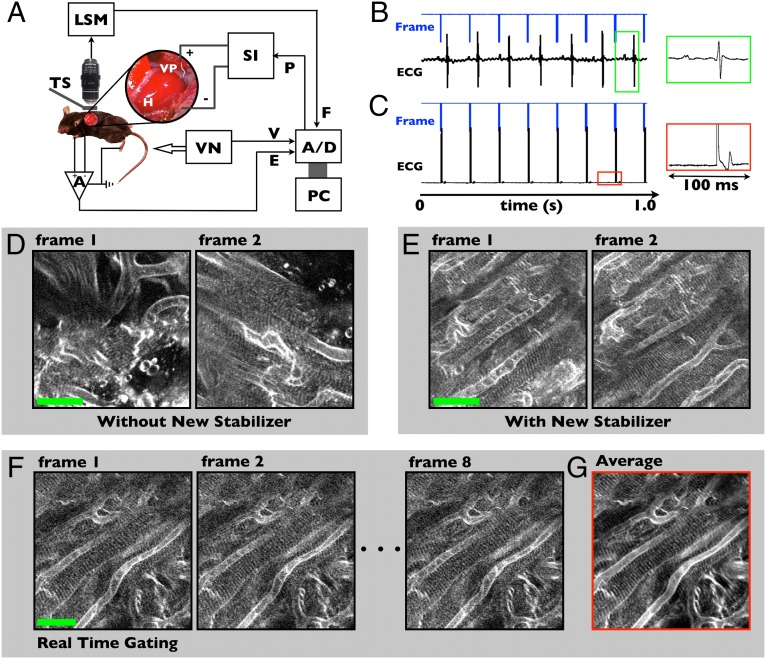
Fig. 1.
Fig. 1.
Real-time prospective cardiac gating for intravital microscopy. (A) System schematic. Laser scanning microscope, LSM, acquisition is synchronized to the cardiac cycle using pacing. The microscope frame signal, F, controls the pacemaker drive signal, P, which is delivered by a stimulus isolator, SI, through a ventricular pace wire, VP, secured to the apex of the heart, H, with a suture. Reproducibility of heart motion is ensured with a tissue stabilizer, TS. A, differential amplifier; A/D, analog-to-digital converter; E, electrocardiogram; PC, personal computer; V, ventilation timing signal; VN, mechanical ventilator. (B and C) Timing waveforms demonstrate asynchronous acquisition (B) and synchronization of the acquisition with the cardiac cycle using pacing (C). The insets illustrate ventricular capture with widening of the paced electrocardiogram (ECG) complex (C), compared with the native ECG (B). (D and E) A grid stabilizer (Fig. S2 C and D) provides improved suppression of motion artifact for single-myocyte imaging. Sequential two-photon microscopy frames using a previously demonstrated ring stabilizer (D) have significant frame-to-frame variation, whereas the grid stabilizer allows tracking of individual myocytes (E) (Movie S1). (F and G) Real-time cardiac gating removes myocyte motion from images with high repeatability over seconds. Summing over a series of eight frames (1 s) demonstrates the high degree of stabilization and enables improved signal-to-noise without loss of resolution in the averaged image (G). Movie S2 demonstrates real-time gating. (Scale bars in DF, 25 µm.)
Fig. 2.
Fig. 2.
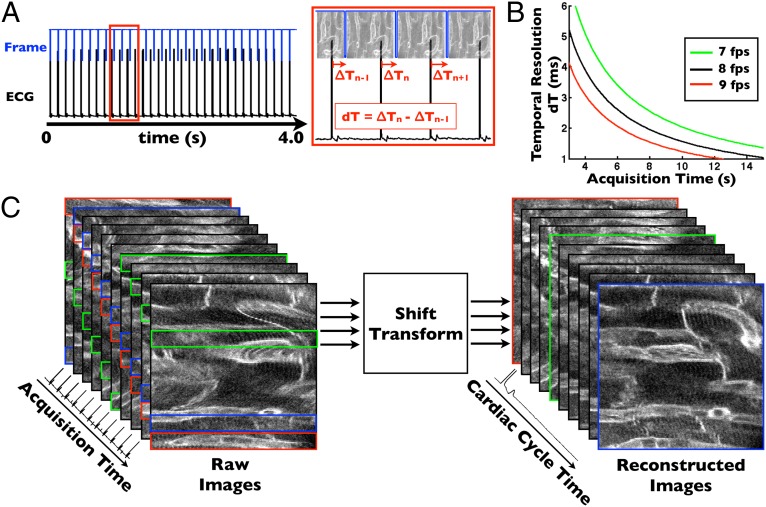
Prospective sequential segmented microscopy enables motion-artifact-free imaging of the beating heart. (A) Introduction of a precise frequency difference between the microscope acquisition rate and the cardiac pacing rate enables high-resolution temporal sampling of the cardiac cycle over multiple heart beats. Each successive frame is slightly shifted from the prior with respect to the cardiac cycle by an amount dT, which defines the temporal sampling resolution. (B) Temporal sampling resolution is determined by the acquisition time of the gated sequence, which is inversely related to the frequency difference between the microscope frame rate and the paced heart rate. (C) Image processing scheme. Fast raster-scanned image lines are time-shifted to construct an image at a specific point in the cardiac cycle. Each constructed image consists of lines acquired over multiple heart beats. Movie S3 shows raw and processed image sequences.
Fig. 3.
Fig. 3.
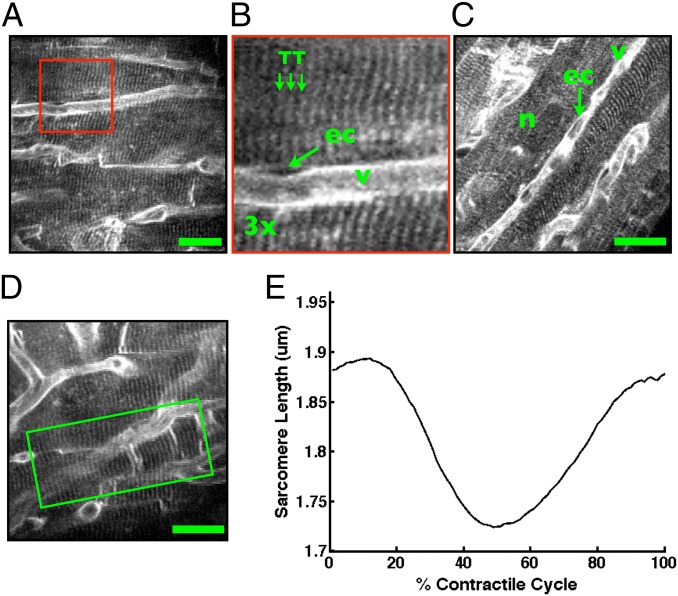
Intravital microscopy of cardiomyocyte structure and function in the beating heart. (AD) Two-photon images reveal subcellular structure in individual cardiomyocytes in the contracting heart. Capillary vessels, v, endothelial cells, ec, cell nuclei, n, and cardiomyocyte transverse tubule structure, TT, are clearly resolved. Image in B is a zoom view of the boxed region in A. Images here are in diastole. Motion-artifact-free images can be formed at every point in the cardiac cycle (Figs. S5 and S6), however, allowing visualization of myocyte contraction. Movies S3 and S4 demonstrate contracting cardiomyocytes in vivo in the beating heart. (E) Measurement of the single-cell contractile cycle from an individual cardiomyocyte (shown in D and Movie S4). Mean sarcomere length is computed over a region of interest (green box in D) at every point in the cardiac cycle by Fourier transform analysis of the sarcomere striations in PSSM images (Fig. S7 and Materials and Methods). (Scale bars in A, C, and D, 20 µm.)

References

    1. Rubart M. Two-photon microscopy of cells and tissue. Circ Res. 2004;95(12):1154–1166. - PubMed
    1. Pittet MJ, Weissleder R. Intravital imaging. Cell. 2011;147(5):983–991. - PMC - PubMed
    1. Botcherby EJ, et al. Fast measurement of sarcomere length and cell orientation in Langendorff-perfused hearts using remote focusing microscopy. Circ Res. 2013;113(7):863–870. - PubMed
    1. Bub G, et al. Measurement and analysis of sarcomere length in rat cardiomyocytes in situ and in vitro. Am J Physiol Heart Circ Physiol. 2010;298(5):H1616–H1625. - PMC - PubMed
    1. Hama T, Takahashi A, Ichihara A, Takamatsu T. Real time in situ confocal imaging of calcium wave in the perfused whole heart of the rat. Cell Signal. 1998;10(5):331–337. - PubMed

Publication types

LinkOut - more resources