Review
. 2014 Jun;41(3):213-21.
doi: 10.1159/000362888. Epub 2014 May 12.

Physiology of iron metabolism

Affiliations
Review

Physiology of iron metabolism

Sophie Waldvogel-Abramowski et al. Transfus Med Hemother. 2014 Jun.

Abstract

A revolution occurred during the last decade in the comprehension of the physiology as well as in the physiopathology of iron metabolism. The purpose of this review is to summarize the recent knowledge that has accumulated, allowing a better comprehension of the mechanisms implicated in iron homeostasis. Iron metabolism is very fine tuned. The free molecule is very toxic; therefore, complex regulatory mechanisms have been developed in mammalian to insure adequate intestinal absorption, transportation, utilization, and elimination. 'Ironomics' certainly will be the future of the understanding of genes as well as of the protein-protein interactions involved in iron metabolism.

Keywords: Iron; Metabolism; Transfusion medicine.


Figures
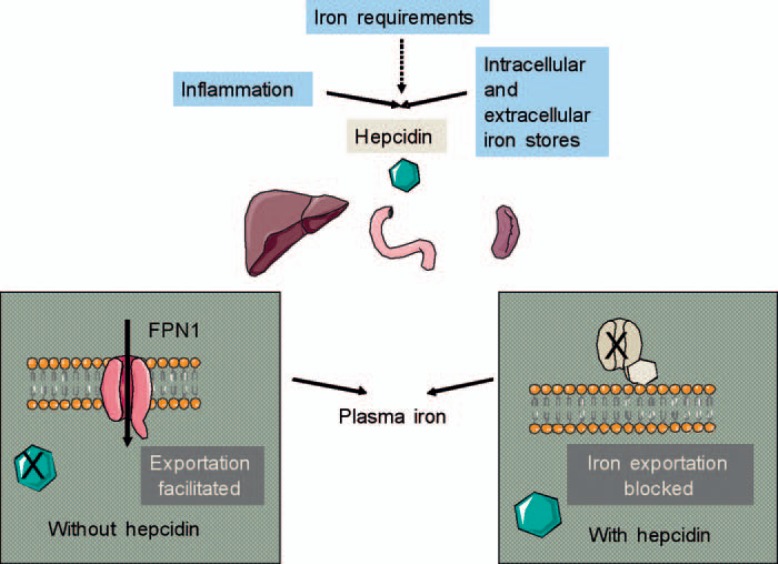
Fig. 1
Fig. 1
Many mechanisms are involved in the regulation of hepcidin synthesis. The peptide is mainly produced by the liver, in responses to many different mechanisms. In presence of inflammation as well as in situations with increased intracellular and extracellular iron stores, the concentration of hepcidin is increased. Inversely, when iron requirements are high, such as in increased erythropoiesis, hepcidin levels are low. Hepcidin blocks the exportation of iron from hepatocytes, macrophages as well as from the enterocytes, by binding to ferroportin (FPN1) allowing it internalization and degradation (illustrations used elements from Servier Medical Art: www.servier.fr/servier-medical-art).
Fig. 2
Fig. 2
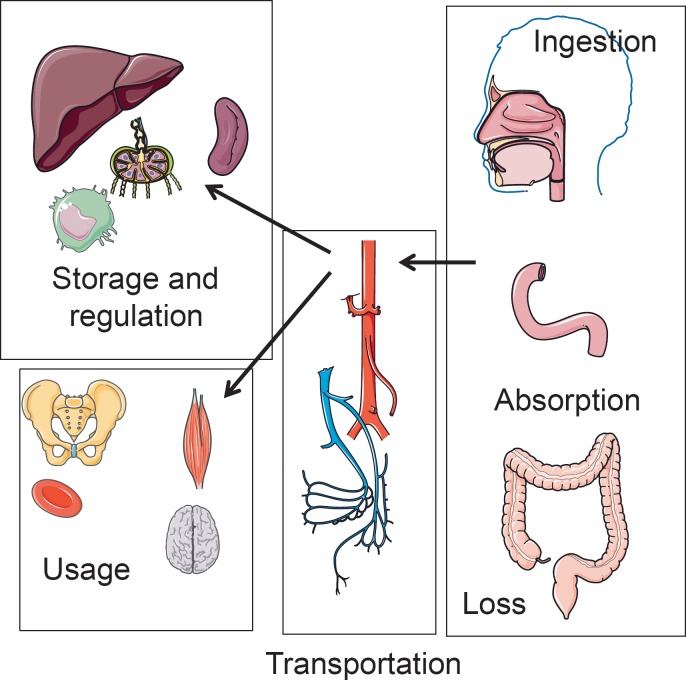
Iron metabolism is finely regulated. Males contain about 4,000 mg of iron, of which 2,500 mg is within erythrocytes; 1,000 mg is stored in splenic and hepatic macrophages, and the rest is distributed in various proteins such as myoglobin, cytochromes or other ferroproteins. About 1–2 mg of iron is lost every day, through skin and enteric desquamation and minor blood losses. This loss is balanced by intestinal absorption. Therefore, iron recycling accounts for most of the iron homeostasis in human. The situation is different in menstruating women where there are discussions about iron stores, ferritin and hemoglobin levels (illustrations used elements from Servier Medical Art: www.servier.fr/servier-medical-art).
Fig. 3
Fig. 3
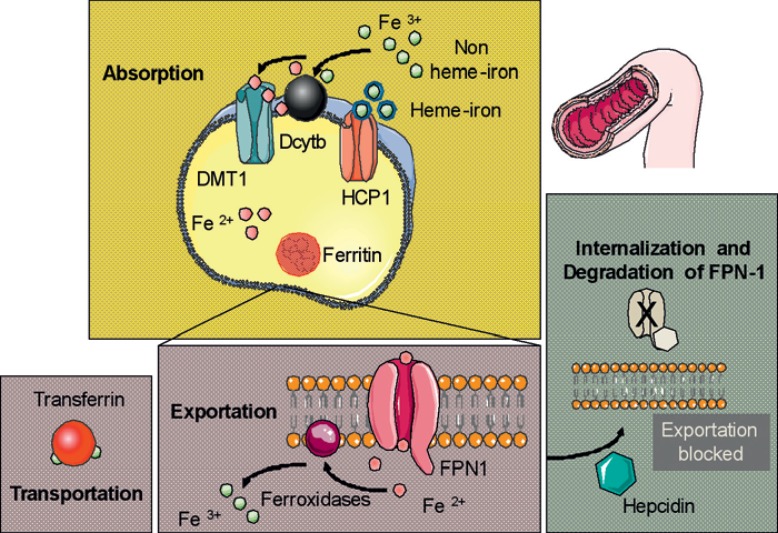
Regulation of iron absorption and exportation by enterocytes. Both heme and non-heme iron are absorbed by specific pathways, including divalent metal transporter-1 (DMT-1) and heme carrier protein (HCP1), in association with the ferrireductase, duodenal cytochrome B (Dcytb). Within the cell, iron can be stored within the ferritin molecule. The metal is exported by the protein ferroportin (FPN1), and transported into the blood by transferrin. In presence of hepcidin, ferroportin is internalized and degradated. Thus, iron exportation is blocked. Inversely, in the absence of hepcidin, ferroportin is maintained on the cell membrane, and iron transportation is facilitated (illustrations used elements from Servier Medical Art: www.servier.fr/servier-medical-art).

References

    1. Guyatt GH, Oxman AD, Ali M, Willan A, McIlroy W, Patterson C. Laboratory diagnosis of iron-deficiency anemia: an overview. J Gen Intern Med. 1992;7:145–153. - PubMed
    1. Nadakkavukaran IM, Gan EK, Olynyk JK. Screening for hereditary haemochromatosis. Pathology. 2012;44:148–152. - PubMed
    1. Waalen J, Beutler E. Hereditary hemochromatosis: screening and management. Curr Hematol Rep. 2006;5:34–40. - PubMed
    1. Cremonesi L, Forni GL, Soriani N, Lamagna M, Fermo I, Daraio F, Galli A, Pietra D, Malcovati L, Ferrari M, Camaschella C, Cazzola M. Genetic and clinical heterogeneity of ferroportin disease. Br J Haematol. 2005;131:663–670. - PubMed
    1. Cazzola M. Role of ferritin and ferroportin genes in unexplained hyperferritinaemia. Best Pract Res Clin Haematol. 2005;18:251–263. - PubMed

LinkOut - more resources