


Suicide and the 2008 economic recession: who is most at risk? Trends in suicide rates in England and Wales 2001-2011
- PMID: 25054280
- PMCID: PMC4151136
- DOI: 10.1016/j.socscimed.2014.07.024
Suicide and the 2008 economic recession: who is most at risk? Trends in suicide rates in England and Wales 2001-2011
Abstract
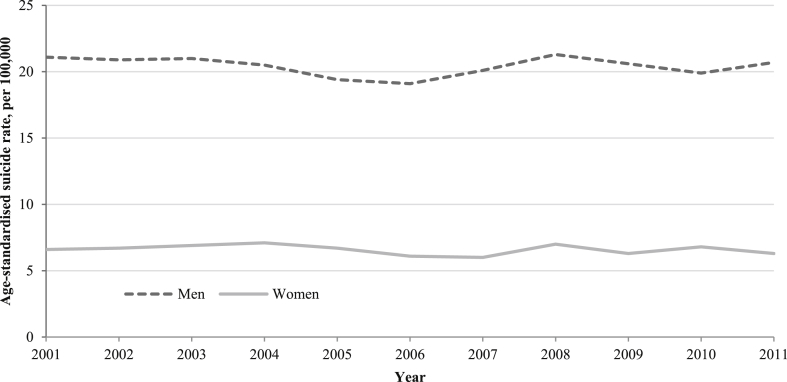
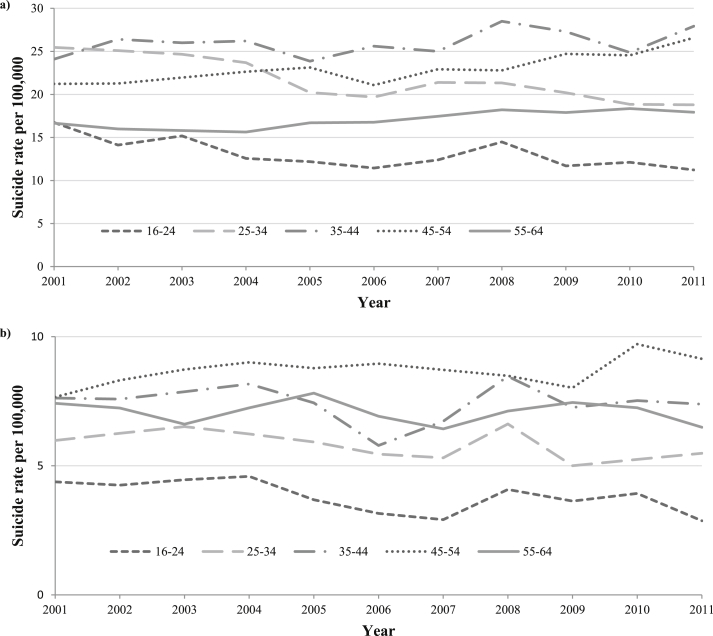
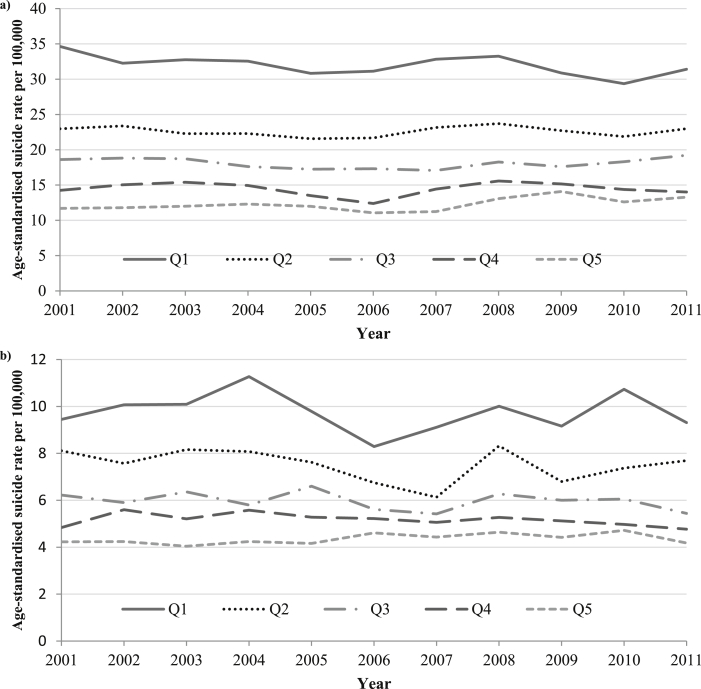
The negative impacts of previous economic recessions on suicide rates have largely been attributed to rapid rises in unemployment in the context of inadequate social and work protection programmes. We have investigated trends in indicators of the 2008 economic recession and trends in suicide rates in England and Wales in men and women of working age (16-64 years old) for the period 2001-2011, before, during and after the economic recession, our aim was to identify demographic groups whose suicide rates were most affected. We found no clear evidence of an association between trends in female suicide rates and indicators of economic recession. Evidence of a halt in the previous downward trend in suicide rates occurred for men aged 16-34 years in 2006 (95% CI Quarter 3 (Q3) 2004, Q3 2007 for 16-24 year olds & Q1 2005, Q4 2006 for 25-34 year olds), whilst suicide rates in 35-44 year old men reversed from a downward to upward trend in early 2010 (95% CI Q4 2008, Q2 2011). For the younger men (16-34 years) this change preceded the sharp increases in redundancy and unemployment rates of early 2008 and lagged behind rising trends in house repossessions and bankruptcy that began around 2003. An exception were the 35-44 year old men for whom a change in suicide rate trends from downwards to upwards coincided with peaks in redundancies, unemployment and rises in long-term unemployment. Suicide rates across the decade rose monotonically in men aged 45-64 years. Male suicide in the most-to-medium deprived areas showed evidence of decreasing rates across the decade, whilst in the least-deprived areas suicide rates were fairly static but remained much lower than those in the most-deprived areas. There were small post-recession increases in the proportion of suicides in men in higher management/professional, small employer/self-employed occupations and fulltime education. A halt in the downward trend in suicide rates amongst men aged 16-34 years, may have begun before the 2008 economic recession whilst for men aged 35-44 years old increased suicide rates mirrored recession related unemployment. This evidence suggests indicators of economic strain other than unemployment and redundancies, such as personal debt and house repossessions may contribute to increased suicide rates in younger-age men whilst for men aged 35-44 years old job loss and long-term unemployment is a key risk factor.
Keywords: Economic recession; England and Wales; Joinpoint regression; Risk; Suicide rates; suicide trends.
Copyright © 2014 The Authors. Published by Elsevier Ltd.. All rights reserved.
Figures

References
-
- Chang S.-S., Gunnell D., Sterne J.A.C., Lu T.-H., Cheng A.T.A. Was the economic crisis 1997–1998 responsible for rising suicide rates in East/Southeast Asia? A time–trend analysis for Japan, Hong Kong, South Korea, Taiwan, Singapore and Thailand. Soc. Sci. Med. 2009;68(7):1322–1331. doi: 10.1016/j.socscimed.2009.01.010. - DOI - PubMed
-
- Durkheim E. Routledge and Kegan Paul; London: 1952. Suicide: a study in sociology, (originally published 1987)
Publication types
MeSH terms
Grants and funding
LinkOut - more resources
Full Text Sources
Other Literature Sources
Medical
