


A multicenter randomized trial indicates initial prednisolone treatment for childhood nephrotic syndrome for two months is not inferior to six-month treatment
- PMID: 25054775
- PMCID: PMC4284810
- DOI: 10.1038/ki.2014.260
A multicenter randomized trial indicates initial prednisolone treatment for childhood nephrotic syndrome for two months is not inferior to six-month treatment
Abstract
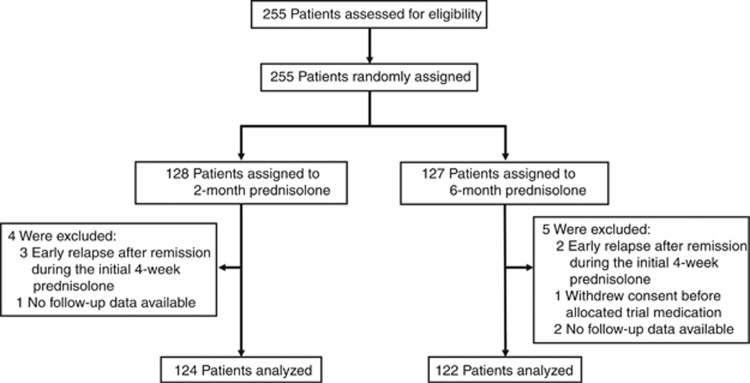
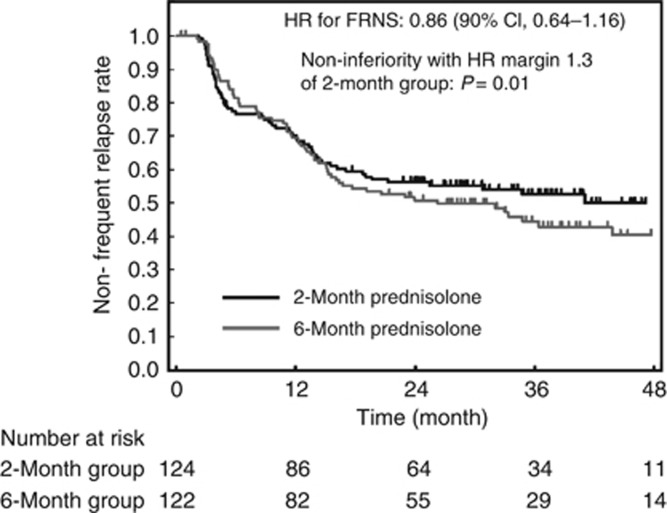
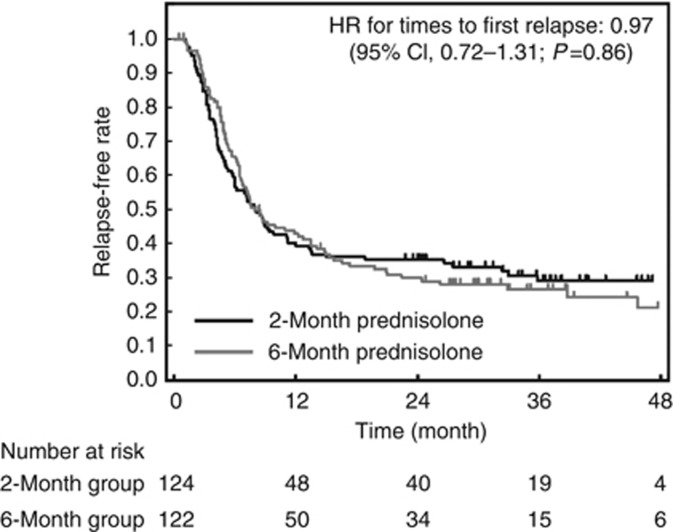
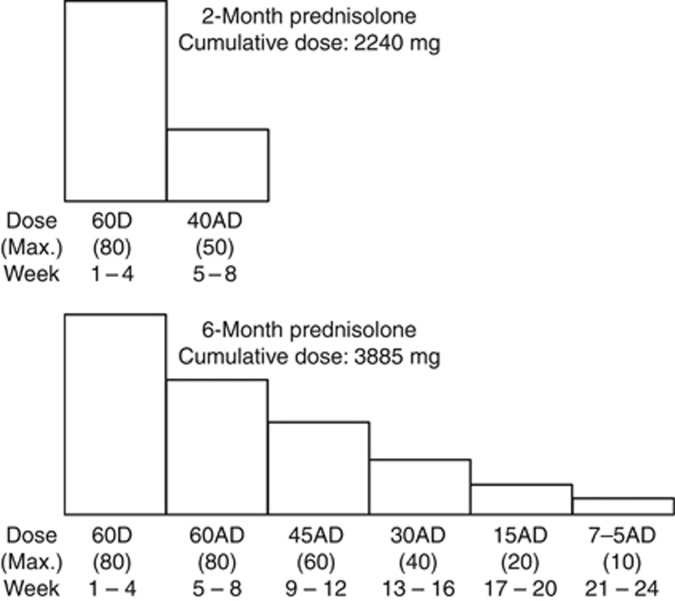
In this multicenter, open-label, randomized controlled trial, we determined whether 2-month prednisolone therapy for steroid-sensitive nephrotic syndrome was inferior or not to 6-month therapy despite significantly less steroid exposure. The primary end point was time from start of initial treatment to start of frequently relapsing nephrotic syndrome. The pre-specified non-inferiority margin was a hazard ratio of 1.3 with one-sided significance of 5%. We randomly assigned 255 children with an initial episode of steroid-sensitive nephrotic syndrome to either 2 - or 6-month treatment of which 246 were eligible for final analysis. The total prednisolone exposure counted both initial and relapse prednisolone treatment administered over 24 months. Median follow-up in months was 36.7 in the 2-month and 38.2 in the 6-month treatment group. Time to frequent relaps was similar in both groups; however, the median was reached only in the 6-month group (799 days). The hazard ratio was 0.86 (90% confidence interval, 0.64-1.16) and met the non-inferior margin. Time to first relapse was also similar in both groups: median day 242 (2-month) and 243 (6-month). Frequency and severity of adverse events were similar in both groups. Most adverse events were transient and occurred during initial or relapse therapy. Thus, 2 months of initial prednisolone therapy for steroid-sensitive nephrotic syndrome, despite less prednisolone exposure, is not inferior to 6 months of initial therapy in terms of time to onset of frequently relapsing nephrotic syndrome.
Figures
Comment in
-
Is two month initial prednisolone treatment for nephrotic syndrome inferior to longer duration therapy?Indian Pediatr. 2014 Oct;51(10):811-7. doi: 10.1007/s13312-014-0508-7. Indian Pediatr. 2014. PMID: 25362013 No abstract available.
-
New lessons from randomized trials in steroid-sensitive nephrotic syndrome: clear evidence against long steroid therapy.Kidney Int. 2015 Jan;87(1):17-9. doi: 10.1038/ki.2014.354. Kidney Int. 2015. PMID: 25549122
-
Re "How postoperative respiratory distress conspired with friendly fire to kill 'Stonewall' Jackson".Pharos Alpha Omega Alpha Honor Med Soc. 2015 Spring;78(2):46. Pharos Alpha Omega Alpha Honor Med Soc. 2015. PMID: 26043525 No abstract available.
References
-
- Schlesinger ER, Sultz HA, Mosher WE, et al. The nephrotic syndrome: its incidence and implications for the community. Am J Dis Child. 1968;116:623–632. - PubMed
-
- van Husen M, Kemper MJ. New therapies in steroid-sensitive and steroid-resistant idiopathic nephrotic syndrome. Pediatr Nephrol. 2011;26:881–892. - PubMed
-
- Tarshish P, Tobin JN, Bernstein J, et al. Prognostic significance of the early course of minimal change nephrotic syndrome: report of the International Study of Kidney Disease in Children. J Am Soc Nephrol. 1997;8:769–776. - PubMed
-
- Ueda N, Chihara M, Kawaguchi S, et al. Intermittent versus long-term tapering prednisolone for initial therapy in children with idiopathic nephrotic syndrome. J Pediatr. 1988;112:122–126. - PubMed
-
- Ehrich JH, Brodehl J. Long versus standard prednisone therapy for initial treatment of idiopathic nephrotic syndrome in children. Arbeitsgemeinschaft für Pädiatrische Nephrologie. Eur J Pediatr. 1993;152:357–361. - PubMed
Publication types
MeSH terms
Substances
Associated data
LinkOut - more resources
Full Text Sources
Other Literature Sources
Medical
Molecular Biology Databases
Miscellaneous
