


Emerging methods for disease monitoring in malignant gliomas
- PMID: 25054821
- PMCID: PMC4986516
- DOI: 10.2217/cns.13.44
Emerging methods for disease monitoring in malignant gliomas
Abstract
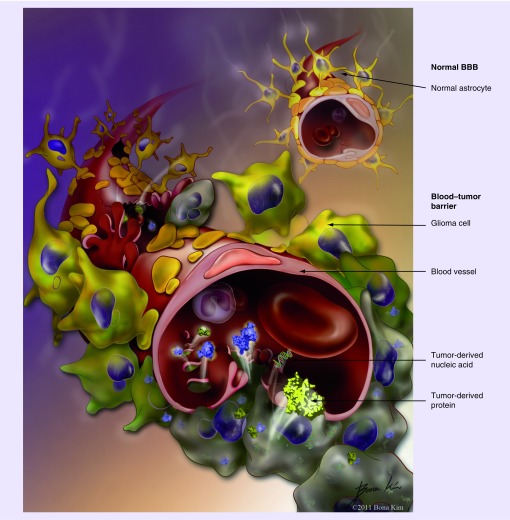
MRI remains the backbone of measuring disease burden and treatment response in individuals with malignant gliomas. Traditional radiographic approaches, however, are largely limited to depicting anatomic changes and are not a direct measure of disease burden. For example, contrast enhancement is related to blood-brain barrier integrity rather than actual tumor size. Without accurate measures of disease, common clinical dilemmas include 'pseudo-progression' (e.g., after chemoradiation) or 'pseudo-response' (e.g., with steroid treatment and antiangiogenic agents), which can lead to delays in therapy, premature discontinuation of successful treatments and to unnecessary surgical procedures. This overview focuses on novel, minimally invasive approaches in the area of imaging and blood-based biomarkers that aim to more accurately determine disease status and response to treatment in malignant brain tumors.
Conflict of interest statement
Figures
References
-
- Brandsma D, Stalpers L, Taal W, Sminia P, van den Bent MJ. Clinical features, mechanisms, and management of pseudoprogression in malignant gliomas. Lancet Oncol. 2008;9(5):453–461. - PubMed
-
▪Provides a thorough overview of the phenomenon and mechanism of so-called pseudo-progression in malignant gliomas.
-
- Brandes AA, Franceschi E, Tosoni A, et al. MGMT promoter methylation status can predict the incidence and outcome of pseudoprogression after concomitant radiochemotherapy in newly diagnosed glioblastoma patients. J. Clin. Oncol. 2008;26(13):2192–2197. - PubMed
-
Describes an association between MGMT promoter methylation and a higher rate of pseudo-progression in patients with newly diagnosed glioblastoma.
-
- Macdonald DR, Cascino TL, Schold SC, Jr, Cairncross JG. Response criteria for Phase II studies of supratentorial malignant glioma. J. Clin. Oncol. 1990;8(7):1277–1280. - PubMed
-
- Wen PY, Macdonald DR, Reardon DA, et al. Updated response assessment criteria for high-grade gliomas: response assessment in neuro-oncology working group. J. Clin. Oncol. 2010;28(11):1963–1972. - PubMed
-
▪Describes the so-called Revised Assessment in Neuro-Oncology criteria, response criteria for treatment of high-grade gliomas that are now widely used in clinical trials.
-
- Zeng QS, Li CF, Liu H, Zhen JH, Feng DC. Distinction between recurrent glioma and radiation injury using magnetic resonance spectroscopy in combination with diffusion-weighted imaging. Int. J. Radiat. Oncol. Biol. Phys. 2007;68(1):151–158. - PubMed
Publication types
MeSH terms
Substances
Grants and funding
LinkOut - more resources
Full Text Sources
Other Literature Sources
