


Measuring family HRQoL spillover effects using direct health utility assessment
- PMID: 25057048
- PMCID: PMC4270843
- DOI: 10.1177/0272989X14541328
Measuring family HRQoL spillover effects using direct health utility assessment
Abstract
Background: Applications of cost-effectiveness analysis do not typically incorporate effects on caregiver quality of life despite increasing evidence that these effects are measurable.
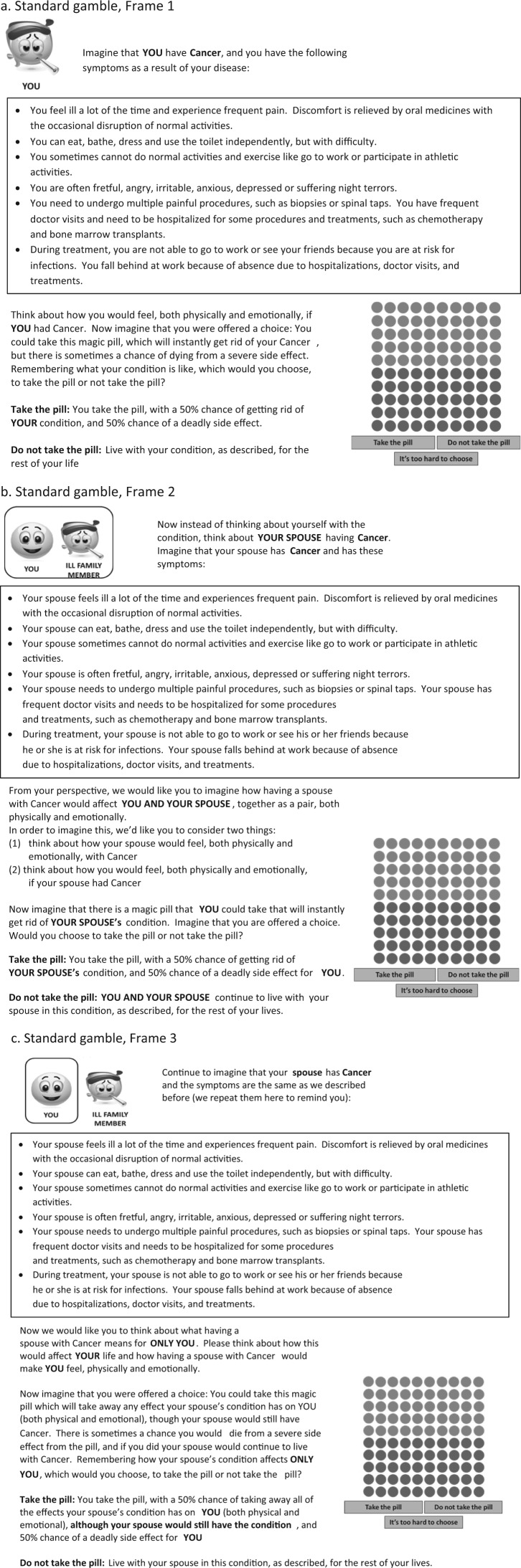
Methods: Using a national sample of US adults, we conducted 2 cross-sectional surveys during December 2011 and January 2012. One version asked respondents to value their own experience as the family member of a person with a chronic illness (experienced sample), and the other version asked respondents to value hypothetical scenarios describing the experience of having a family member with a chronic illness (community sample). Conditions included Alzheimer's disease/dementia, arthritis, cancer, and depression. Using standard gamble questions, respondents were asked to value the spillover effects of a family member's illness. We used regression analysis to evaluate the disutility (loss in health-related quality of life) of having a family member with a chronic illness by condition and relationship type, controlling for the respondent's own conditions and sociodemographic characteristics.
Results: For the experienced sample (n = 1389), regression analyses suggested that greater spillover was associated with certain conditions (arthritis, depression) compared with other conditions (Alzheimer's disease, cancer). For the community sample (n = 1205), regression analyses indicated that lower spillover was associated with condition (cancer) but not the type of relationship with the ill family member (parent, child, spouse).
Conclusions: The effects of illness extend beyond the individual patient to include effects on caregivers of patients, parents of ill children, spouses, and other close family and household members. Cost-effectiveness analyses should consider the inclusion of health-related quality of life spillover effects in addition to caregiving time costs incurred by family members of ill individuals.
Keywords: caregivers; cost-effectiveness analysis; family; health utility; health-related quality of life.
© The Author(s) 2014.
Figures


References
-
- Brouwer WBF. Too important to ignore: informal caregivers and other significant others. PharmacoEconomics. 2006;24(1):39–41. - PubMed
-
- Bobinac A, van Exel NJ, Rutten FF, Brouwer WB. Health effects in significant others: separating family and care-giving effects. Med Decis Making. 2011;31(2):292–8. - PubMed
-
- Wittenberg E, Saada A, Prosser LA. How illness affects family members: domains of well-being affected by “spillover.” Conference Proceedings for the 34th Annual Meeting of the Society for Medical Decision Making; 2012 October 17–20; Phoenix, AZ.
-
- Gold MR, Siegel JE, Russell LB, Weinstein MC, eds. Cost-Effectiveness in Health and Medicine. New York: Oxford University Press; 1996.
Publication types
MeSH terms
Grants and funding
LinkOut - more resources
Full Text Sources
Other Literature Sources
Medical
