Review
. 2014 Aug 15;462(1):1-13.
doi: 10.1042/BJ20140712.

The molecular regulation of Janus kinase (JAK) activation

Affiliations
Review

The molecular regulation of Janus kinase (JAK) activation

Jeffrey J Babon et al. Biochem J. .

Abstract

The JAK (Janus kinase) family members serve essential roles as the intracellular signalling effectors of cytokine receptors. This family, comprising JAK1, JAK2, JAK3 and TYK2 (tyrosine kinase 2), was first described more than 20 years ago, but the complexities underlying their activation, regulation and pleiotropic signalling functions are still being explored. Here, we review the current knowledge of their physiological functions and the causative role of activating and inactivating JAK mutations in human diseases, including haemopoietic malignancies, immunodeficiency and inflammatory diseases. At the molecular level, recent studies have greatly advanced our knowledge of the structures and organization of the component FERM (4.1/ezrin/radixin/moesin)-SH2 (Src homology 2), pseudokinase and kinase domains within the JAKs, the mechanism of JAK activation and, in particular, the role of the pseudokinase domain as a suppressor of the adjacent tyrosine kinase domain's catalytic activity. We also review recent advances in our understanding of the mechanisms of negative regulation exerted by the SH2 domain-containing proteins, SOCS (suppressors of cytokine signalling) proteins and LNK. These recent studies highlight the diversity of regulatory mechanisms utilized by the JAK family to maintain signalling fidelity, and suggest alternative therapeutic strategies to complement existing ATP-competitive kinase inhibitors.


Figures
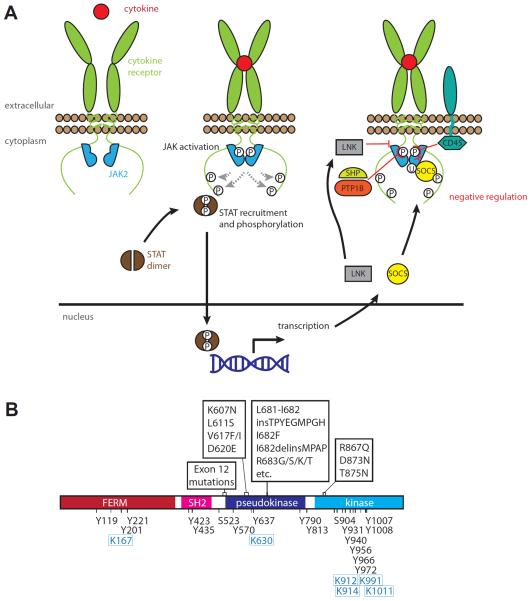
Figure 1
Figure 1
Overview of JAK activation and regulation. (A) Summary of the JAK/STAT signalling pathway and its negative regulation. Ligation of a cytokine receptor leads to a transition of the associated JAK molecules from an inactive (left) to activated state (middle). Activated JAK is characterised by phosphorylation of activation loop residues within its kinase domain (encircled P; middle). Activated JAKs phosphorylate tyrosines within the receptor intracellular region to enable recruitment and phosphorylation of the principal downstream effectors, the STATs. Many layers of negative regulation have been identified (right), including phosphatases (CD45, PTP1B, SHP1 and SHP2) and SH2 domain containing regulators from the LNK and SOCS families. SOCS proteins inhibit JAK signalling by both inhibiting kinase activity and by mediating ubiquitylation (encircled U), leading to proteasomal degradation. (B) Intrinsic regulatory events annotated on the human JAK2 domain structure. Mutational hotspots associated with myeloproliferative neoplasms are annotated above [, , , –49, 142, 143]. Residues subject to phosphorylation [, –152] and sumoylation [153] are annotated below in black text and blue boxed text, respectively. In addition to the crucial role of the activation loop tyrosines, 1007 and 1008 [65, 66], Y119, Y221, Y317, Y570, Y637, Y813, Y866, Y913, Y966 and Y972 have been reported to arise from JAK2 auto- or trans-phosphorylation and contribute variously to the modulation of JAK2 activation [–, , –156].
Figure 2
Figure 2
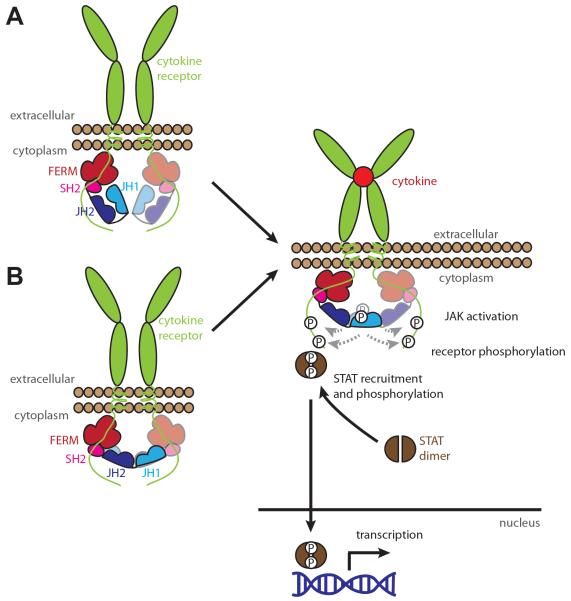
The two prevailing models for regulation of JAK kinase domain catalytic activity by the pseudokinase domain: (A) in cis; (B) in trans. In the in cis inhibition model (A), the pseudokinase domain binds the kinase domain within the same JAK monomer, leading to a suppression in catalytic activity. The in trans model for inhibition (B) involves the binding of the pseudokinase domain from one JAK to the kinase domain of another within a receptor-assembled JAK dimer to suppress the kinase domain's catalytic activity. Activation of JAK in either model involves reorientation of the JAKs to facilitate mutual trans-phosphorylation and thus activation of the JAK kinase domains.
Figure 3
Figure 3
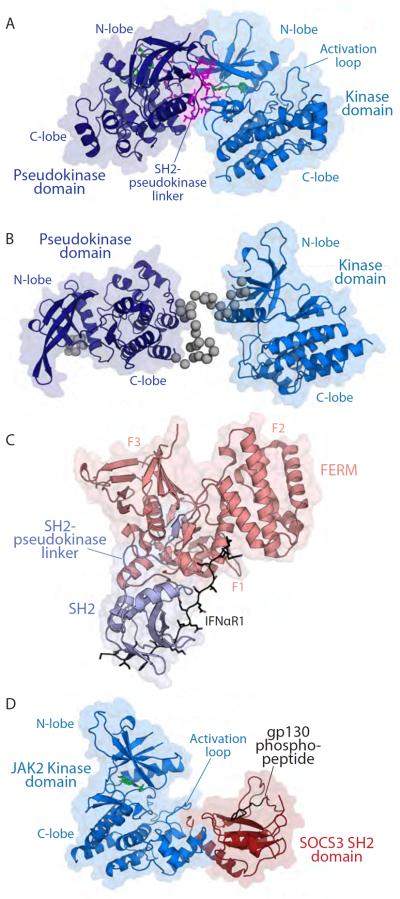
Structures of component domains within JAK family members. A. Crystal structure of TYK2 pseudokinase-kinase tandem domains (PDB, 4OLI; [76]). The pseudokinase domain is coloured in deep blue and the kinase domain is coloured in marine. Residues involved in the pseudokinase-kinase domain interface are shown as magenta sticks. B. The solution structure of JAK2 pseudokinase-kinase tandem domains determined by SAXS [77]. Domains are coloured as for TYK2 in panel A, but with grey beads to model the N-terminus and interdomain linker. The component crystal structures of the JAK2 pseudokinase (PDB, 4FVP; [68]) and kinase (PDB, 2B7A; [157]) domains were used to prepare this rigid body model. C. Crystal structure of TYK2-FERM SH2 domain in complex with IFNAR1 (PDB, 4PO6; [82]). The FERM domain is coloured in salmon with F1, F2 and F3 subdomains labelled. The SH2 domain is coloured pale blue. The IFNAR1 Box 2 peptide is coloured black. D. Crystal structure of the JAK2 kinase domain (blue) in complex with the SOCS3 SH2 domain (red) and the gp130 phospho-Y757 peptide (black) (PDB, 4GL9; [114]). Small molecule inhibitors are shown as green sticks in panels A and D.

References

    1. Wilks AF. Two putative protein-tyrosine kinases identified by application of the polymerase chain reaction. Proc Natl Acad Sci USA. 1989;86:1603–1607. - PMC - PubMed
    1. Wilks AF, Harpur AG, Kurban RR, Ralph SJ, Zürcher G, Ziemiecki A. Two novel protein-tyrosine kinases, each with a second phosphotransferase-related catalytic domain, define a new class of protein kinase. Molecular and cellular biology. 1991;11:2057–2065. - PMC - PubMed
    1. Firmbach-Kraft I, Byers M, Shows T, Dalla-Favera R, Krolewski JJ. tyk2, prototype of a novel class of non-receptor tyrosine kinase genes. Oncogene. 1990;5:1329–1336. - PubMed
    1. Kawamura M, McVicar DW, Johnston JA, Blake TB, Chen YQ, Lal BK, Lloyd AR, Kelvin DJ, Staples JE, Ortaldo JR. Molecular cloning of L-JAK, a Janus family protein-tyrosine kinase expressed in natural killer cells and activated leukocytes. Proc Natl Acad Sci USA. 1994;91:6374–6378. - PMC - PubMed
    1. Rane SG, Reddy EP. JAK3: a novel JAK kinase associated with terminal differentiation of hematopoietic cells. Oncogene. 1994;9:2415–2423. - PubMed

Publication types

MeSH terms

Substances