


Influenza virus-glycan interactions
- PMID: 25061947
- PMCID: PMC4149921
- DOI: 10.1016/j.coviro.2014.06.004
Influenza virus-glycan interactions
Abstract
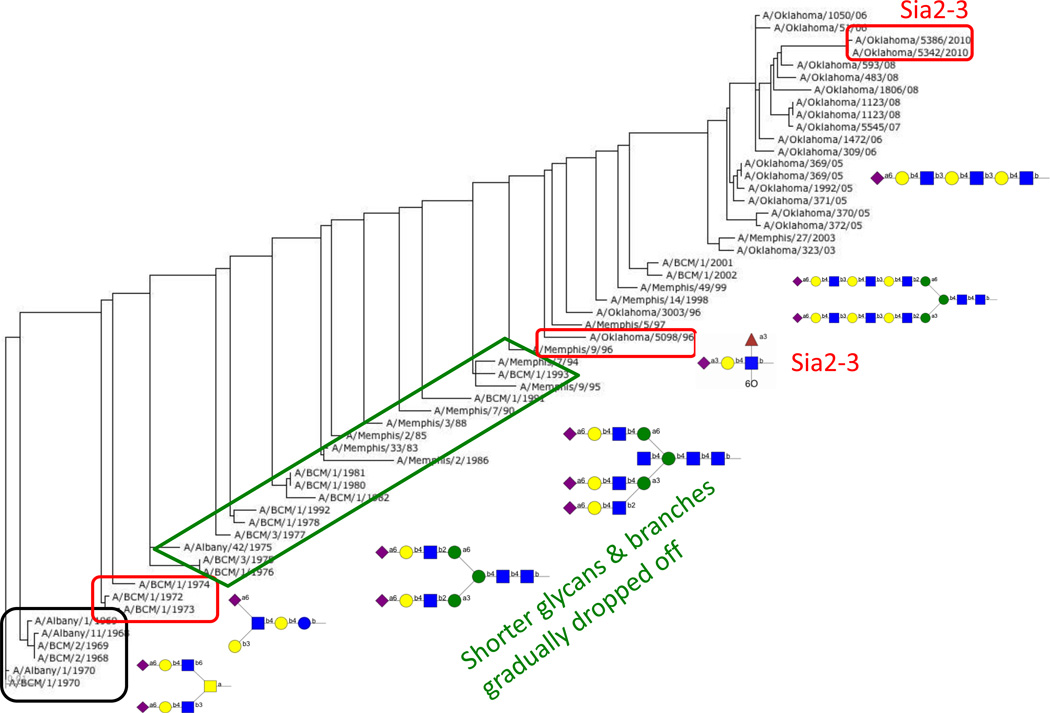
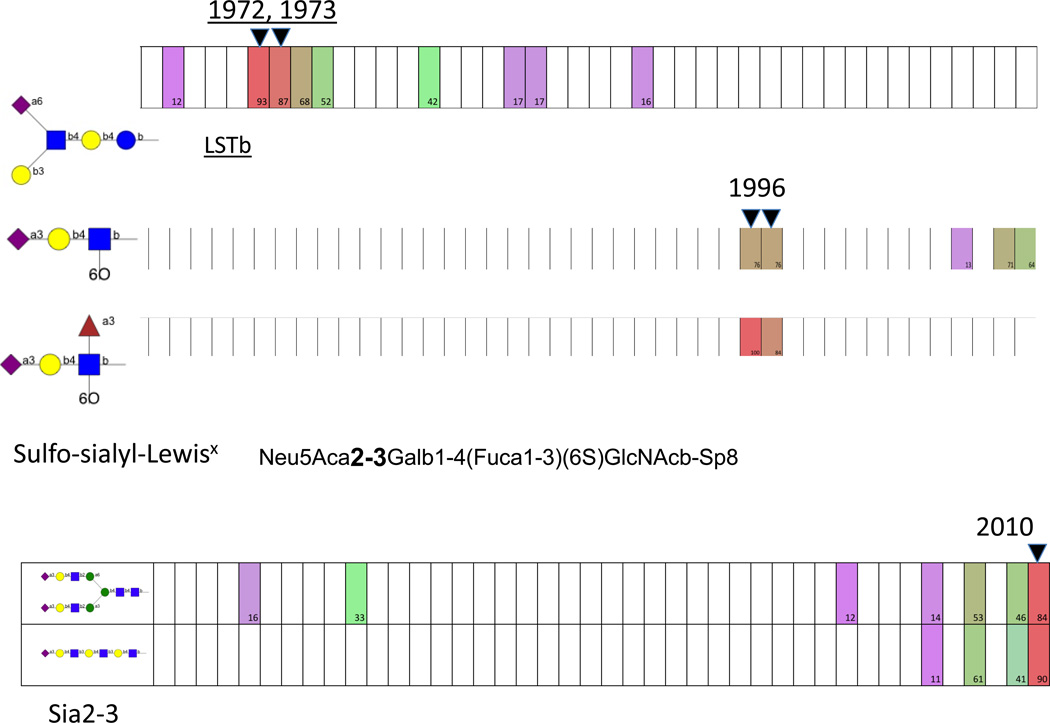
It has been known for many years that influenza viruses bind by their hemagglutinin surface glycoprotein to sialic acid (N-acetylneuraminic acid) on the surface of the host cell, and that avian viruses most commonly bind to sialic acid linked α2-3 to galactose while most human viruses bind to sialic acid in the α2-6 configuration. Over the past few years there has been a large increase in data on this binding due to technological advances in glycan binding assays, reverse genetic systems for influenza and in X-ray crystallography. The results show some surprising changes in binding specificity that do not appear to affect the ability of the virus to infect host cells.
Copyright © 2014 Elsevier B.V. All rights reserved.
Figures
References
-
- Rogers GN, Paulson JC, Daniels RS, Skehel JJ. Single amino acid substitutions in influenza haemagglutinin change receptor binding specificity. Nature. 1983;304:76–78. - PubMed
-
- Rogers GN, Daniels RS, Skehel JJ, Wiley DC, Wang XF, Higa HH, Paulson JC. Host-mediated selection of influenza virus receptor variants. Sialic acid-alpha 2,6Gal-specific clones of A/duck/Ukraine/1/63 revert to sialic acid-alpha 2,3Gal-specific wild type in ovo. J Biol Chem. 1985;260:7362–7367. - PubMed
-
-
Herfst S, Schrauwen EJ, Linster M, Chutinimitkul S, de Wit E, Munster VJ, Sorrell EM, Bestebroer TM, Burke DF, Smith DJ, et al. Airborne transmission of influenza A/H5N1 virus between ferrets. Science. 2012;336:1534–1541. Together with reference 5, this paper describes passaging a mutated H5N1 virus multiple times in ferrets until it acquired the ability to transmit between ferrets by aerosol.
-
-
-
Imai M, Watanabe T, Hatta M, Das SC, Ozawa M, Shinya K, Zhong G, Hanson A, Katsura H, Watanabe S, et al. Experimental adaptation of an influenza H5 HA confers respiratory droplet transmission to a reassortant H5 HA/H1N1 virus in ferrets. Nature. 2012;486:420–428. Together with reference 4, this paper describes passaging a mutated H5N1 virus multiple times in ferrets until it acquired the ability to transmit between ferrets by aerosol.
-
Publication types
MeSH terms
Substances
Grants and funding
LinkOut - more resources
Full Text Sources
Other Literature Sources
Medical
Miscellaneous
