Review
. 2014 Aug;19(8):829-44.
doi: 10.1634/theoncologist.2014-0042. Epub 2014 Jul 25.

European perspective on multiple myeloma treatment strategies in 2014

Affiliations
Review

European perspective on multiple myeloma treatment strategies in 2014

Heinz Ludwig et al. Oncologist. 2014 Aug.

Abstract

The treatment of multiple myeloma has undergone significant changes and has resulted in the achievement of molecular remissions, the prolongation of remission duration, and extended survival becoming realistic goals, with a cure being possible in a small but growing number of patients. In addition, nowadays it is possible to categorize patients more precisely into different risk groups, thus allowing the evaluation of therapies in different settings and enabling a better comparison of results across trials. Here, we review the evidence from clinical studies, which forms the basis for our recommendations for the management of patients with myeloma. Treatment approaches depend on "fitness," with chronological age still being an important discriminator for selecting therapy. In younger, fit patients, a short three drug-based induction treatment followed by autologous stem cell transplantation (ASCT) remains the preferred option. Consolidation and maintenance therapy are attractive strategies not yet approved by the European Medicines Agency, and a decision regarding post-ASCT therapy should only be made after detailed discussion of the pros and cons with the individual patient. Two- and three-drug combinations are recommended for patients not eligible for transplantation. Treatment should be administered for at least nine cycles, although different durations of initial therapy have only rarely been compared so far. Comorbidity and frailty should be thoroughly assessed in elderly patients, and treatment must be adapted to individual needs, carefully selecting appropriate drugs and doses. A substantial number of new drugs and novel drug classes in early clinical development have shown promising activity. Their introduction into clinical practice will most likely further improve treatment results.

Keywords: Autologous stem cell transplantation; Consolidation; Elderly patients; Maintenance; Multiple myeloma; Nontransplant setting; Risk stratification.


Conflict of interest statement

Disclosures of potential conflicts of interest may be found at the end of this article.

Figures
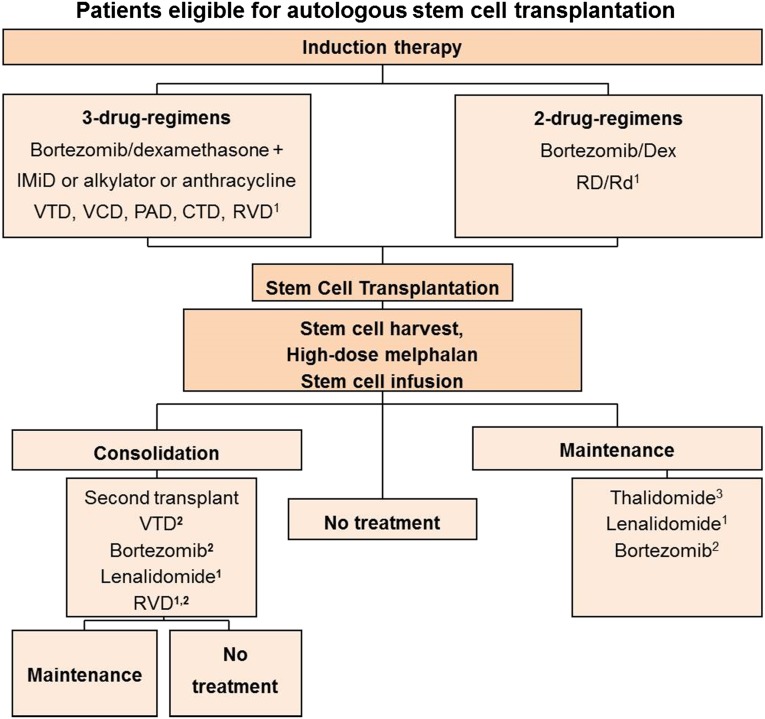
Figure 1.
Figure 1.
Treatment algorithm for patients eligible for autologous stem cell transplantation. 1Lenalidomide is currently not approved by the European Medicines Agency (EMA) for the treatment of newly diagnosed multiple myeloma or as consolidation or maintenance treatment. 2Bortezomib is currently not approved by the EMA as consolidation or maintenance treatment. 3Thalidomide is currently not approved by the EMA for the treatment of transplant-eligible patients or as consolidation or maintenance treatment. Abbreviations: CTD, cyclophosphamide, thalidomide, and dexamethasone; Dex, dexamethasone; IMiD, immunomodulatory drug; PAD, bortezomib, doxorubicin, and dexamethaone; Rd, lenalidomide, low-dose dexamethasone; RD, lenalidomide, high-dose dexamethasone; RVD, lenalidomide, bortezomib, and dexamethasone; VCD, bortezomib, cyclophosphamide, and dexamethasone; VTD, bortezomib, thalidomide, and dexamethasone.
Figure 2.
Figure 2.
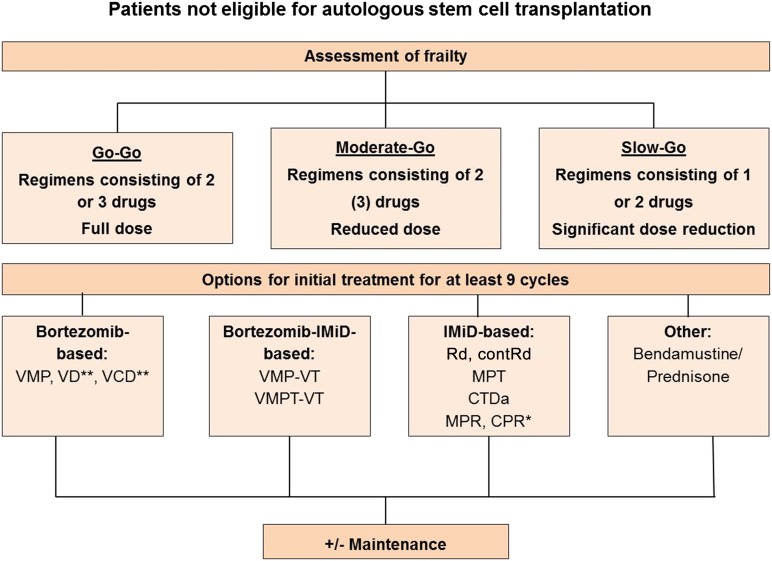
Treatment algorithm for patients not eligible for autologous stem cell transplantation. ∗, Rd and CPR showed similar activity in very elderly patients [90]; ∗∗, VD and VCD have activity similar to that of VMP [85, 86]. These treatments are not approved by the European Medicines Agency for treatment of transplant-ineligible patients. Abbreviations: contRd, lenalidomide, low-dose dexamethasone until progression; CPR, cyclophosphamide, prednisone, and lenalidomide; CTDa, attenuated cyclophosphamide, thalidomide, and dexamethasone; MPR, melaphalan, prednisone, and lenalidomide; MPT, melphalan, prednisone, and thalidomide; Rd, lenalidomide, low-dose dexamethasone; VCD, bortezomib, cyclophosphamide, and dexamethasone; VD, bortezomib and dexamethasone; VMP, bortezomib, melphalan, and prednisone.
Figure 3.
Figure 3.
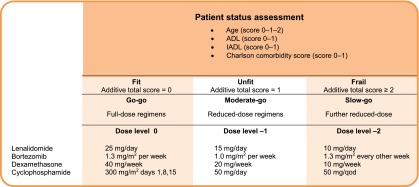
Treatment algorithm for elderly patients with myeloma (adapted from [104]). Abbreviations: ADL, activities of daily living; IADL, instrumental activities of daily living; qod, every other day.
Figure 4.
Figure 4.
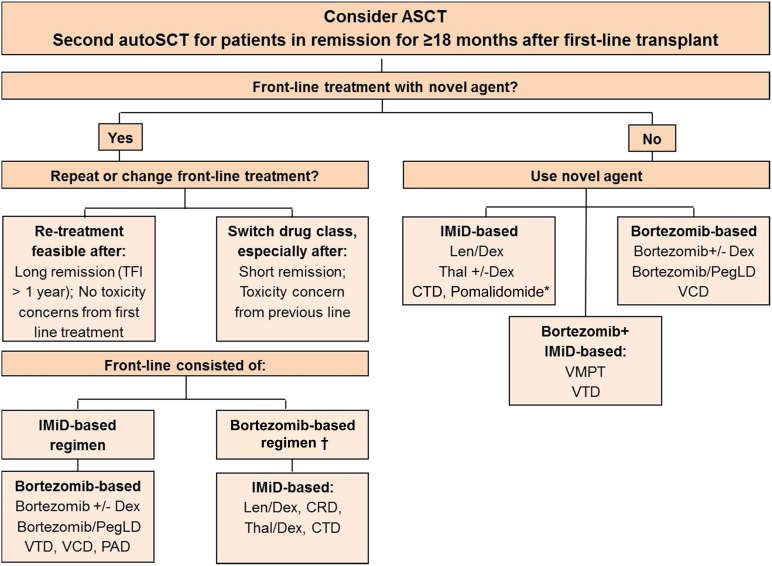
Treatment algorithm for patients in first relapse. †, Retreatment with bortezomib after front-line bortezomib only if no peripheral neuropathy (PN) is present or if PN has recovered and there is no other therapeutic alternative. ∗, Pomalidomide is likely to be a valuable option, but presently the agent is approved for third or later line therapy only. Abbreviations: autoSCT, autologous stem cell transplantation; CRD, cyclophosphamide, lenalidomide, and dexamethasone; CTD, cyclophosphamide, thalidomide, and dexamethasone; Dex, dexamethasone; IMiD, immunomodulatory drug; Len, lenalidomide; PAD, bortezomib, doxorubicin, and dexamethasone; PegLD: pegylated liposomal doxorubicin; TFI, treatment-free interval; Thal, thalidomide; VCD, bortezomib, cyclophosphamide, and dexamethasone; VTD, bortezomib, thalidomide, dexamethasone.

References

    1. Brenner H, Gondos A, Pulte D. Recent major improvement in long-term survival of younger patients with multiple myeloma. Blood. 2008;111:2521–2526. - PubMed
    1. Kumar SK, Rajkumar SV, Dispenzieri A, et al. Improved survival in multiple myeloma and the impact of novel therapies. Blood. 2008;111:2516–2520. - PMC - PubMed
    1. Kumar SK, Dispenzieri A, Lacy MQ, et al. Continued improvement in survival in multiple myeloma: Changes in early mortality and outcomes in older patients. Leukemia. 2013;28 - PMC - PubMed
    1. Turesson I, Velez R, Kristinsson SY, et al. Patterns of improved survival in patients with multiple myeloma in the twenty-first century: A population-based study. J Clin Oncol. 2010;28:830–834. - PMC - PubMed
    1. Venner CP, Connors JM, Sutherland HJ, et al. Novel agents improve survival of transplant patients with multiple myeloma including those with high-risk disease defined by early relapse (<12 months) Leuk Lymphoma. 2011;52:34–41. - PubMed

Publication types

MeSH terms