


CCMpred--fast and precise prediction of protein residue-residue contacts from correlated mutations
- PMID: 25064567
- PMCID: PMC4201158
- DOI: 10.1093/bioinformatics/btu500
CCMpred--fast and precise prediction of protein residue-residue contacts from correlated mutations
Abstract
Motivation: Recent breakthroughs in protein residue-residue contact prediction have made reliable de novo prediction of protein structures possible. The key was to apply statistical methods that can distinguish direct couplings between pairs of columns in a multiple sequence alignment from merely correlated pairs, i.e. to separate direct from indirect effects. Two classes of such methods exist, either relying on regularized inversion of the covariance matrix or on pseudo-likelihood maximization (PLM). Although PLM-based methods offer clearly higher precision, available tools are not sufficiently optimized and are written in interpreted languages that introduce additional overheads. This impedes the runtime and large-scale contact prediction for larger protein families, multi-domain proteins and protein-protein interactions.
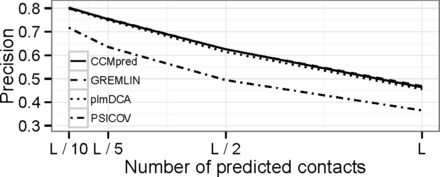
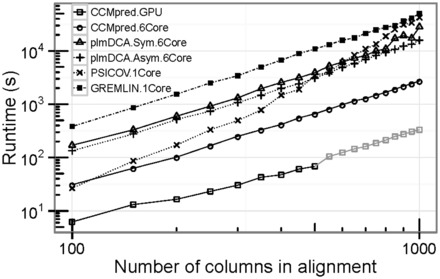
Results: Here we introduce CCMpred, our performance-optimized PLM implementation in C and CUDA C. Using graphics cards in the price range of current six-core processors, CCMpred can predict contacts for typical alignments 35-113 times faster and with the same precision as the most accurate published methods. For users without a CUDA-capable graphics card, CCMpred can also run in a CPU mode that is still 4-14 times faster. Thanks to our speed-ups (http://dictionary.cambridge.org/dictionary/british/speed-up) contacts for typical protein families can be predicted in 15-60 s on a consumer-grade GPU and 1-6 min on a six-core CPU.
Availability and implementation: CCMpred is free and open-source software under the GNU Affero General Public License v3 (or later) available at https://bitbucket.org/soedinglab/ccmpred.
© The Author 2014. Published by Oxford University Press.
Figures
References
-
- Dunn SD, et al. Mutual information without the influence of phylogeny or entropy dramatically improves residue contact prediction. Bioinformatics. 2008;24:333–340. - PubMed
-
- Ekeberg M, et al. Improved contact prediction in proteins: using pseudolikelihoods to infer potts models. Phys. Rev. E. 2013;87:012707. - PubMed
-
- Jones DT, et al. PSICOV: precise structural contact prediction using sparse inverse covariance estimation on large multiple sequence alignments. Bioinformatics. 2012;28:184–190. - PubMed
Publication types
MeSH terms
Substances
LinkOut - more resources
Full Text Sources
Other Literature Sources
