. 2014 Nov 1;30(21):3029-35.
doi: 10.1093/bioinformatics/btu502. Epub 2014 Jul 26.

CCBuilder: an interactive web-based tool for building, designing and assessing coiled-coil protein assemblies

Affiliations

CCBuilder: an interactive web-based tool for building, designing and assessing coiled-coil protein assemblies

Christopher W Wood et al. Bioinformatics. .

Abstract

Motivation: The ability to accurately model protein structures at the atomistic level underpins efforts to understand protein folding, to engineer natural proteins predictably and to design proteins de novo. Homology-based methods are well established and produce impressive results. However, these are limited to structures presented by and resolved for natural proteins. Addressing this problem more widely and deriving truly ab initio models requires mathematical descriptions for protein folds; the means to decorate these with natural, engineered or de novo sequences; and methods to score the resulting models.

Results: We present CCBuilder, a web-based application that tackles the problem for a defined but large class of protein structure, the α-helical coiled coils. CCBuilder generates coiled-coil backbones, builds side chains onto these frameworks and provides a range of metrics to measure the quality of the models. Its straightforward graphical user interface provides broad functionality that allows users to build and assess models, in which helix geometry, coiled-coil architecture and topology and protein sequence can be varied rapidly. We demonstrate the utility of CCBuilder by assembling models for 653 coiled-coil structures from the PDB, which cover >96% of the known coiled-coil types, and by generating models for rarer and de novo coiled-coil structures.

Availability and implementation: CCBuilder is freely available, without registration, at http://coiledcoils.chm.bris.ac.uk/app/cc_builder/.


Figures

Fig. 1.
Fig. 1.
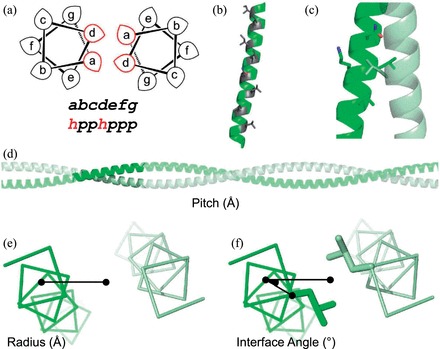
Sequence and structural features of the α-helical coiled coil. (a) Helical wheel representing a coiled-coil dimer. Hydrophobic residues are typically located at the a and d positions, with polar residues at the b, c, e, f and g positions. (b) A single helix from a coiled coil, highlighting the stripe of a/d residues (grey) that forms the assembly interface. (c) KIH packing, where the knob residue (usually a or d) from one helix (grey) projects into a hole created by four residues (black) on its partner (e.g. d’g’a’d’ or a’d’e’a’). (d) The pitch parameter describes the distance (Å) for a component helix to screw 360° around the super-helical axis. (e) The radius of assembly is measured from the super-helical axis to the centre of a component helix. (f) Interface angle, or ϕ1, is measured as the angle between the vector from the super-helical axis to the helical centre and the vector from the helical centre to the Cα carbon of an a-position residue
Fig. 2.
Fig. 2.
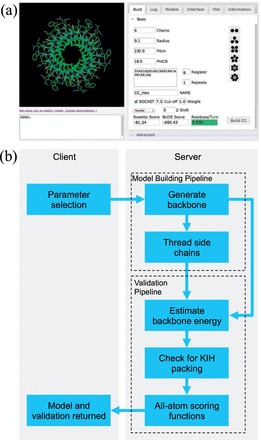
Overall architecture, appearance and workflow of CCBuilder. (a) GUI displaying the molecule viewer and the ‘Basic’ build tab, which contains fields for parameter entry and displays the returned model scoring. (b) Application architecture and workflow
Fig. 3.
Fig. 3.
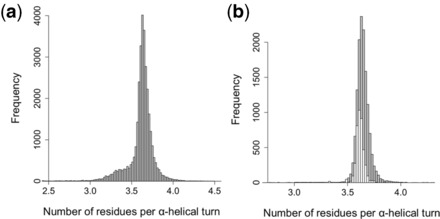
Distribution of residues per α-helical turn. (a) Residues per α-helical turn (n) in a set of 32 878 α-helices extracted from 2417 crystal structures with a resolution of <1.6 Å and sequence identity <30%, using helix definitions contained in the header of the coordinate files. Mean values of n = 3.60 (SD = 0.20). (b) Grey bars: values of n found in a subset of 13 703 helices from the distribution in Figure 3A, using helices defined by DSSP (Kabsch and Sander, 1983). Mean = 3.65 (SD = 0.07). White bars: values of n found in 4167 helices extracted from 1473 coiled-coil crystal structures. Mean = 3.62 (SD = 0.07)
Fig. 4.
Fig. 4.
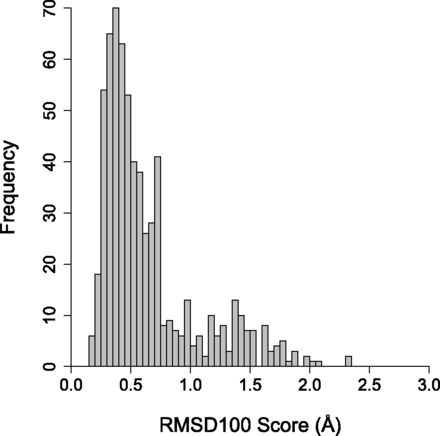
Distribution of RMSD100 scores measured between the backbone atoms of models generated with CCBuilder and crystal structures of known coiled coils. The set used for validation contained 594 parallel and 59 antiparallel coiled coils extracted from CC+ The mean RMSD100 score was 2.20 Å (SD = 0.67) for all atoms, 0.77 Å (SD = 0.49) for backbone only and 0.76 Å (SD = 0.53) for Cα carbons only
Fig. 5.
Fig. 5.
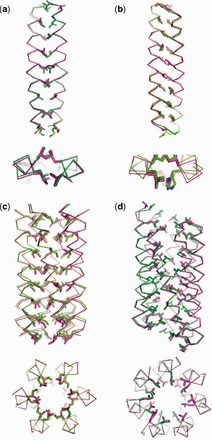
Overlays of crystal structures and models generated by CCBuilder. (a) Parallel dimer (2ZTA) RMSD 0.59 Å all atoms, 0.30 Å backbone and 0.30 Å Cα only. (b) Antiparallel dimer, with distinct z-shifted, (1GMJ) RMSD 0.98 Å all atoms, 0.63 Å backbone and 0.64 Å Cα only. (c) Parallel hexamer (3R3K) RMSD 0.71 Å all atoms, 0.34 Å backbone and 0.34 Å Cα only. (d) Slipped parallel heptamer (2HY6) 0.35 Å all atoms, 0.30 Å backbone and 0.29 Å Cα only. Key: Magenta = Crystal structure, Green = CCBuilder model

References

    1. Bansal M, et al. HELANAL: a program to characterize helix geometry in proteins. J. Biomol. Struct. Dyn. 2000;17:811–819. - PubMed
    1. Bowie JU, et al. A method to identify protein sequences that fold into a known three-dimensional structure. Science. 1991;253:164–170. - PubMed
    1. Bradley P, et al. Toward high-resolution de novo structure prediction for small proteins. Science. 2005;309:1868–1871. - PubMed
    1. Burton AJ, et al. Accessibility, reactivity, and selectivity of side chains within a channel of de novo peptide assembly. J. Am. Chem. Soc. 2013;135:12524–12527. - PubMed
    1. Cabezón E, et al. The structure of bovine IF(1), the regulatory subunit of mitochondrial F-ATPase. EMBO J. 2001;20:6990–6996. - PMC - PubMed

Publication types