


Revisiting the matricellular concept
- PMID: 25064829
- PMCID: PMC4379989
- DOI: 10.1016/j.matbio.2014.07.005
Revisiting the matricellular concept
Abstract
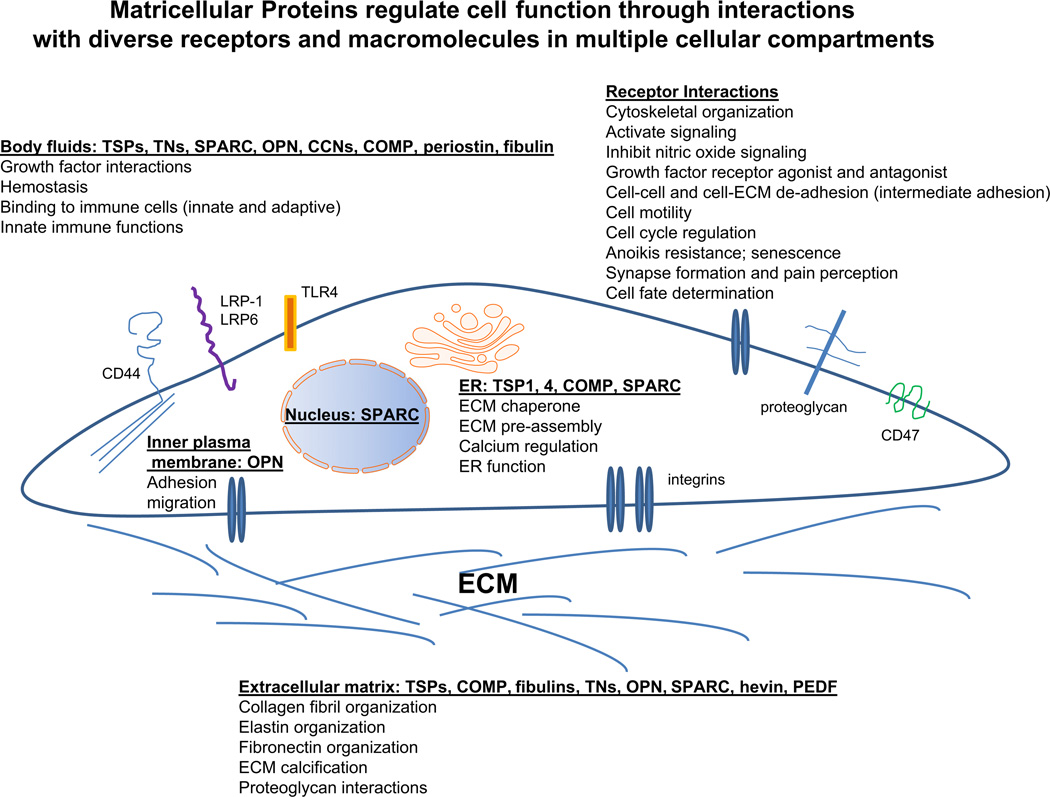
The concept of a matricellular protein was first proposed by Paul Bornstein in the mid-1990s to account for the non-lethal phenotypes of mice with inactivated genes encoding thrombospondin-1, tenascin-C, or SPARC. It was also recognized that these extracellular matrix proteins were primarily counter or de-adhesive. This review reappraises the matricellular concept after nearly two decades of continuous investigation. The expanded matricellular family as well as the diverse and often unexpected functions, cellular location, and interacting partners/receptors of matricellular proteins are considered. Development of therapeutic strategies that target matricellular proteins are discussed in the context of pathology and regenerative medicine.
Keywords: CCN; Cell adhesion; Extracellular matrix; Fibulin; Hevin; Matricellular; Osteopontin; Periostin; R-spondin; Regenerative medicine; SPARC; Tenascins; Thrombospondins.
Copyright © 2014. Published by Elsevier B.V.
Figures
References
-
- Acharya C, Yik JH, Kishore A, Van Dinh V, Di Cesare PE, Haudenschild DR. Cartilage oligomeric matrix protein and its binding partners in the cartilage extracellular matrix: interaction, regulation and role in chondrogenesis. Matrix Biol. 2014;37:102–111. in this issue. - PubMed
-
- Adams JC, Engel J. Bioinformaric analysis of adhesion proteins. Methods Mol. Biol. 2007;370:147–172. - PubMed
-
- Alberdi E, Aymerich MS, Becerra SP. Binding of pigment epithelium-derived factor (PEDF) to retinoblastoma cells and cerebellar granule neurons. Evidence for a PEDF receptor. J. Biol. Chem. 1999;274:31605–31612. - PubMed
Publication types
MeSH terms
Substances
Grants and funding
LinkOut - more resources
Full Text Sources
Other Literature Sources
Research Materials
Miscellaneous
