. 2014 Aug 7;95(2):143-61.
doi: 10.1016/j.ajhg.2014.06.014. Epub 2014 Jul 24.

The Alu-rich genomic architecture of SPAST predisposes to diverse and functionally distinct disease-associated CNV alleles

Affiliations

The Alu-rich genomic architecture of SPAST predisposes to diverse and functionally distinct disease-associated CNV alleles

Philip M Boone et al. Am J Hum Genet. .

Abstract

Intragenic copy-number variants (CNVs) contribute to the allelic spectrum of both Mendelian and complex disorders. Although pathogenic deletions and duplications in SPAST (mutations in which cause autosomal-dominant spastic paraplegia 4 [SPG4]) have been described, their origins and molecular consequences remain obscure. We mapped breakpoint junctions of 54 SPAST CNVs at nucleotide resolution. Diverse combinations of exons are deleted or duplicated, highlighting the importance of particular exons for spastin function. Of the 54 CNVs, 38 (70%) appear to be mediated by an Alu-based mechanism, suggesting that the Alu-rich genomic architecture of SPAST renders this locus susceptible to various genome rearrangements. Analysis of breakpoint Alus further informs a model of Alu-mediated CNV formation characterized by small CNV size and potential involvement of mechanisms other than homologous recombination. Twelve deletions (22%) overlap part of SPAST and a portion of a nearby, directly oriented gene, predicting novel chimeric genes in these subjects' genomes. cDNA from a subject with a SPAST final exon deletion contained multiple SPAST:SLC30A6 fusion transcripts, indicating that SPAST CNVs can have transcriptional effects beyond the gene itself. SLC30A6 has been implicated in Alzheimer disease, so these fusion gene data could explain a report of spastic paraplegia and dementia cosegregating in a family with deletion of the final exon of SPAST. Our findings provide evidence that the Alu genomic architecture of SPAST predisposes to diverse CNV alleles with distinct transcriptional--and possibly phenotypic--consequences. Moreover, we provide further mechanistic insights into Alu-mediated copy-number change that are extendable to other loci.


Figures

Figure 1
Figure 1
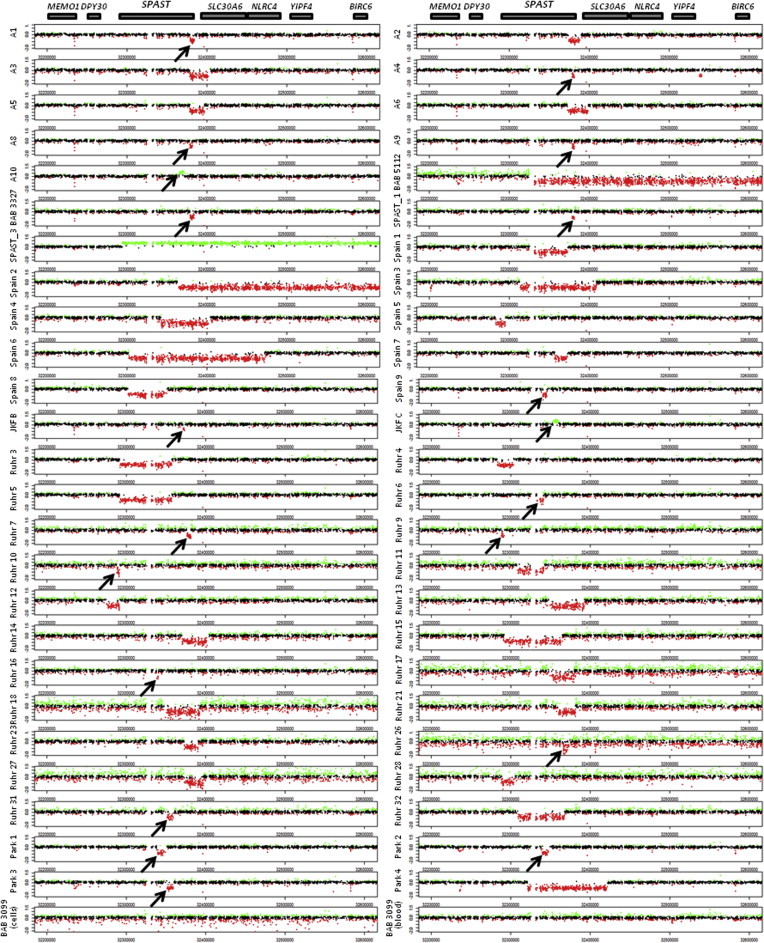
Targeted aCGH Confirms and Maps CNVs in SPAST Array CGH log2 plots are aligned with models of SPAST and nearby genes. Very small CNVs are indicated by arrows. Coordinates refer to chromosome 2. No SPAST CNV was identified in either blood- or cell-culture-derived DNA from the control individual, BAB 3099.
Figure 2
Figure 2
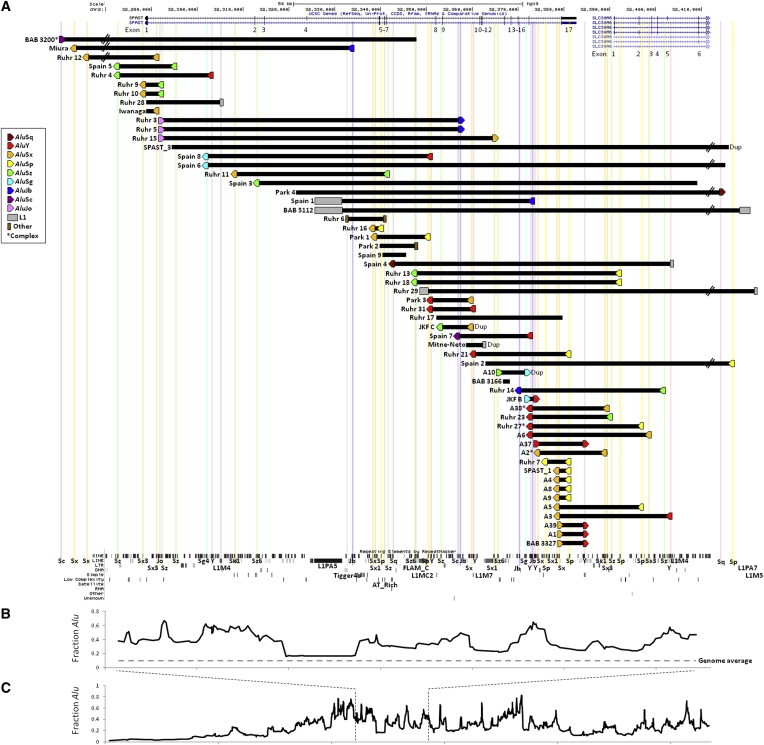
CNVs in SPAST Rearrange Diverse Exons and Have Breakpoints Predominately Localizing to Pairs of Alus in Direct Orientation (A) CNVs are plotted by exact coordinates obtained by sequencing (black bars) and include both duplications (denoted “Dup”) and deletions (all others). Repetitive elements at CNV breakpoints are indicated by colored shapes and aligned with the RepeatMasker track (bottom, via UCSC Genome Browser) by colored lines. The genomic orientation of Alus is denoted by a right-facing (+) or left-facing (−) pentagon. Of 59 breakpoints, 39 (66%) localize to directly oriented Alu pairs. Note that BAB 3166 was identified in a young individual with no current spastic paraplegia and that the phenotypes of SPAST_1 and SPAST_3 are unknown; thus, these three CNVs might or might not be pathogenic. Complex CNV (these CNVs are plotted as simple CNVs with only the first and final breakpoint repeat indicated). The breakpoints of Ruhr 26 and Ruhr 32 were not found, so these CNVs are not included. (B) A moving average of Alu density (calculated in overlapping blocks of ten Alu elements) is aligned with (A), demonstrating that SPAST is overall an Alu-rich gene with “neighborhoods” of even higher Alu density. Alu data were downloaded from RepeatMasker. (C) Zoomed-out plot of Alu density over a ∼1.1 Mb section of chromosome 2.
Figure 3
Figure 3
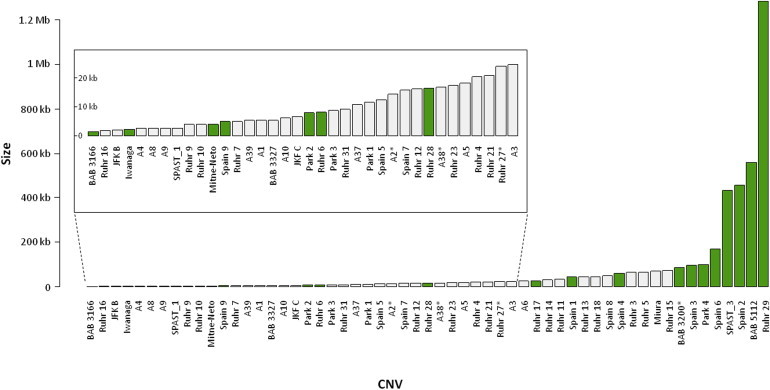
CNV Size: Skew toward Small Rearrangements and Association with Breakpoint Repeat Architecture SPAST CNVs, plotted in ascending size order. Most SPAST CNVs are small (median size = 16.5 kb). CNVs flanked by Alu pairs (gray) are significantly smaller than remaining CNVs (green) (Kruskal-Wallis rank sum test, p = 0.00856; identical CNVs in multiple individuals [e.g., Ruhr 3 and 5] are collapsed to single entries, and CNVs published by other authors [which may be biased toward small, non-Alu-Alu-mediated events] are removed). Complex CNV. BAB 5112 is LINE-LINE mediated. CNVs <25 kb are magnified in the inset to show detail. The size of complex CNVs is rounded to the nearest 0.1 kb.
Figure 4
Figure 4
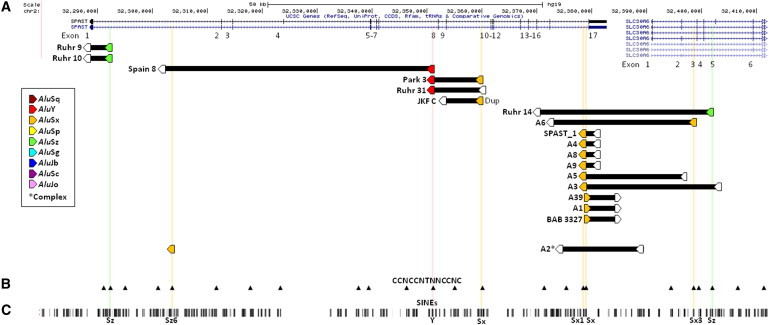
The Consensus 13-mer, CCNCCNTNNCCNC, Associated with Meiotic Recombination/NAHR Hotspots Is Present at Breakpoint Alus of Some Alu-Mediated CNVs (A) CNVs (black bars) displayed with breakpoint Alus (pentagons; filled and intersected by a colored line if they contain the consensus 13-mer [CCNCCNTNNCCNC] associated with meiotic recombination/ NAHR hotspots42, 43). This motif is present at a single breakpoint Alu of ten Alu-mediated CNVs, at both breakpoint Alus of one CNV (Park 3), and in the Alu from which inserted breakpoint sequence is derived in one apparently complex rearrangement (A2). Abbreviation: Dup, duplication. (B) All instances of the 13-mer (black arrowheads). (C) SINE elements (RepeatMasker track via UCSC Genome Browser).
Figure 5
Figure 5
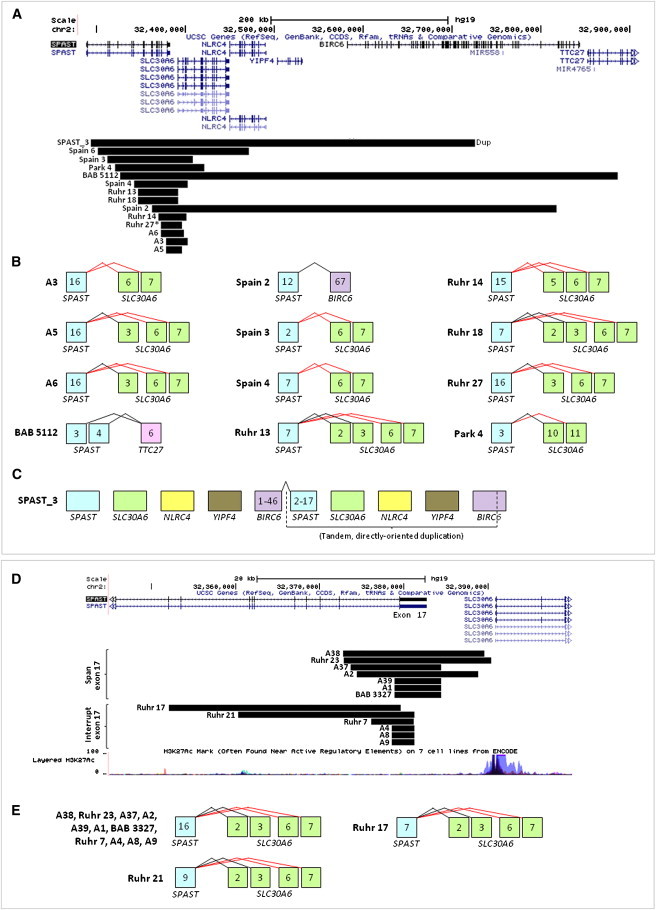
SPAST CNVs Extending into 3′ Genes Create Chimeric Genes, and Deletions Involving the Final Exon of SPAST Might Create SPAST:SLC30A6 Fusion Transcripts or Alter SLC30A6 Expression (A–C) Deletions extending into 3′ genes. (A) Fourteen CNVs (black bars) extend into genes 3′ of SPAST (13 deletions, 1 duplication). Three of the downstream genes (SLC30A6, BIRC6, TTC27) are in direct orientation with SPAST; thus, SPAST deletions intersecting these 3′ genes potentially yield chimeric genes. (B) Potential fusion transcripts resulting from the deletions shown in (A) for which the 3′ intersected gene is directly oriented with SPAST. Potential fusion transcripts are based only on known splice isoforms of the 3′ genes and include all SPAST exons present, although other splice variants are possible. Predicted in-frame splicing is shown in black, out-of-frame in red. The deletion intersecting NLRC4 (Spain 6) is not shown, because this gene is oriented oppositely to SPAST. (C) Potential fusion transcript resulting from the duplication in subject SPAST_3. This tandem, directly oriented duplication results in duplication of three genes (SLC30A6, NLRC4, YIPF4) and a potential in-frame transcript joining exons 1–46 of BIRC6 with exons 2–17 of SPAST; the normal, diploid copy number of full-length SPAST and BIRC6 are left intact. (D and E) Deletions involving the final exon of SPAST. (D) Deletions with 3′ breakpoints in the intergenic space between SPAST and SLC30A6 (top, “span exon 17”) or within the final exon of SPAST (exon 17) (bottom, “interrupt exon 17”). The former group of deletions may alter SLC30A6 expression by eliminating upstream SLC30A6 regulatory sequence (potential regulatory sequences shown by H3K27Ac track from UCSC), and both groups of CNVs may result in fusion transcripts with SLC30A6 by eliminating splicing to SPAST exon 17. (E) Potential fusion transcripts resulting from the deletions shown in (D). Potential fusion transcripts are based only on known splice isoforms of SLC30A6 and include all SPAST exons present. Black, predicted in-frame; red, predicted out of frame.
Figure 6
Figure 6
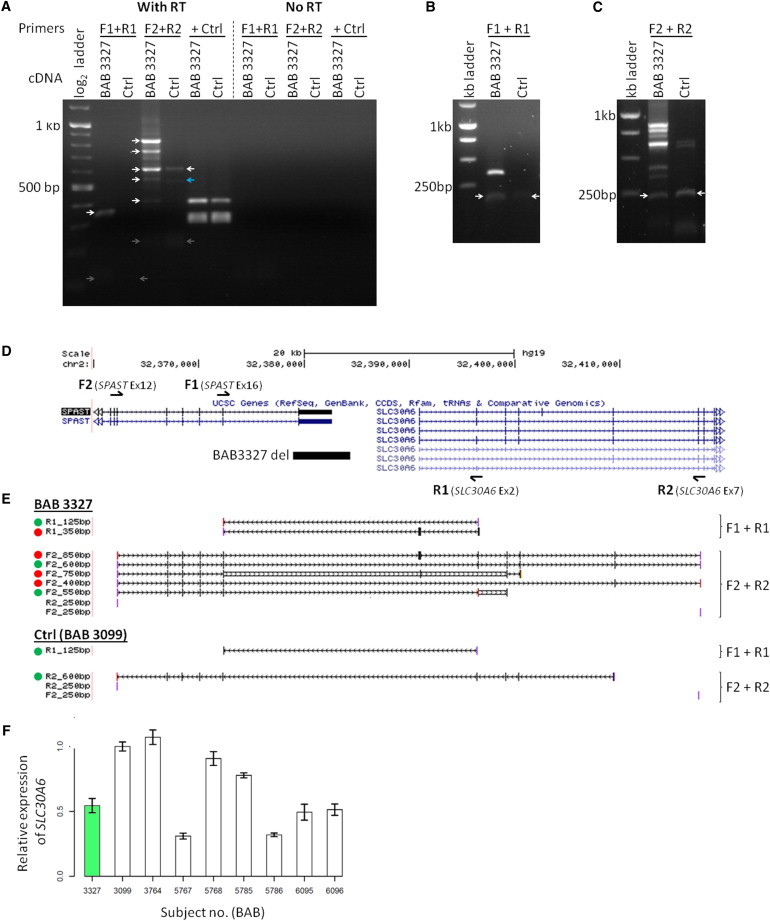
A Deletion of SPAST Exon 17 Yields Multiple SPAST:SLC30A6 Fusion Transcripts (A–D) PCR primers (arrows above and below gene models in D) were designed to detect SPAST:SLC30A6 fusion transcripts in cDNA from subject BAB 3327, who has a deletion encompassing SPAST exon 17 (black bar in D). One primer set (F1 and R1) closely flanks the deletion, and the other (F2 and R2) spans a greater distance to account for alternative splicing known to exist in SLC30A6 (exon 7 is the first constitutive exon in this gene). PCR of cDNA (A) reveals multiple transcripts in BAB 3327 not present in the control individual (BAB 3099). The majority of bands (white arrows) were extracted and sequenced. One extracted band (blue arrow) failed sequencing. Four bands (gray arrows) required a second preparation/electrophoresis to be visualized, extracted, and sequenced (B and C, white arrows). (E) Sequencing of PCR products in (A)–(C) demonstrates a variety of SPAST:SLC30A6 fusion transcript isoforms in BAB 3327, only some of which are present in the control individual (BAB 3099). Dots indicate predicted in-frame (green dots) or out-of-frame (red dots) transcripts. Reading frame is unclear for transcripts with no dot. PCR products were sequenced in both forward (F) and reverse (R) genomic orientation, although only one orientation may be shown. (F) SLC30A6 qPCR. In lymphoblastoid cell lines, overall level of expression of SLC30A6 in BAB 3327 does not differ significantly from that of eight healthy controls (50th centile versus controls, empirical cumulative distribution function). Data plotted as mean ± standard deviation.

References

    1. Wiszniewski W., Hunter J.V., Hanchard N.A., Willer J.R., Shaw C., Tian Q., Illner A., Wang X., Cheung S.W., Patel A. TM4SF20 ancestral deletion and susceptibility to a pediatric disorder of early language delay and cerebral white matter hyperintensities. Am. J. Hum. Genet. 2013;93:197–210. - PMC - PubMed
    1. Okamoto Y., Goksungur M.T., Pehlivan D., Beck C.R., Gonzaga-Jauregui C., Muzny D.M., Atik M.M., Carvalho C.M.B., Matur Z., Bayraktar S. Exonic duplication CNV of NDRG1 associated with autosomal-recessive HMSN-Lom/CMT4D. Genet. Med. 2014;16:386–394. - PMC - PubMed
    1. Benito-Sanz S., Royo J.L., Barroso E., Paumard-Hernández B., Barreda-Bonis A.C., Liu P., Gracía R., Lupski J.R., Campos-Barros Á., Gómez-Skarmeta J.L., Heath K.E. Identification of the first recurrent PAR1 deletion in Léri-Weill dyschondrosteosis and idiopathic short stature reveals the presence of a novel SHOX enhancer. J. Med. Genet. 2012;49:442–450. - PubMed
    1. Hjeij R., Lindstrand A., Francis R., Zariwala M.A., Liu X., Li Y., Damerla R., Dougherty G.W., Abouhamed M., Olbrich H. ARMC4 mutations cause primary ciliary dyskinesia with randomization of left/right body asymmetry. Am. J. Hum. Genet. 2013;93:357–367. - PMC - PubMed
    1. Loureiro J.L., Brandão E., Ruano L., Brandão A.F., Lopes A.M., Thieleke-Matos C., Miller-Fleming L., Cruz V.T., Barbosa M., Silveira I. Autosomal dominant spastic paraplegias: a review of 89 families resulting from a portuguese survey. JAMA Neurol. 2013;70:481–487. - PubMed

Publication types

Supplementary concepts

LinkOut - more resources