


Gene expression in subcutaneous adipose tissue differs in women with polycystic ovary syndrome and controls matched pair-wise for age, body weight, and body mass index
- PMID: 25068085
- PMCID: PMC4110095
- DOI: 10.4161/adip.28731
Gene expression in subcutaneous adipose tissue differs in women with polycystic ovary syndrome and controls matched pair-wise for age, body weight, and body mass index
Abstract
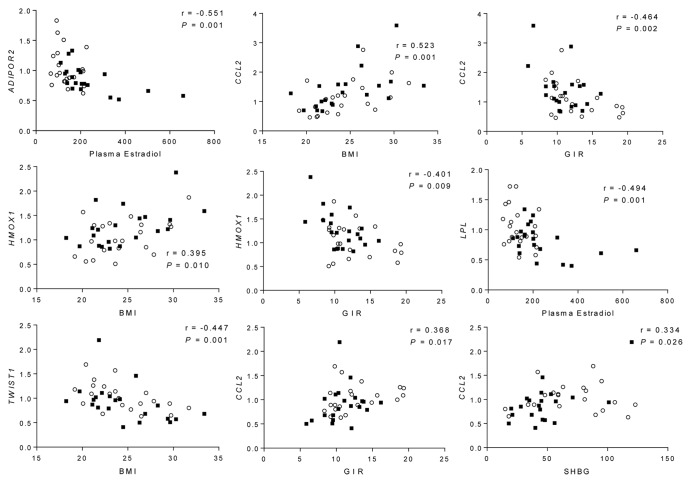
Adipose tissue dysfunction may be a central factor in the pathogenesis of insulin resistance in women with polycystic ovary syndrome (PCOS). Gene expression in subcutaneous adipose tissue in PCOS and its relation to metabolic and endocrine features of the syndrome have been fragmentarily investigated. The aim was to assess in subcutaneous adipose tissue the expression of genes potentially associated with adipose tissue dysfunction and to explore their relation to features of the syndrome. Twenty-one women with PCOS (body mass index [BMI] 18.2-33.4 kg/m(2)) and 21 controls (BMI 19.2-31.7 kg/m(2)) were matched pair-wise for age, body weight, and BMI. Tissue biopsies were obtained to measure mRNA expression of 44 genes (TaqMan Low Density Array). Differential expression levels were correlated with BMI, glucose infusion rate (GIR), sex hormone binding globulin (SHBG), and sex steroids. In PCOS, expression of adiponectin receptor 2 (ADIPOR2), LPL, and twist-related protein 1 (TWIST1) was decreased, while expression of chemokine (C-C motif) ligand 2 (CCL2) and heme oxygenase (decycling 1) (HMOX1) was increased. TWIST1 and HMOX1, both novel adipokines, correlated with BMI and GIR. After BMI adjustment, LPL and ADIPOR2 expression correlated with plasma estradiol, and CCL2 expression correlated with GIR, in all women. We conclude that adipose tissue mRNA expression differed in PCOS women and controls and that two novel adipokines, TWIST1 and HMOX1, together with adiponectin, LPL, and CCL2, and their downstream pathways merit further investigation.
Keywords: PCOS; adiponectin receptor 2 (ADIPOR2); adipose tissue; chemokine (C-C motif) ligand 2 (CCL2); gene expression; heme oxygenase (decycling 1) (HMOX1); insulin sensitivity; lipoprotein lipase (LPL); twist-related protein 1 (TWIST1).
Figures

References
-
- Mannerås-Holm L, Leonhardt H, Kullberg J, Jennische E, Odén A, Holm G, Hellström M, Lönn L, Olivecrona G, Stener-Victorin E, et al. Adipose tissue has aberrant morphology and function in PCOS: enlarged adipocytes and low serum adiponectin, but not circulating sex steroids, are strongly associated with insulin resistance. J Clin Endocrinol Metab. 2011;96:E304–11. doi: 10.1210/jc.2010-1290. - DOI - PubMed
-
- Corbould A. Insulin resistance in skeletal muscle and adipose tissue in polycystic ovary syndrome: are the molecular mechanisms distinct from type 2 diabetes? Panminerva Med. 2008;50:279–94. - PubMed
LinkOut - more resources
Full Text Sources
Other Literature Sources
Research Materials
Miscellaneous
