. 2014 Aug;6(8):2096-110.
doi: 10.1093/gbe/evu160.

Genome evolution and plasticity of Serratia marcescens, an important multidrug-resistant nosocomial pathogen

Affiliations

Genome evolution and plasticity of Serratia marcescens, an important multidrug-resistant nosocomial pathogen

Atsushi Iguchi et al. Genome Biol Evol. 2014 Aug.

Abstract

Serratia marcescens is an important nosocomial pathogen that can cause an array of infections, most notably of the urinary tract and bloodstream. Naturally, it is found in many environmental niches, and is capable of infecting plants and animals. The emergence and spread of multidrug-resistant strains producing extended-spectrum or metallo beta-lactamases now pose a threat to public health worldwide. Here we report the complete genome sequences of two carefully selected S. marcescens strains, a multidrug-resistant clinical isolate (strain SM39) and an insect isolate (strain Db11). Our comparative analyses reveal the core genome of S. marcescens and define the potential metabolic capacity, virulence, and multidrug resistance of this species. We show a remarkable intraspecies genetic diversity, both at the sequence level and with regards genome flexibility, which may reflect the diversity of niches inhabited by members of this species. A broader analysis with other Serratia species identifies a set of approximately 3,000 genes that characterize the genus. Within this apparent genetic diversity, we identified many genes implicated in the high virulence potential and antibiotic resistance of SM39, including the metallo beta-lactamase and multiple other drug resistance determinants carried on plasmid pSMC1. We further show that pSMC1 is most closely related to plasmids circulating in Pseudomonas species. Our data will provide a valuable basis for future studies on S. marcescens and new insights into the genetic mechanisms that underlie the emergence of pathogens highly resistant to multiple antimicrobial agents.

Keywords: Serratia marcescens; genome plasticity; multidrug resistance; virulence.


Figures

F<sc>ig</sc>. 1.—
Fig. 1.—
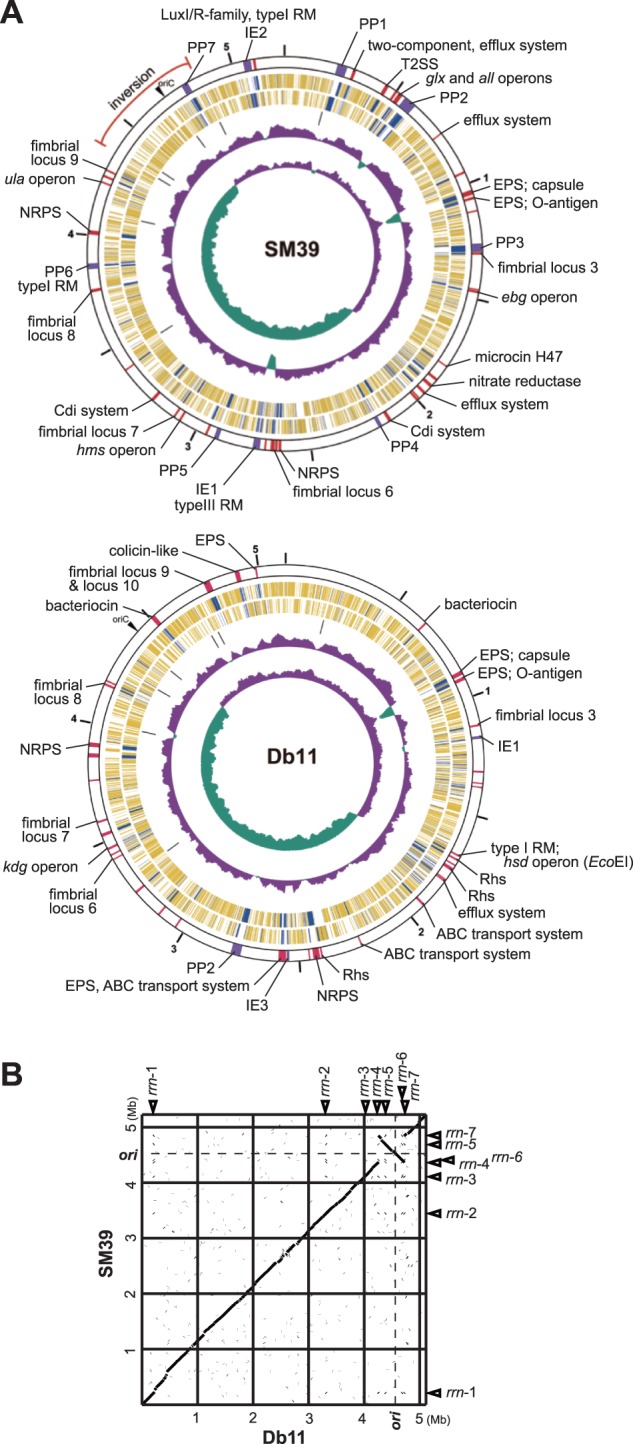
The chromosomes of Serratia marcescens strains SM39 and Db11. (A) Circular maps of the SM39 and Db11 chromosomes. From the outside in, the first circle shows the nucleotide sequence positions (in Mb), and the second circle shows the locations of strain-specific regions of ≥5 kb (purple: prophages and integrative elements; red: others) with an indication of their features and/or encoded products/functions (PP, prophages; IE, integrative elements; EPS, exopolysaccharide biosynthesis). The third and fourth circles show CDSs transcribed clockwise and anticlockwise, respectively (yellow: CDSs conserved in both strains, blue: CDSs specific to one strain), the fifth circle the rRNA operons, the sixth circle the G+C content, and the seventh circle the GC skew. (B) Dot plot presentation of DNA sequence homologies between the chromosomes. Locations of ori and seven rRNA operons (rrn1–rrn7) are indicated.
F<sc>ig</sc>. 2.—
Fig. 2.—
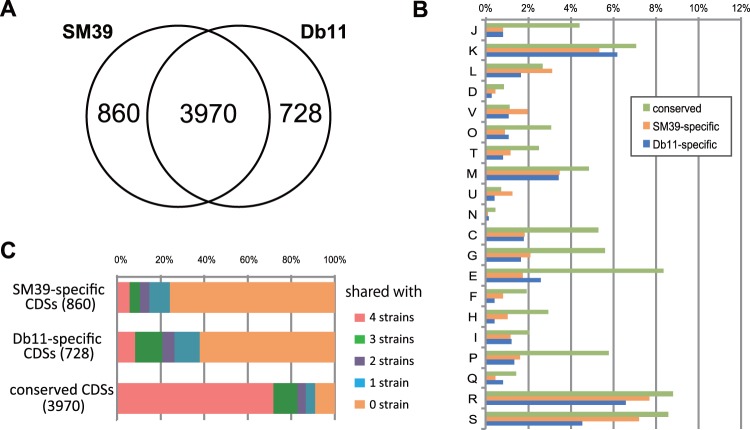
Comparison of the gene contents of SM39 and Db11. (A) Venn diagram showing the numbers of conserved and strain-specific CDSs. (B) COG category-based functional analysis of each group of CDSs, the conserved and strain-specific CDSs. J: translation, ribosomal structure, and biogenesis; K: transcription; L: replication, recombination, and repair; D: cell cycle control, cell division chromosome partitioning; V: defense mechanisms; O: posttranslational modification, protein turnover, and chaperones; T: signal transduction mechanisms; M: cell wall/membrane/envelope biogenesis; U: intracellular trafficking, secretion, and vesicular transport; N: Cell motility; C: energy production and conversion; G: carbohydrate transport and metabolism; E: amino acid transport and metabolism; F: nucleotide transport and metabolism; H: coenzyme transport and metabolism; I: lipid transport and metabolism; P: inorganic ion transport and metabolism; Q: secondary metabolites biosynthesis, transport, and catabolism; R: general function prediction only; S: function unknown. (C) Conservation of each group of CDSs in four strains of other Serratia species (S. proteamaculans 568, S. odorifera DSM4582, S. plymuthica 4Rx13, and S. plymuthica AS9).
F<sc>ig</sc>. 3.—
Fig. 3.—
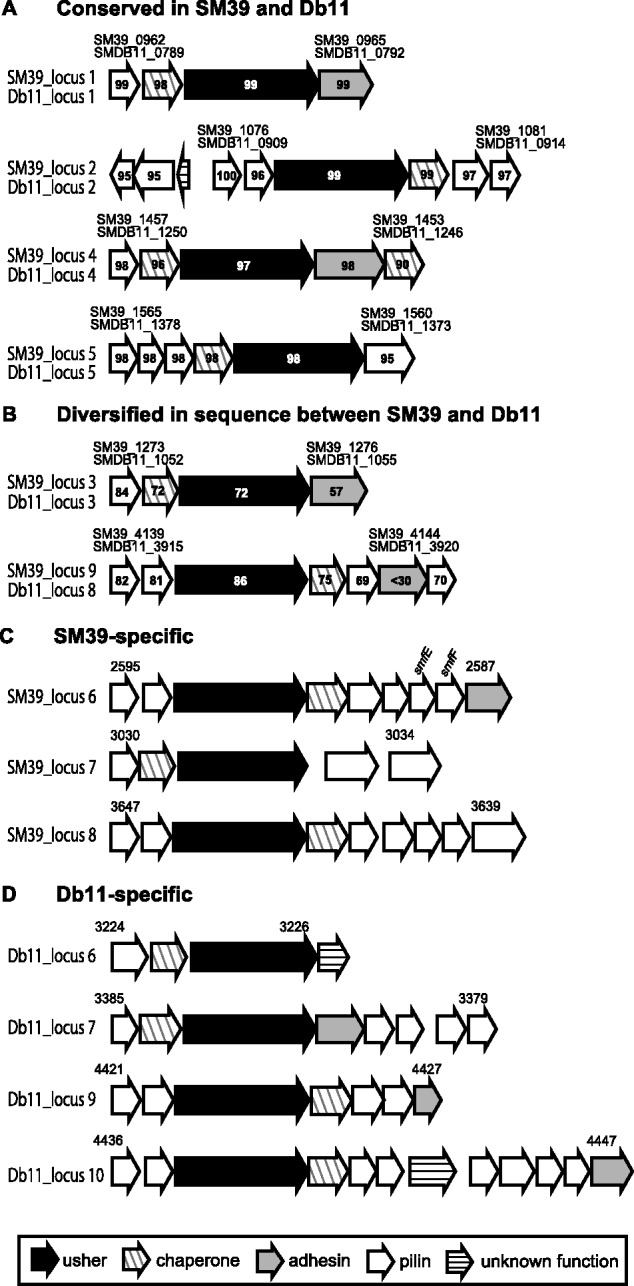
Fimbriae operons identified in SM39 and Db11. The gene organization of the operons for biosynthesis of chaperone-usher fimbriae identified in SM39 and Db11 is shown. (A) Operons “conserved” between the two strains showing a high sequence identity (>95% amino acid sequence identity for all gene products) and (B) genes in the “diversified” operons show low sequence identity (up to 86% amino acid sequence identity). Note that both strains contain a set of type IV fimbriae-related genes, orthologs of which have been identified of Escherichia coli, and that a homologue (SM39_0944) of yagZ/ecpA/matB, the gene for E. coli common pili (also known as Mat fimbriae) was found in SM39 but not in Db11.
F<sc>ig</sc>. 4.—
Fig. 4.—
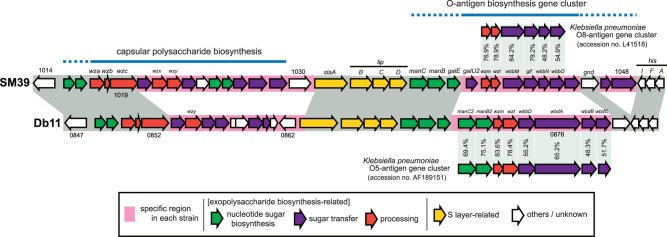
Comparison of the SM39 and Db11 genomic loci bearing exopolysaccharide biosynthesis gene clusters. The gene organization of the gene clusters for O antigen biosynthesis and for group 1 CPS biosynthesis is compared between SM39 (untypeable) and Db11 (O28:K7). The O antigen biosynthesis genes of SM39 and Db11 show high level of similarities to those of Klebsiella pneumoniae O8 and those of K. pneumoniae O5, respectively. The Db11 operon also has a high level of similarity to that of Escherichia coli O8 (Iguchi A, Iyoda S, Kikuchi T, Ogura Y, Katsura K, Ohnishi M, Hayashi T and Thomson NR, unpublished data), consistent with the cross-reactivity between Serratia marcescens O28, K. pneumoniae O5, and E. coli O8 antigens previously reported by Aucken and Pitt (1991).
F<sc>ig</sc>. 5.—
Fig. 5.—
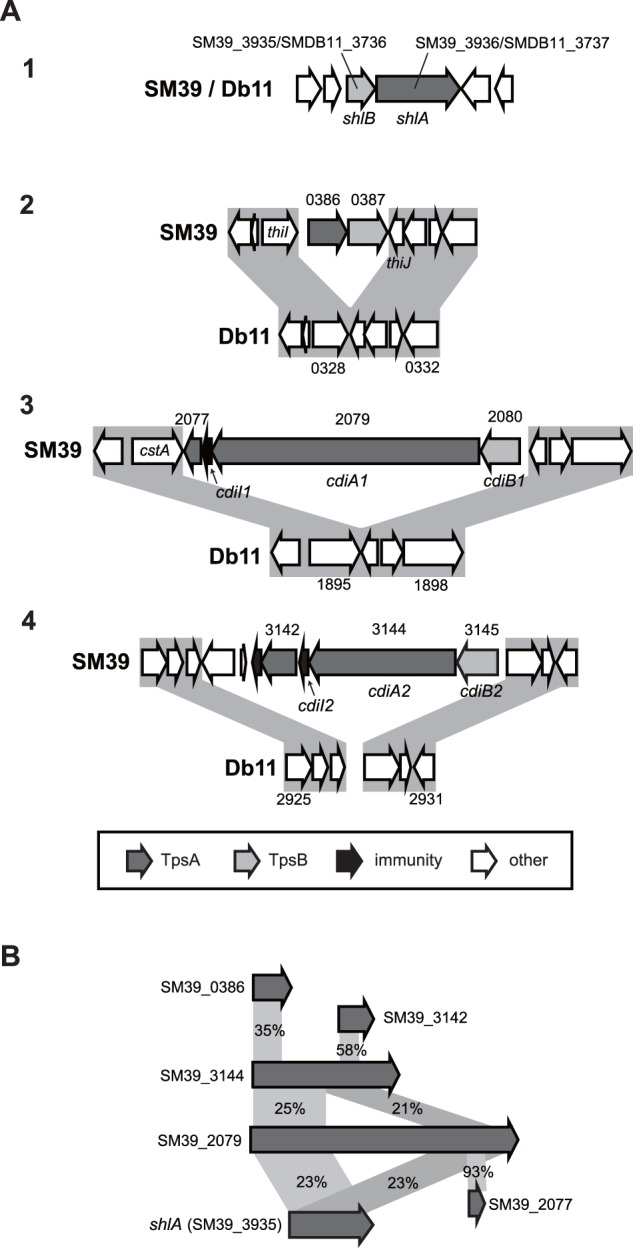
Gene clusters for hemolysin/hemagglutin-like two-partner Type V secretion systems identified in SM39 and Db11. (A) The gene organization of the gene clusters for hemolysin/hemagglutin-like two-partner systems in SM39 and Db11 is shown. TpsA components are the passenger proteins (including the ShlA hemolysin and CdiA proteins) and TpsB components are the cognate translocator proteins (including ShlB and CdiB proteins). Although the shlBA operon (image 1) is conserved in the two strains, three additional gene clusters were found only in SM39. Two of these, SM39_2080-2077 (image 3) and SM39_3145-3141 (image 4), based on homology, encode Cdi systems. In addition to CdiA and CdiB proteins, a third component conferring resistance to the C-terminal toxin domain of CdiA is encoded downstream of CdiA, the CdiI immunity protein (SM39_2078 and SM39_3143, respectively). A putative “orphan” CdiA C-terminus (including a distinct potential toxin domain) and cognate CdiI pair is encoded by SM39_3142-3141. The function of the third SM39-specific cluster, SM39_0386-0387 (image 2), is unknown. (B) Similarities between the TpsA hemolysin/hemagglutin-related proteins (amino acid sequence identity) are shown, with those newly identified in SM39 showing partial similarity to ShlA.
F<sc>ig</sc>. 6.—
Fig. 6.—
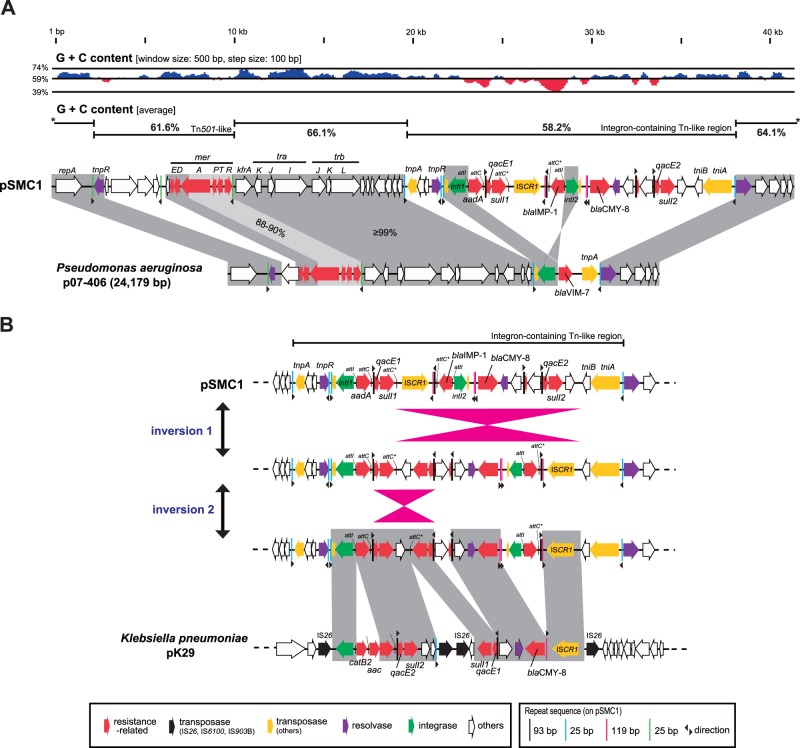
Genomic features and a possible evolutionary process of the pSMC1 multidrug-resistant plasmid of SM39. (A) Genomic comparison of pSMC1 and p07-406, an IncP plasmid of Pseudomonas aeruginosa. Although significant differences were observed in the region corresponding to a Tn501-like transposon and the region corresponding to an integron-carrying transposon, the backbones of the two plasmid genomes are nearly identical and their GC content is significantly higher than that of the Serratia marcescens chromosomes and rather similar to that of Pseudomonas species, suggesting that pSMC1 originated from Pseudomonas species. (B) Structural comparison of the integron of pSMC1 with that on pK29 of Klebsiella pneumoniae. The difference in genetic structure between the two integrons could be generated by two inversion events and by insertion of IS elements and acquisition/duplication of several genes.

References

    1. Andrews SC, Robinson AK, Rodriguez-Quinones F. Bacterial iron homeostasis. FEMS Microbiol Rev. 2003;27:215–237. - PubMed
    1. Aoki SK, et al. A widespread family of polymorphic contact-dependent toxin delivery systems in bacteria. Nature. 2010;468:439–442. - PMC - PubMed
    1. Aucken HM, Pitt TL. Serological relationships of the O antigens of Klebsiella pneumoniae O5, Escherichia coli O8 and a new O serotype of Serratia marcescens. FEMS Microbiol Lett. 1991;64:93–97. - PubMed
    1. Chain PS, et al. Genomics. Genome project standards in a new era of sequencing. Science. 2009;326:236–237. - PMC - PubMed
    1. Chen J, Kuroda T, Huda MN, Mizushima T, Tsuchiya T. An RND-type multidrug efflux pump SdeXY from Serratia marcescens. J Antimicrob Chemother. 2003;52:176–179. - PubMed

Publication types

MeSH terms

Substances