


Deep layer neurons in the rat medial entorhinal cortex fire sparsely irrespective of spatial novelty
- PMID: 25071455
- PMCID: PMC4092364
- DOI: 10.3389/fncir.2014.00074
Deep layer neurons in the rat medial entorhinal cortex fire sparsely irrespective of spatial novelty
Abstract
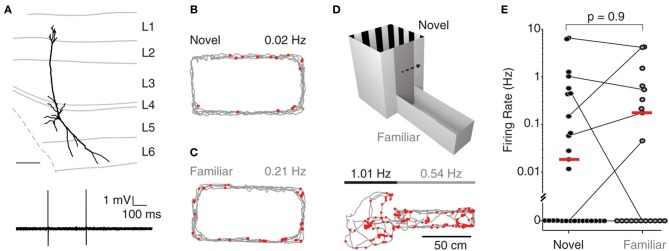
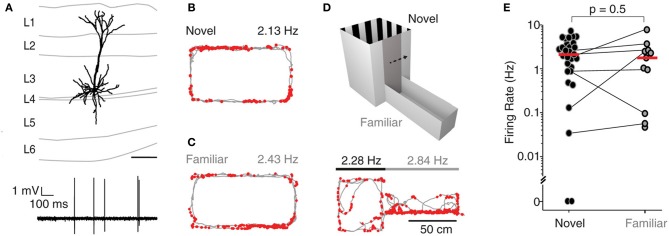
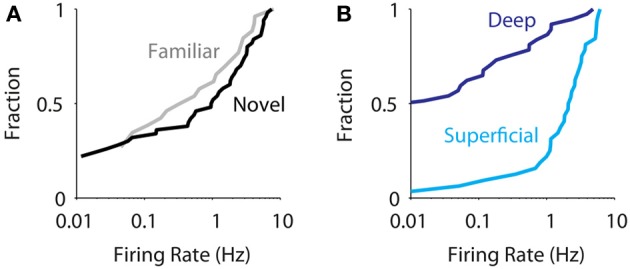
Extracellular recordings in medial entorhinal cortex have revealed the existence of spatially-modulated firing patterns, which are thought to contribute to a cognitive map of external space. Previous work indicated that during exploration of novel environments, spiking activity in deep entorhinal layers is much sparser than in superficial layers. In the present report, we ask whether this laminar activity profile is a consequence of environmental novelty. We report on a large dataset of juxtacellularly-recorded neurons (n = 70) whose spiking activity was monitored while rats explored either a novel or a familiar environment, or both within the same session. Irrespective of previous knowledge of the environment, deep layer activity was very low during exploration (median firing rate 0.4 Hz for non-silent cells), with a large fraction of silent cells (n = 19 of a total 37), while superficial layer activity was several times higher (median firing rate 2.4 Hz; n = 33). The persistence of laminar differences in firing activity both under environmental novelty and familiarity, and even in head-restrained stationary animals, suggests that sparse coding might be a constitutive feature of deep entorhinal layers.
Keywords: medial entorhinal cortex; novelty; rat; sparse coding; spatial.
Figures
References
Publication types
MeSH terms
LinkOut - more resources
Full Text Sources
Other Literature Sources
