


Reproduction, smell, and neurodevelopmental disorders: genetic defects in different hypogonadotropic hypogonadal syndromes
- PMID: 25071724
- PMCID: PMC4088923
- DOI: 10.3389/fendo.2014.00109
Reproduction, smell, and neurodevelopmental disorders: genetic defects in different hypogonadotropic hypogonadal syndromes
Abstract
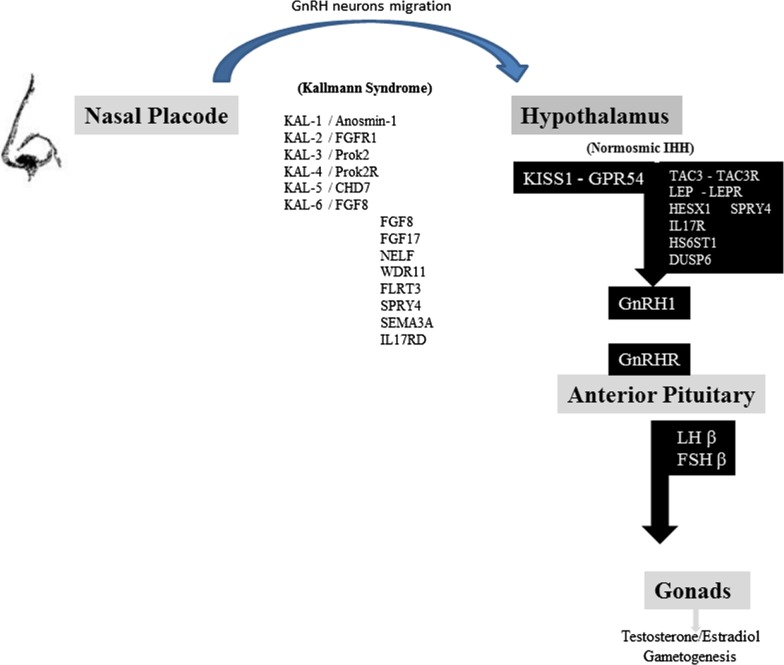
The neuroendocrine control of reproduction in mammals is governed by a neural hypothalamic network of nearly 1500 gonadotropin-releasing hormone (GnRH) secreting neurons that modulate the activity of the reproductive axis across life. Congenital hypogonadotropic hypogonadism (HH) is a clinical syndrome that is characterized by partial or complete pubertal failure. HH may result from inadequate hypothalamic GnRH axis activation, or a failure of pituitary gonadotropin secretion/effects. In man, several genes that participate in olfactory and GnRH neuronal migration are thought to interact during the embryonic life. A growing number of mutations in different genes are responsible for congenital HH. Based on the presence or absence of olfaction dysfunction, HH is divided in two syndromes: HH with olfactory alterations [Kallmann syndrome (KS)] and idiopathic hypogonadotropic hypogonadism (IHH) with normal smell (normosmic IHH). KS is a heterogeneous disorder affecting 1 in 5000 males, with a three to fivefold of males over females. KS is associated with mutations in KAL1, FGFR1/FGF8, FGF17, IL17RD, PROK2/PROKR2, NELF, CHD7, HS6ST1, FLRT3, SPRY4, DUSP6, SEMA3A, NELF, and WDR11 genes that are related to defects in neuronal migration. These reproductive and olfactory deficits include a variable non-reproductive phenotype, including sensorineural deafness, coloboma, bimanual synkinesis, craniofacial abnormalities, and/or renal agenesis. Interestingly, defects in PROKR2, FGFR1, FGF8, CHD7, DUSP6, and WDR11 genes are also associated with normosmic IHH, whereas mutations in KISS1/KISSR, TAC3/TACR3, GNRH1/GNRHR, LEP/LEPR, HESX1, FSHB, and LHB are only present in patients with normosmic IHH. In this paper, we summarize the reproductive, neurodevelopmental, and genetic aspects of HH in human pathology.
Keywords: Kallman syndrome; genetics; hypogonadotropic hypogonadism; kisspeptin; male; olfaction; reproduction.
Figures
References
-
- Valdes-Socin S, Debray FG, Parent AS, Lebrethon MC, Bourguignon JP, Bours V, et al. How to explore…congenital isolated hypogonadotropic hypogonadism? Rev Med Liege (2010) 65(11):634–41 - PubMed
Publication types
LinkOut - more resources
Full Text Sources
Other Literature Sources
Medical
Miscellaneous
