Review
. 2014 Jul 11:5:332.
doi: 10.3389/fpls.2014.00332. eCollection 2014.

Ubiquitin-mediated control of seed size in plants

Affiliations
Review

Ubiquitin-mediated control of seed size in plants

Na Li et al. Front Plant Sci. .

Abstract

Seed size in higher plants is an important agronomic trait, and is also crucial for evolutionary fitness. In flowering plants, the seed comprises three major anatomical components, the embryo, the endosperm and the seed coat, each with different genetic compositions. Therefore, seed size is coordinately determined by the growth of the embryo, endosperm and maternal tissue. Recent studies have revealed multiple pathways that influence seed size in plants. Several factors involved in ubiquitin-related activities have been recently known to determine seed size in Arabidopsis and rice. In this review, we summarize current knowledge of ubiquitin-mediated control of seed size and discuss the role of the ubiquitin pathway in seed size control.

Keywords: E3 ubiquitin ligase; seed development; seed size; ubiquitin; ubiquitin receptor.


Figures
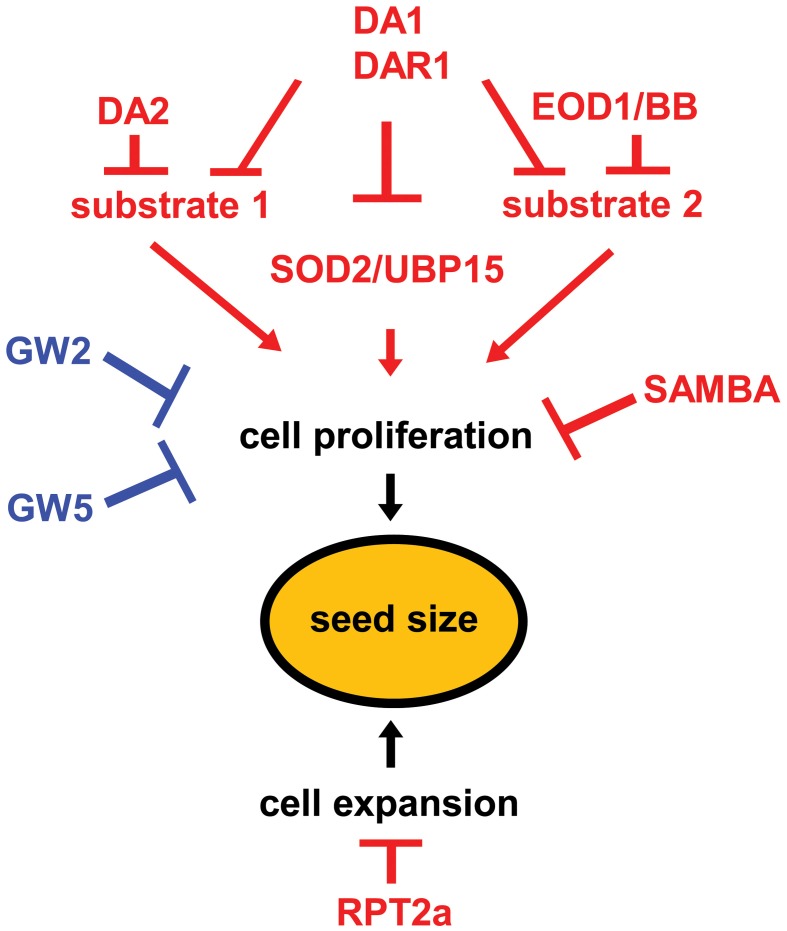
Figure 1
Figure 1
A genetic and molecular framework for ubiquitin-mediated control of seed size. DA1 and DAR1 act redundantly to restrict cell proliferation. DA1 and DA2 may control cell proliferation by suppressing a common substrate (substrate 1). Similarly, DA1 and EOD1 may regulate cell division through a common target (substrate 2). DA1 acts upstream of UBP15 and modulates its stability to control cell proliferation. GW2, GW5 and SAMBA control seed size by restricting cell proliferation, respectively. RPT2a regulates seed size by limiting cell expansion. The seed size regulators in Arabidopsis and rice are shown as red and blue, respectively.

References

    1. Bednarek J., Boulaflous A., Girousse C., Ravel C., Tassy C., Barret P., et al. (2012). Down-regulation of the TaGW2 gene by RNA interference results in decreased grain size and weight in wheat. J. Exp. Bot. 63, 5945–5955 10.1093/jxb/ers249 - DOI - PubMed
    1. Chaudhury A. M., Berger F. (2001). Maternal control of seed development. Semin. Cell Dev. Biol. 12, 381–386 10.1006/scdb.2001.0267 - DOI - PubMed
    1. Chaudhury A. M., Koltunow A., Payne T., Luo M., Tucker M. R., Dennis E. S., et al. (2001). Control of early seed development. Annu. Rev. Cell Dev. Biol. 17, 677–699 10.1146/annurev.cellbio.17.1.677 - DOI - PubMed
    1. De Veylder L., Joubes J., Inze D. (2003). Plant cell cycle transitions. Curr. Opin. Plant Biol. 6, 536–543 10.1016/j.pbi.2003.09.001 - DOI - PubMed
    1. Disch S., Anastasiou E., Sharma V. K., Laux T., Fletcher J. C., Lenhard M. (2006). The E3 ubiquitin ligase BIG BROTHER controls Arabidopsis organ size in a dosage-dependent manner. Curr. Biol. 16, 272–279 10.1016/j.cub.2005.12.026 - DOI - PubMed
