Review
. 2014 Jun 30:2:69.
doi: 10.3389/fped.2014.00069. eCollection 2014.

Potential therapeutic use of the ketogenic diet in autism spectrum disorders

Affiliations
Review

Potential therapeutic use of the ketogenic diet in autism spectrum disorders

Eleonora Napoli et al. Front Pediatr. .

Abstract

The ketogenic diet (KGD) has been recognized as an effective treatment for individuals with glucose transporter 1 (GLUT1) and pyruvate dehydrogenase (PDH) deficiencies as well as with epilepsy. More recently, its use has been advocated in a number of neurological disorders prompting a newfound interest in its possible therapeutic use in autism spectrum disorders (ASD). One study and one case report indicated that children with ASD treated with a KGD showed decreased seizure frequencies and exhibited behavioral improvements (i.e., improved learning abilities and social skills). The KGD could benefit individuals with ASD affected with epileptic episodes as well as those with either PDH or mild respiratory chain (RC) complex deficiencies. Given that the mechanism of action of the KGD is not fully understood, caution should be exercised in ASD cases lacking a careful biochemical and metabolic characterization to avoid deleterious side effects or refractory outcomes.

Keywords: autism spectrum disorders; bioenergetics; dietary intervention; epilepsy; ketogenic diet; mitochondria; oxidative stress.


Figures
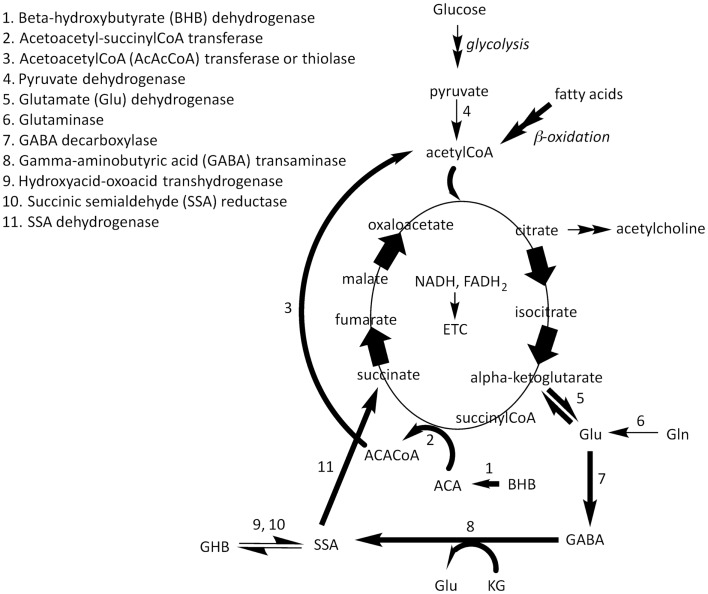
Figure 1
Figure 1
β-hydroxybutyrate and ACA are utilized as fuel molecules in all mitochondria-containing tissues (except liver). BHB is oxidized to ACA by β-hydroxybutyrate dehydrogenase at the inner mitochondrial membrane (arrow 1). ACA acquires the CoA moiety from succinylCoA resulting in succinate and acetoacetylCoA (ACACoA; arrow 2). ACACoA releases acetylCoA catalyzed by ACACoA thiolase (arrow 3). AcetylCoA generated from β-oxidation of fatty acids from the diet and acetylCoA generated by the catabolism of KB is condensed into citrate in the Krebs cycle. The increased flux in the right part of this cycle, increases the concentration of α-ketoglutarate (KG) resulting in increases in the production of Glu via glutamate dehydrogenase (arrow 5) or a transaminase (not shown). Glu from these reactions in addition to that formed from the deamination of glutamine (Gln) via glutaminase (arrow 6) result in the generation of γ-aminobutyric acid (GABA). The GABA shunt bypasses two steps of the Krebs cycle – the KG dehydrogenase complex and the succinyl coenzyme A (CoA) synthase – for the conversion of KG into succinate. It involves three enzymes: a Glu decarboxylase (GAD; arrow 7), which catalyzes the decarboxylation of glutamate to GABA, a GABA transaminase (arrow 8), which converts GABA to succinate semialdehyde (SSA), and an SSA dehydrogenase (arrow 11), which catalyzes the oxidation of SSA to succinate. SSA can be reduced to γ-hydroxybutyric acid (GHB) by an alternative reaction catalyzed by either a hydroxyacid–oxoacid transhydrogenase or SSA reductase (arrows 9, 10).

References

    1. Freeman J, Veggiotti P, Lanzi G, Tagliabue A, Perucca E. The ketogenic diet: from molecular mechanisms to clinical effects. Epilepsy Res (2006) 68:145–8010.1016/j.eplepsyres.2005.10.003 - DOI - PubMed
    1. Rogovik AL, Goldman RD. Ketogenic diet for treatment of epilepsy. Can Fam Physician (2010) 56:540–2 - PMC - PubMed
    1. Freeman JM, Kossoff EH, Hartman AL. The ketogenic diet: one decade later. Pediatrics (2007) 119:535–4310.1542/peds.2006-2447 - DOI - PubMed
    1. Kossoff EH, Turner Z, Bluml RM, Pyzik PL, Vining EP. A randomized, crossover comparison of daily carbohydrate limits using the modified Atkins diet. Epilepsy Behav (2007) 10:432–610.1016/j.yebeh.2007.01.012 - DOI - PubMed
    1. Weber S, Molgaard C, Taudorf K, Uldall P. Modified Atkins diet to children and adolescents with medical intractable epilepsy. Seizure (2009) 18:237–4010.1016/j.seizure.2008.10.004 - DOI - PubMed
