


Feasibility of two modes of treatment delivery for child anxiety in primary care
- PMID: 25075802
- PMCID: PMC4303047
- DOI: 10.1016/j.brat.2014.06.010
Feasibility of two modes of treatment delivery for child anxiety in primary care
Abstract
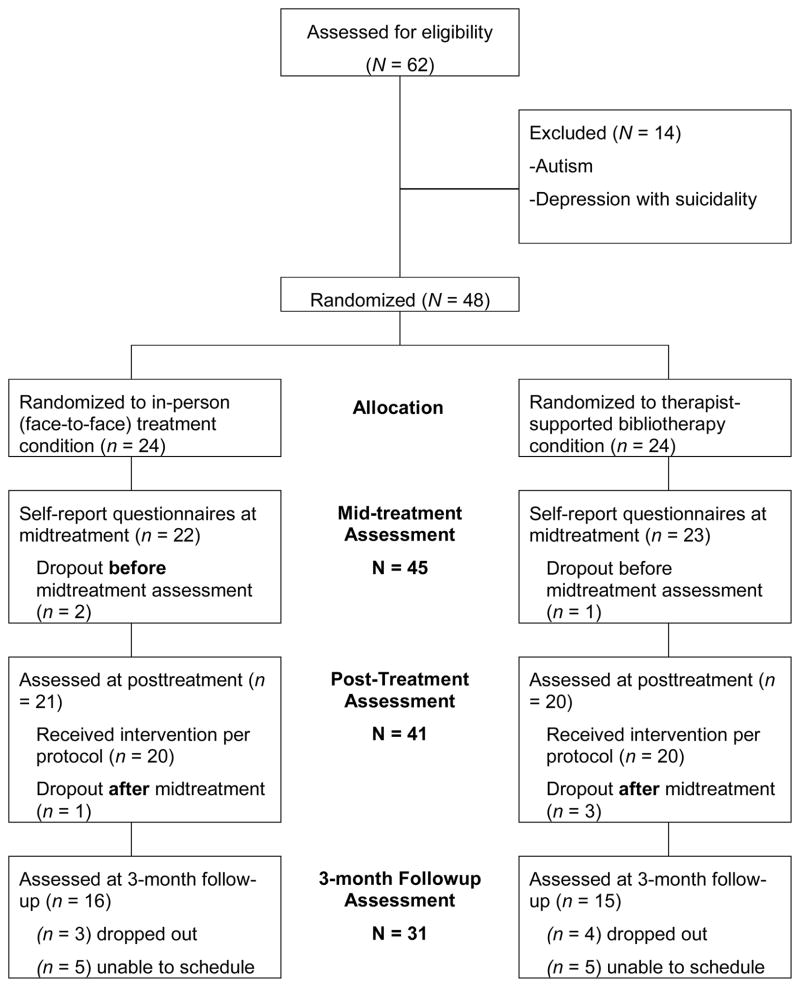
In this study, we examine the feasibility of cognitive behavior therapy (CBT) for children with anxiety in primary care, using two modes of treatment delivery. A total of 48 parents and youth (8-13) with anxiety disorders were randomly assigned to receive 10-sessions of CBT either delivered by a child anxiety specialist in the primary care clinic or implemented by the parent with therapist support by telephone (i.e., face-to-face or therapist-supported bibliotherapy). Feasibility outcomes including satisfaction, barriers to treatment participation, safety, and dropout were assessed. Independent evaluators, blind to treatment condition, administered the Anxiety Disorders Interview Schedule for Children (ADIS) and the Clinical Global Impression of Improvement (CGI-I) at baseline, post-treatment and 3-month follow-up; clinical self-report questionnaires were also administered. Findings revealed high satisfaction, low endorsement of barriers, low drop out rates, and no adverse events across the two modalities. According to the CGI-I, 58.3%-75% of participants were considered responders (i.e., much or very much improved) at the various time points. Similar patterns were found for remission from "primary anxiety disorder" and "all anxiety disorders" as defined by the ADIS. Clinically significant improvement was seen on the various parent and child self-report measures of anxiety. Findings suggest that both therapy modalities are feasible and associated with significant treatment gains in the primary care setting. (clinicaltrials.gov unique identifier: NCT00769925).
Keywords: Child anxiety; Cognitive behavior therapy; Primary care; Randomized controlled trial; Therapist-supported bibliotherapy.
Copyright © 2014 Elsevier Ltd. All rights reserved.
References
-
- Asarnow JR, Jaycox LH, Anderson M. Depression among youth in primary care models for delivering mental health services. Child Adolesc Psychiatr Clin N Am. 2002;11(3):477–497. viii. - PubMed
-
- Birmaher B, Brent DA, Chiappetta L, Bridge J, Monga S, Baugher M. Psychometric properties of the Screen for Child Anxiety Related Emotional Disorders (SCARED): a replication study. J Am Acad Child Adolesc Psychiatry. 1999;38(10):1230–1236. doi: 10.1097/00004583-199910000-00011. S0890–8567(09)63237–8 [pii] - DOI - PubMed
-
- Busch B, Biederman J, Cohen LG, Sayer JM, Monuteaux MC, Mick E, Faraone SV. Correlates of ADHD Among Children in Pediatric and Psychiatric Clinics. Psychiatr Serv. 2002;53(9):1103–1111. - PubMed
Publication types
MeSH terms
Associated data
Grants and funding
LinkOut - more resources
Full Text Sources
Other Literature Sources
Medical
