Review
. 2014 Jul 15:5:333.
doi: 10.3389/fimmu.2014.00333. eCollection 2014.

Organ-specific and memory treg cells: specificity, development, function, and maintenance

Affiliations
Review

Organ-specific and memory treg cells: specificity, development, function, and maintenance

Iris K Gratz et al. Front Immunol. .

Abstract

Foxp3(+) regulatory T cells (Treg cells) are essential for establishing and maintaining self-tolerance, and also inhibit immune responses to innocuous environmental antigens. Imbalances and dysfunction in Treg cells lead to a variety of immune-mediated diseases, as deficits in Treg cell function contribute to the development autoimmune disease and pathological tissue damage, whereas overabundance of Treg cells can promote chronic infection and tumorigenesis. Recent studies have highlighted the fact that Treg cells themselves are a diverse collection of phenotypically and functionally specialized populations, with distinct developmental origins, antigen-specificities, tissue-tropisms, and homeostatic requirements. The signals directing the differentiation of these populations, their specificities and the mechanisms by which they combine to promote organ-specific and systemic tolerance, and how they embody the emerging property of regulatory memory are the focus of this review.

Keywords: Foxp3; T cell homeostasis; immune memory; immune tolerance; regulatory T cells.


Figures
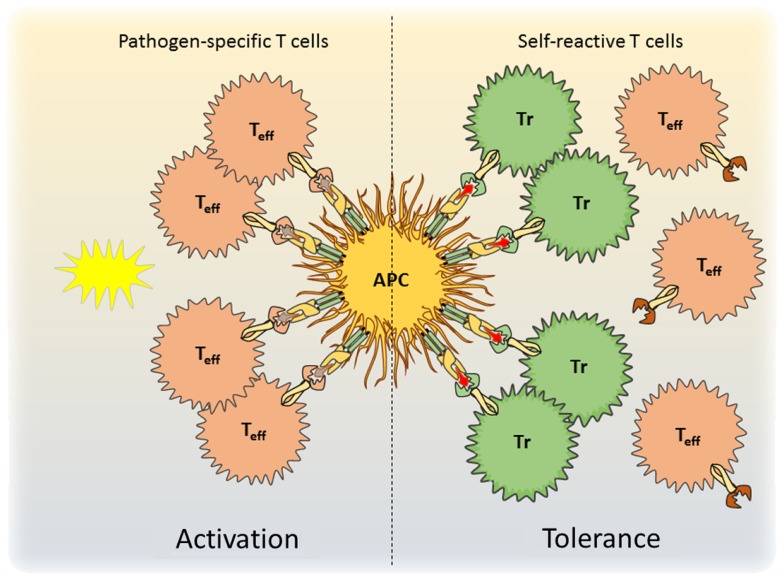
Figure 1
Figure 1
A model for antigen-specific function of Tregs during infection is shown. During pathogen encounter, activated antigen-presenting cells present both self- and pathogen-derived antigens to CD4+ T cells. Whereas pathogen-specific effector T cells are activated (left), competition for access to antigen with Treg cells prevents the activation of autoreactive effector T cells and maintains self-tolerance (right).
Figure 2
Figure 2
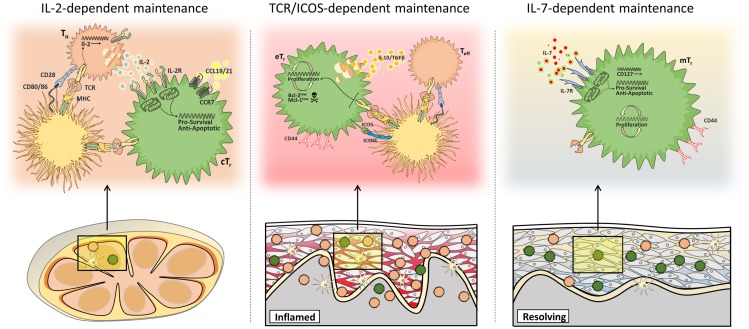
Multiple mechanisms of Treg cell maintenance. Different populations of Treg cells are subject to distinct homeostatic constraints. Central Treg cells (cTr) access paracrine IL-2 in secondary lymphoid tissues (left), whereas maintenance of effector Treg cells (eTr) in non-lymphoid tissues depends on continued TCR/ICOS signals (middle), and memory Treg cells (mTr) in the skin are supported by IL-7/IL-7R-mediated survival signals (right).

References

    1. Curotto de Lafaille MA, Lafaille JJ. Natural and adaptive Foxp3+ regulatory T cells: more of the same or a division of labor? Immunity (2009) 30:626–3510.1016/j.immuni.2009.05.002 - DOI - PubMed
    1. Bennett CL, Christie J, Ramsdell F, Brunkow ME, Ferguson PJ, Whitesell L, et al. The immune dysregulation, polyendocrinopathy, enteropathy, X-linked syndrome (IPEX) is caused by mutations of FOXP3. Nat Genet (2001) 27:20–110.1038/83713 - DOI - PubMed
    1. Rai E, Wakeland EK. Genetic predisposition to autoimmunity – what have we learned? Semin Immunol (2011) 23:67–8310.1016/j.smim.2011.01.015 - DOI - PubMed
    1. Veiga-Parga T, Sehrawat S, Rouse BT. Role of regulatory T cells during virus infection. Immunol Rev (2013) 255:182–9610.1111/imr.12085 - DOI - PMC - PubMed
    1. Waldmann H, Hilbrands R, Howie D, Cobbold S. Harnessing FOXP3+ regulatory T cells for transplantation tolerance. J Clin Invest (2014) 124:1439–4510.1172/JCI67226 - DOI - PMC - PubMed