. 2014 Aug 1:9:124.
doi: 10.1186/s13023-014-0124-6.

Rescue of fragile X syndrome phenotypes in Fmr1 KO mice by a BKCa channel opener molecule

Rescue of fragile X syndrome phenotypes in Fmr1 KO mice by a BKCa channel opener molecule

Betty Hébert et al. Orphanet J Rare Dis. .

Abstract

Background: Fragile X Syndrome (FXS) is the most common form of inherited intellectual disability and is also associated with autism spectrum disorders. Previous studies implicated BKCa channels in the neuropathogenesis of FXS, but the main question was whether pharmacological BKCa stimulation would be able to rescue FXS neurobehavioral phenotypes.

Methods and results: We used a selective BKCa channel opener molecule (BMS-204352) to address this issue in Fmr1 KO mice, modeling the FXS pathophysiology. In vitro, acute BMS-204352 treatment (10 μM) restored the abnormal dendritic spine phenotype. In vivo, a single injection of BMS-204352 (2 mg/kg) rescued the hippocampal glutamate homeostasis and the behavioral phenotype. Indeed, disturbances in social recognition and interaction, non-social anxiety, and spatial memory were corrected by BMS-204352 in Fmr1 KO mice.

Conclusion: These results demonstrate that the BKCa channel is a new therapeutic target for FXS. We show that BMS-204352 rescues a broad spectrum of behavioral impairments (social, emotional and cognitive) in an animal model of FXS. This pharmacological molecule might open new ways for FXS therapy.


Figures
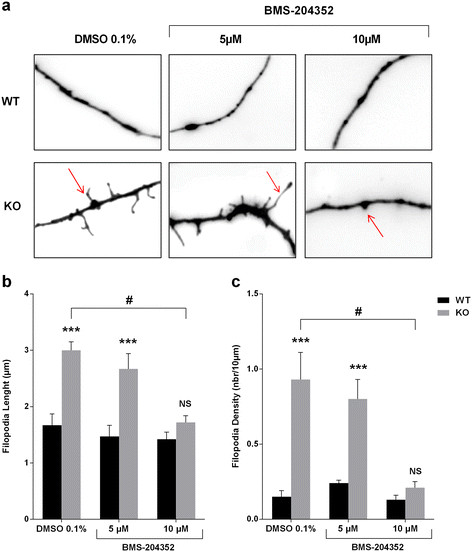
Figure 1
Figure 1
BMS-204352 at 10 μM rescues dendrite spines maturation in Fmr1 KO neurons cultures. (a) Representative pictures of neuron dendrites in different culture conditions with BMS-204352 (5 or 10 μM) or with only its vehicle (DMSO 0.1%). Red arrows indicate filopodia. Scale bar = 10 μm (b) Filopodia length (μm) and (c) density (nbr/10 μm) were investigated in each condition. A two-way ANOVA revealed that vehicle-treated Fmr1 KO neurons showed a significantly higher filopodia length and density compared to vehicle-treated WT neurons. Acute treatment (4 hrs) with BMS-204352 10 μM corrected the Fmr1 KO dendritic spine phenotype, whereas, BMS-204352 5 μM had no significant effect on Fmr1 KO neurons. NS, not significant; ***p < 0.001 for genotype comparison; #p < 0.05 for treatment comparison; n = 60 neurons (from 10 mice) in all groups. Data represent mean ± s.e.m.
Figure 2
Figure 2
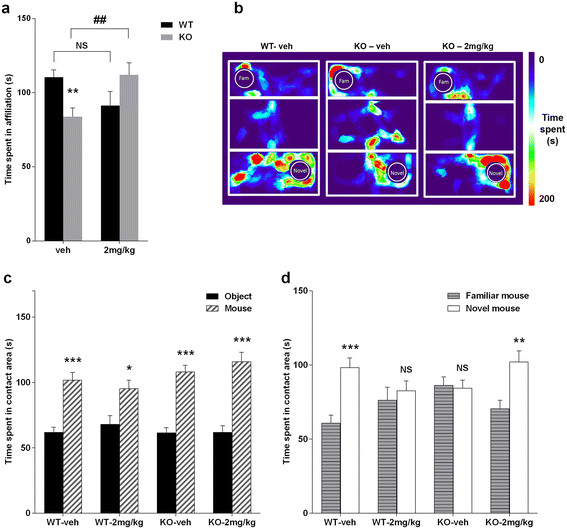
BMS-204352 effects on Social behaviors. Mice were administered with BMS-204352 2 mg/kg or vehicle (veh) and subjected to social behavioral tests 30 min after the injection. (a) Histograms represent time spent in affiliative behaviors obtained in two laboratories. A three-way ANOVA indicated a non-significant effect of laboratory, but a significant interaction between genotype and treatment. Vehicle-treated Fmr1 KO mice spent less time in affiliative behavior compared to WT, but BMS-204352 injection restored a normal social investigation. (n: WT-veh = 27; WT-2 mg/kg = 16; KO-veh = 25; KO-2 mg/kg = 17). NS, not significant; **p < 0.05 compared to the corresponding WT; ##p < 0.05 compared the corresponding treated group. (b) Illustration of BMS-204352 effect on the three-chamber test by a pseudo-colored heat map representing time spent at each positions related to the social preference trial (fam: familiar mouse, novel: novel mouse). (c) Preference for a conspecific versus an object in the three-chamber test was measured by the time spent in the contact area when a stranger mouse and an object were accessible. Repeat-measures ANOVA indicated that vehicle-treated KO mice like WT shown a preference for the mouse versus the object, and that BMS-204352 treatment had no effect. (d) Preference for a novel versus a familiar mouse, was measured by the time spent in the contact area when a stranger and a familiar mouse were accessible. In vehicle-treated groups a preference for the novel mouse was only observed in WT. This preference was rescued by BMS-204352 treatment in Fmr1 KO mice. (n: WT-veh = 34; WT-2 mg/kg = 19; KO-veh = 42; KO-2 mg/kg = 25). NS, not significant; *p < 0.05, **p < 0.01 and ***p < 0.001 (object versus mouse, familiar versus novel mouse). Data represent mean ± s.e.m.
Figure 3
Figure 3
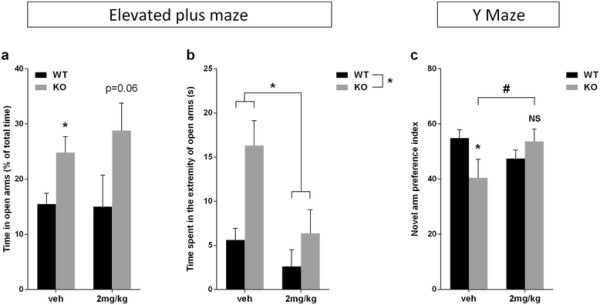
BMS-204352 effects on Emotionality and Spatial memory. (a) Percentage of time spent in open arms time in the elevated plus maze was calculated as the time in open arms/all arms x100. Analysis indicated a main effect of genotype, but no difference between genotypes and treatments was observed. (b) Time spent in the extremity of open arms was also evaluated and showed that Fmr1 KO mice exhibited reduced non-social anxiety in comparison to WT mice. This was corrected by BMS-204352 treatment that increased anxiety in both genotypes. *p < 0.05 (n: WT-veh = 32; WT-2 mg/kg = 7; KO-veh = 32; KO-2 mg/kg = 10). (c) Preference index for a novel arm in the Y-maze was determined by the time spent in the novel arm/ time spent in all 3 arms. Fmr1 KO mice presented spatial memory impairments through their incapacity to distinguish between novel and familiar arms. BMS-204352 treatment restored this cognitive defect to WT level. Significance was determined using two-way ANOVA with post-hoc PLSD test. NS, not significant; *p < 0.05, vs. WT; #p < 0.05 vs. KO-veh (n: WT-veh = 7; WT-2 mg/kg = 6; KO-veh = 7; KO-2 mg/kg = 7). Data represent mean ± s.e.m.
Figure 4
Figure 4
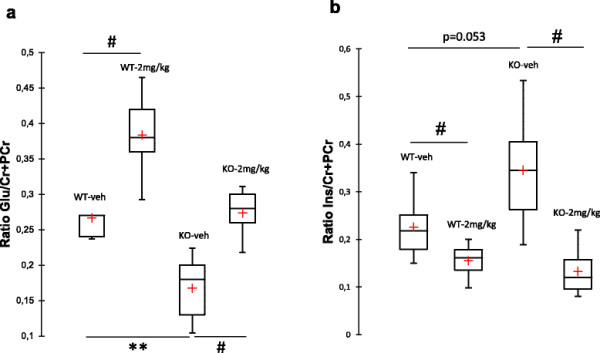
BMS-204352 effects on glutamate and myo-inositol brain level. Mice (3–5 months) were administered with BMS-204352 at 2 mg/kg or vehicle (veh) and subjected to MRS test 30 min after the injection. Box plots (shown as the minimum, 1st quartile, mean, median, 2nd quartile and maximum values) represent (a) glutamate and (b) myo-inositol concentrations in arbitrary unit (AU), after normalization by Creatine/Phosphocreatine, in vehicle or BMS-204352-treated-WT and Fmr1 KO mice. Glutamate level was significantly decreased in Fmr1 KO mice compared to WT, whereas myo-inositol concentration was increased. Furthermore, a single injection of BMS-204352 rescued a WT like metabolites concentration. Significance between WT and KO was determined using Mann–Whitney test and impact of treatment was determined by Wilcoxon test. NS, not significant; **p < 0.01 for genotype comparison; #p < 0.05 for treatment comparison (n: WT-veh = 10; WT-2 mg/kg = 10; KO-veh = 10; KO-2 mg/kg = 10).

References

    1. Hagerman RJ. Advances in the treatment of fragile X syndrome. Pediatrics. 2009;123:378–390. doi: 10.1542/peds.2008-0317. - DOI - PMC - PubMed
    1. Darnell JC, Van Driesche SJ, Zhang C, Hung KY, Mele A, Fraser CE, Stone EF, Chen C, Fak JJ, Chi SW, Licatalosi DD, Richter JD, Darnell RB. FMRP stalls ribosomal translocation on mRNAs linked to synaptic function and autism. Cell. 2011;146:247–261. doi: 10.1016/j.cell.2011.06.013. - DOI - PMC - PubMed
    1. Deng PY, Rotman Z, Blundon JA, Cho Y, Cui J, Cavalli V, Zakharenko SS, Klyachko VA. FMRP regulates neurotransmitter release and synaptic information transmission by modulating action potential duration via BK channels. Neuron. 2013;77:696–711. doi: 10.1016/j.neuron.2012.12.018. - DOI - PMC - PubMed
    1. Irwin SA, Galvez R, Greenough WT. Dendritic spine structural anomalies in fragile-X mental retardation syndrome. Cereb Cortex. 2000;10:1038–1044. doi: 10.1093/cercor/10.10.1038. - DOI - PubMed
    1. Bakker CE, Verheij C, Willemsen R, Helm R, Oerlemans F, Vermey M. Fmr1 knockout mice: a model to study fragile X mental retardation. The Dutch-Belgian Fragile X Consortium. Cell. 1994;78:23–33. - PubMed

Publication types

MeSH terms

Substances