


Evaluating a health care provider delivered intervention to reduce intimate partner violence and mitigate associated health risks: study protocol for a randomized controlled trial in Mexico City
- PMID: 25079882
- PMCID: PMC4127193
- DOI: 10.1186/1471-2458-14-772
Evaluating a health care provider delivered intervention to reduce intimate partner violence and mitigate associated health risks: study protocol for a randomized controlled trial in Mexico City
Abstract
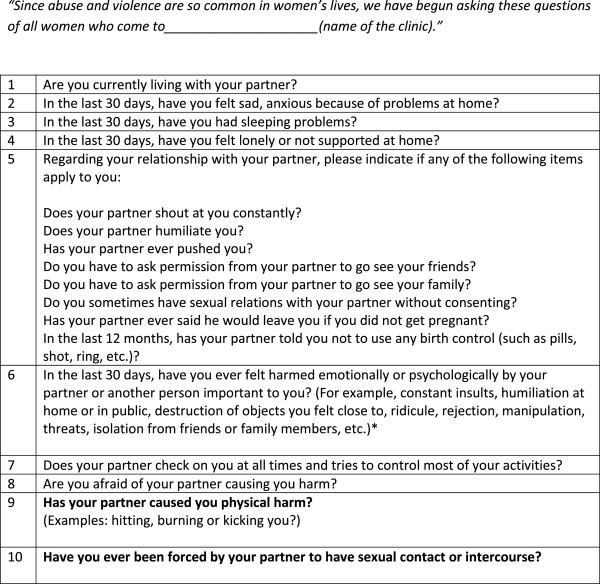
Background: Intimate partner violence (IPV) victimization is a prevalent issue among women residing in Mexico City. Comprehensive and integrated health care provider (HCP) delivered programs in clinic-settings are needed, yet few have been evaluated in Latin America, including Mexico. In addition, there has been minimal attention to interventions among lower income women presenting at settings outside of antenatal care clinics. The current randomized controlled trial seeks to increase midlevel HCPs' capacity, specifically nurses, who are often the first point of contact in this setting, to identify women presenting at health clinics with experiences of IPV and to assist these women with health risk mitigation. Specific outcomes include changes in past-year IPV (physical and/or sexual), reproductive coercion, safety planning, use of community resources, and quality of life.
Methods/design: Forty-two public health clinics in Mexico City were randomized to treatment or control clinics. Nurses meeting eligibility criteria in treatment groups received an intensive training on screening for IPV, providing supportive referrals, and assessing for health and safety risks. Nurses meeting eligibility criteria at control clinics received the standard of care which included a one-day training focused on sensitizing staff to IPV as a health issue and referral cards to give to women. Women were screened for eligibility (currently experiencing abuse in a heterosexual relationship, 18-44 years of age, non-pregnant or in first trimester) by research assistants in private areas of waiting rooms in health clinics. Consenting women completed a baseline survey and received the study protocol for that clinic. In treatment clinics, women received the nurse delivered session at baseline and received a follow-up counseling session after three months. Surveys are conducted at baseline, three months, and fifteen months from baseline.
Discussion: This study will provide important insight into whether a nurse-delivered program can assist women currently experiencing abuse in a Latin American context. Findings can be used to inform IPV programs and policies in Mexico City's public health clinics.
Trial registration: NCT01661504.
References
-
- World Health Organization, London School of Hygiene and Tropical Medicine, South African Medical Research Council . Global and regional estimates of violence against women: Prevalence and health effects of intimate partner violence and non-partner sexual violence. Geneva: World Health Organization; 2013.
-
- Ellsberg M, Jansen HAFM, Heise L, Watts CH, Garcia-Moreno C, WHO Multi-County Study on Women’s Health and Domestic Violence against Women Study Team Intimate partner violence and women’s physical and mental health in the WHO multi-country study on women’s health and domestic violence: an observational study. Lancet. 2008;371(9619):1165–1172. doi: 10.1016/S0140-6736(08)60522-X. - DOI - PubMed
Pre-publication history
-
- The pre-publication history for this paper can be accessed here: http://www.biomedcentral.com/1471-2458/14/772/prepub
Publication types
MeSH terms
Associated data
Grants and funding
LinkOut - more resources
Full Text Sources
Other Literature Sources
Medical
Miscellaneous
