. 2014;7 Suppl 1(Suppl 1):S3.
doi: 10.1186/1755-8794-7-S1-S3. Epub 2014 May 8.

Integrative analysis reveals disease-associated genes and biomarkers for prostate cancer progression

Integrative analysis reveals disease-associated genes and biomarkers for prostate cancer progression

Yin Li et al. BMC Med Genomics. 2014.

Abstract

Background: Prostate cancer is one of the most common complex diseases with high leading cause of death in men. Identifications of prostate cancer associated genes and biomarkers are thus essential as they can gain insights into the mechanisms underlying disease progression and advancing for early diagnosis and developing effective therapies.

Methods: In this study, we presented an integrative analysis of gene expression profiling and protein interaction network at a systematic level to reveal candidate disease-associated genes and biomarkers for prostate cancer progression. At first, we reconstructed the human prostate cancer protein-protein interaction network (HPC-PPIN) and the network was then integrated with the prostate cancer gene expression data to identify modules related to different phases in prostate cancer. At last, the candidate module biomarkers were validated by its predictive ability of prostate cancer progression.

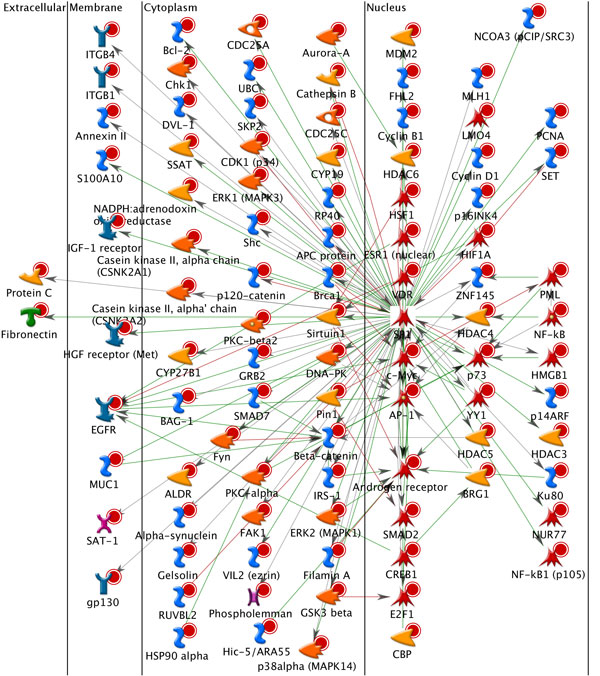
Results: Different phases-specific modules were identified for prostate cancer. Among these modules, transcription Androgen Receptor (AR) nuclear signaling and Epidermal Growth Factor Receptor (EGFR) signalling pathway were shown to be the pathway targets for prostate cancer progression. The identified candidate disease-associated genes showed better predictive ability of prostate cancer progression than those of published biomarkers. In context of functional enrichment analysis, interestingly candidate disease-associated genes were enriched in the nucleus and different functions were encoded for potential transcription factors, for examples key players as AR, Myc, ESR1 and hidden player as Sp1 which was considered as a potential novel biomarker for prostate cancer.

Conclusions: The successful results on prostate cancer samples demonstrated that the integrative analysis is powerful and useful approach to detect candidate disease-associate genes and modules which can be used as the potential biomarkers for prostate cancer progression. The data, tools and supplementary files for this integrative analysis are deposited at http://www.ibio-cn.org/HPC-PPIN/.


Figures
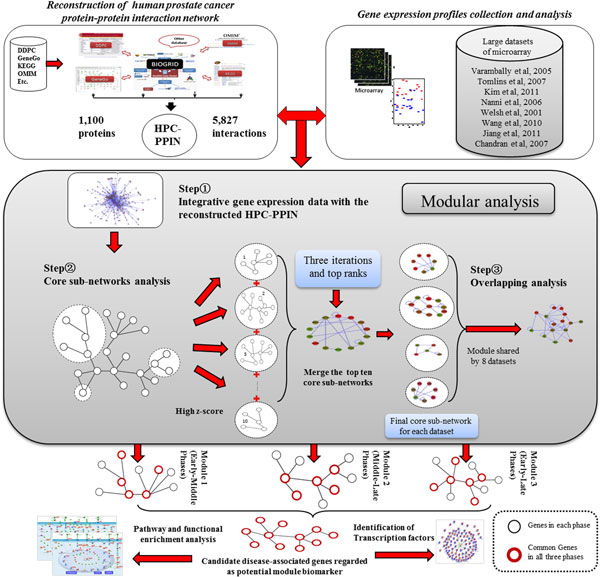
Figure 1
Figure 1
The modular analysis pipeline. Diagram shows identification of candidate disease-associated genes as potential module biomarker based on integrative analysis of the reconstructed human prostate cancer protein-protein interaction network (HPC-PPIN) and the different phases of gene expression profiles of prostate cancer. The threshold for greedy algorithm via Cytoscape jActiveModules (jAM) plugin for the most significant core sub-networks analysis in each gene expression profile was set to three iterations and top ten ranks.
Figure 2
Figure 2
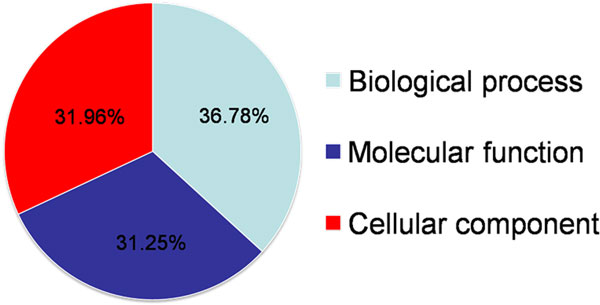
Annotated functions for the reconstructed HPC-PPIN using DAVID system. Pie-chart shows different frequencies of three GO processes distributing into HPC- PPIN.
Figure 3
Figure 3
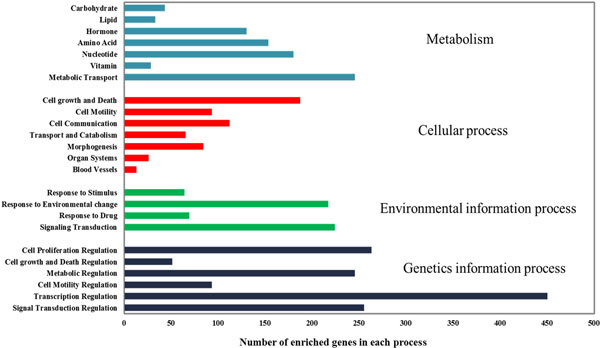
Annotated functions for the reconstructed HPC-PPIN using DAVID system. Bar graph presents different functional classifications distributing into HPC-PPIN based on KEGG categories.
Figure 4
Figure 4
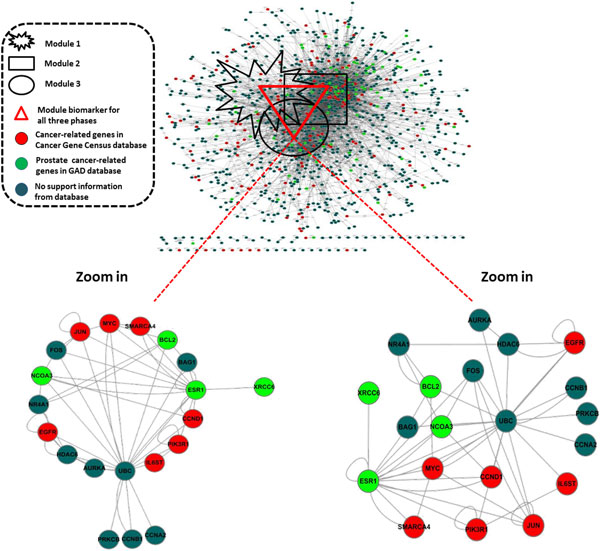
The interaction network of three modules obtained from modular analysis for prostate cancer progression. The highlight interactions within the 94 candidate disease-associated genes identified in all three phases were obtained. The red node indicates cancer-related genes in Cancer Gene Census database. The green node indicates prostate cancer- related genes in GAD database. The blue node indicates no support information from database.
Figure 5
Figure 5
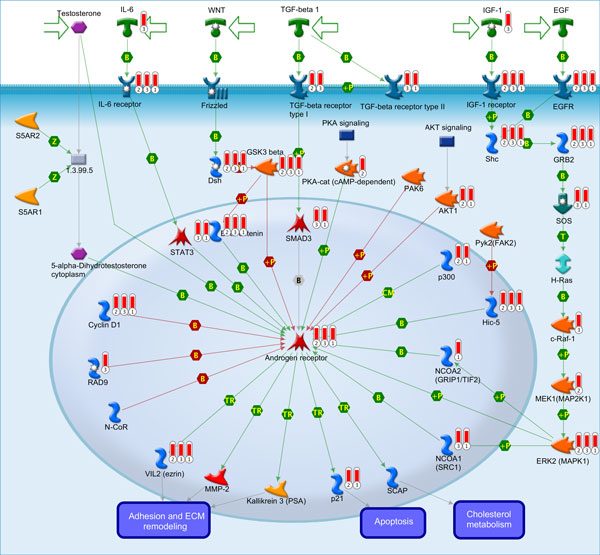
GeneGo graphic representation illustrates Transcription Androgen Receptor (AR) nuclear signaling. Pathway regarded as the enriched significant pathway associated in prostate cancer progression. Transcription factor AR was identified as a hub protein to play a critical role in prostate tumorigenesis and prostate cancer progression.
Figure 6
Figure 6
GeneGo graphic representation for module biomarker. It shows a major fraction of 94 candidate disease-associated genes which was enriched in the nucleus and different functions were mostly encoded for transcription factors.
Figure 7
Figure 7
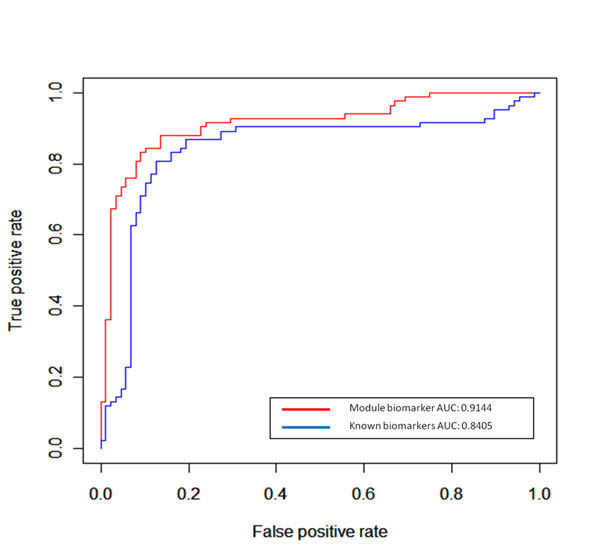
ROC curves are obtained with our module biomarker and known biomarkers. The gene expression dataset (series of GSE6919) from GEO database (www.ncbi.nlm.nih.gov/geo//)
Figure 8
Figure 8
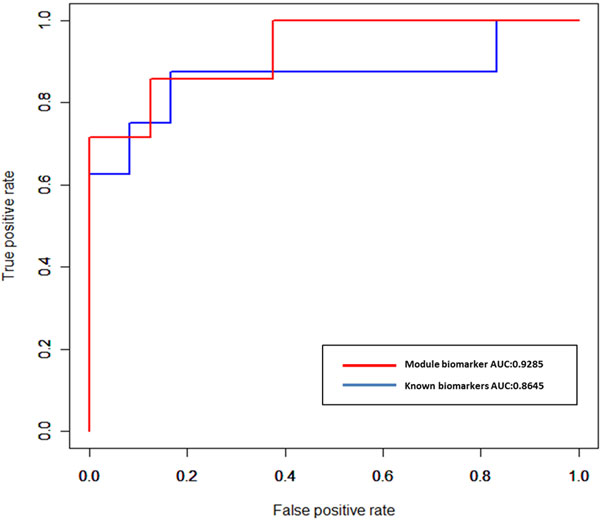
ROC curves are obtained with our module biomarker and known biomarkers. The independent gene expression dataset[75]. AUC means area under curve and ROC means receiver operating characteristic.
Figure 9
Figure 9
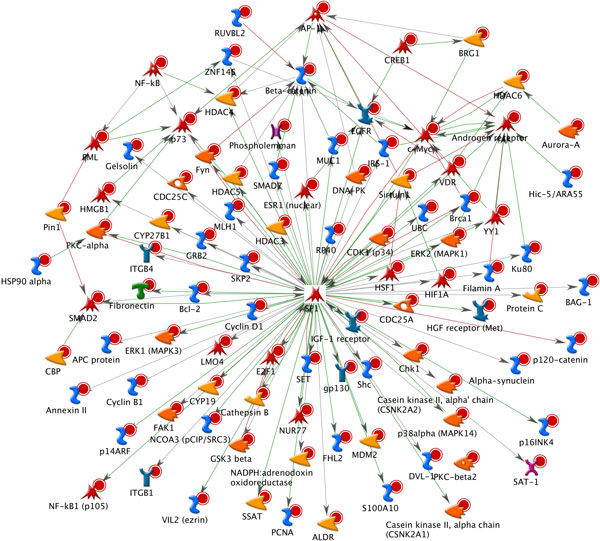
GeneGo graphic representation illustrates transcription factor Sp1 as a potential novel biomarker of prostate cancer. Sp1 is a hidden key transcription factor which directly regulates a lot of candidate disease-associated genes, and also has indirect effect with the remaining genes.

References

    1. Dasgupta S, Srinidhi S, Vishwanatha JK. Oncogenic activation in prostate cancer progression and metastasis: Molecular insights and future challenges. J Carcinog. 2012;7:4. doi: 10.4103/1477-3163.93001. - DOI - PMC - PubMed
    1. Jemal A, Bray F, Center MM, Ferlay J, Ward E, Forman D. Global cancer statistics. CA Cancer J Clin. 2011;7(2):69–90. doi: 10.3322/caac.20107. - DOI - PubMed
    1. Tricoli JV, Schoenfeldt M, Conley BA. Detection of prostate cancer and predicting progression: current and future diagnostic markers. Clin Cancer Res. 2004;7(12 Pt 1):3943–3953. - PubMed
    1. Thun MJ, DeLancey JO, Center MM, Jemal A, Ward EM. The global burden of cancer: priorities for prevention. Carcinogenesis. pp. 100–110. - PMC - PubMed
    1. Lim JE, Hong KW, Jin HS, Kim YS, Park HK, Oh B. Type 2 diabetes genetic association database manually curated for the study design and odds ratio. BMC Med Inform Decis Mak. 2010;7:76. doi: 10.1186/1472-6947-10-76. - DOI - PMC - PubMed

Publication types

MeSH terms