Evidence of experimental vertical transmission of emerging novel ECSA genotype of Chikungunya Virus in Aedes aegypti
- PMID: 25080107
- PMCID: PMC4117456
- DOI: 10.1371/journal.pntd.0002990
Evidence of experimental vertical transmission of emerging novel ECSA genotype of Chikungunya Virus in Aedes aegypti
Abstract
Background: Chikungunya virus (CHIKV) has emerged as one of the most important arboviruses of public health significance in the past decade. The virus is mainly maintained through human-mosquito-human cycle. Other routes of transmission and the mechanism of maintenance of the virus in nature are not clearly known. Vertical transmission may be a mechanism of sustaining the virus during inter-epidemic periods. Laboratory experiments were conducted to determine whether Aedes aegypti, a principal vector, is capable of vertically transmitting CHIKV or not.
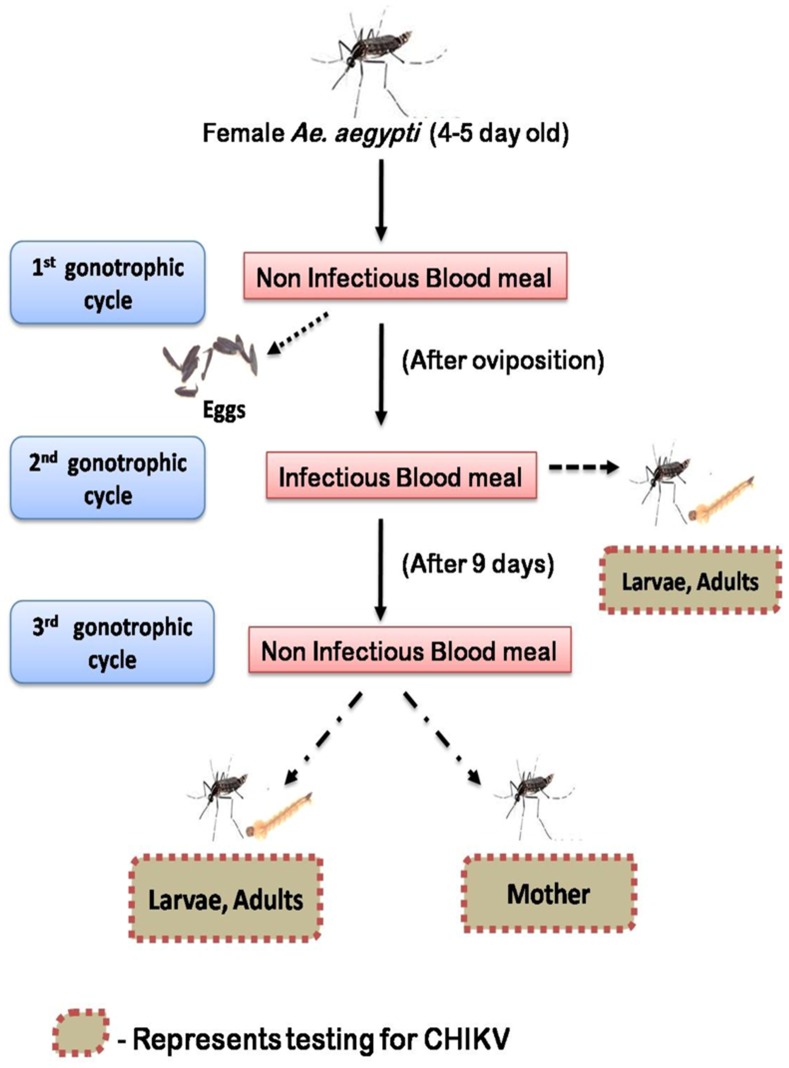
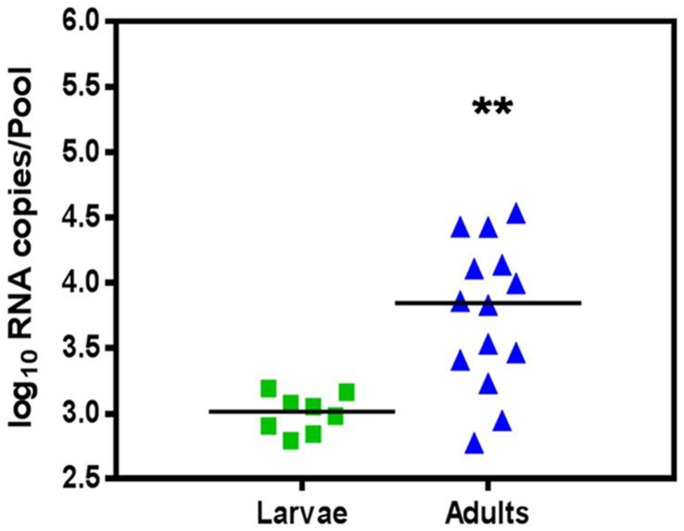
Methodology/principal findings: Female Ae. aegypti were orally infected with a novel ECSA genotype of CHIKV in the 2nd gonotrophic cycle. On day 10 post infection, a non-infectious blood meal was provided to obtain another cycle of eggs. Larvae and adults developed from the eggs obtained following both infectious and non-infectious blood meal were tested for the presence of CHIKV specific RNA through real time RT-PCR. The results revealed that the larvae and adults developed from eggs derived from the infectious blood meal (2nd gonotrophic cycle) were negative for CHIKV RNA. However, the larvae and adults developed after subsequent non-infectious blood meal (3rd gonotrophic cycle) were positive with minimum filial infection rates of 28.2 (1∶35.5) and 20.2 (1∶49.5) respectively.
Conclusion/significance: This study is the first to confirm experimental vertical transmission of emerging novel ECSA genotype of CHIKV in Ae. aegypti from India, indicating the possibilities of occurrence of this phenomenon in nature. This evidence may have important consequence for survival of CHIKV during adverse climatic conditions and inter-epidemic periods.
Conflict of interest statement
The authors have declared that no competing interests exist.
Figures
References
-
- Jupp PG, McIntosh BM, (1988) Chikungunya virus disease, in: Monath, T.P., (Ed.), The arboviruses: epidemiology and ecology vol. II. CRC Press, Boca Raton, FL, pp. 137–157.
-
- Powers AM, Brault AC, Tesh RB, Weaver SC (2000) Re-emergence of Chikungunya and O'nyong-nyong viruses: Evidence for distinct geographical lineages and distant evolutionary relationships. J Gen Virol 81: 471–479. - PubMed
-
- Rezza G, Nicoletti L, Angelini R, Romi R, Finarelli AC, et al. (2007) Infection with Chikungunya virus in Italy: An outbreak a temperate region. Lancet 370: 1840–1846. - PubMed
-
- Chevillon C, Briant L, Renaud F, Devaux C (2008) The Chikungunya threat: an ecological and evolutionary perspective. Trends Microbiol 16: 80–88. - PubMed
Publication types
MeSH terms
Substances
LinkOut - more resources
Full Text Sources
Other Literature Sources
Medical
Miscellaneous